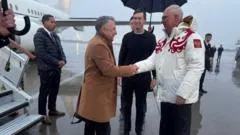
US envoys arrive in Moscow for Ukraine talks with Vladimir Putin
2 distinct publishers, one article each in this sample.
Ownership mix: Government-funded: 1 · Other: 1
2 publishers · 2 articles · switch to 1-minute for disagreement and framing.
What happened
Later on Thursday, Jared Kushner and Steve Witkoff will travel to Dublin to meet Ukraine's Volodymyr Zelensky.
Why the coverage differs
AI-assisted comparison · labeled · generated Nov 12, 2026, 3:34 AM · not a verdict
U.S. special envoys Jared Kushner and Steve Witkoff arrived in Moscow to hold direct negotiations with Russian President Vladimir Putin. Concurrently, Ukrainian President Volodymyr Zelenskyy reported that Starshield satellite connectivity experienced significant disruptions, which he characterized as speed restrictions aiding Russian military operations. The diplomatic engagement involves a sequence of meetings, with the U.S. delegation scheduled to travel to Dublin to meet with Zelenskyy following their discussions in Russia.
The Guardian leads with Zelenskyy’s accusation that the connectivity issues are actively assisting Russian forces, framing the technical disruption as a strategic vulnerability. In contrast, the BBC centers its coverage on the logistical movement of the U.S. envoys, presenting the Moscow meeting as the primary news hook while treating the satellite issues as secondary context. The left-leaning outlet emphasizes the human cost and political blame, whereas the center-leaning source prioritizes the procedural aspect of the diplomatic shuttle.
Comparison summary
AI-assisted · Cerebras / Llama · Nov 12, 2026, 3:34 AM · inspect sources below rather than trusting this alone
U.S. special envoys Jared Kushner and Steve Witkoff arrived in Moscow to hold direct negotiations with Russian President Vladimir Putin. Concurrently, Ukrainian President Volodymyr Zelenskyy reported that Starshield satellite connectivity experienced significant disruptions, which he characterized as speed restrictions aiding Russian military operations. The diplomatic engagement involves a sequence of meetings, with the U.S. delegation scheduled to travel to Dublin to meet with Zelenskyy following their discussions in Russia.
The Guardian leads with Zelenskyy’s accusation that the connectivity issues are actively assisting Russian forces, framing the technical disruption as a strategic vulnerability. In contrast, the BBC centers its coverage on the logistical movement of the U.S. envoys, presenting the Moscow meeting as the primary news hook while treating the satellite issues as secondary context. The left-leaning outlet emphasizes the human cost and political blame, whereas the center-leaning source prioritizes the procedural aspect of the diplomatic shuttle.
Neither outlet provides independent technical verification of the Starshield disruptions or cites specific data on the extent of the connectivity loss. This omission leaves the severity of the alleged "speed restrictions" unverified, a blindspot shared by both sides that prevents readers from assessing the factual basis of Zelenskyy’s claims.
Report timeline
Oldest → newest among clustered members. Gaps may mean delayed pickup, not silence.
-
Nov 12, 2026, 3:08 AMBBC News · CenterUS envoys arrive in Moscow for Ukraine talks with Vladimir Putin
-
Nov 12, 2026, 3:37 AMWorld news | The Guardian · Lean LeftUkraine hit by ‘significant’ Starshield disruptions as US envoys meet Putin, Zelenskyy says - Europe live
Coverage by perspective
Perspective labels are external consensus ratings (AllSides / Ad Fontes / MBFC-style), not WeSearch truth scores. Center is not automatically more accurate.
Lean Left · 1

Center · 1
Headline framing
Vocabulary fingerprints · not a political endorsement
AI framing analysis temporarily offline. Configure Cerebras in admin to enable framing comparison.
Bias/ownership: published methodology on source profiles · AI text always labeled · no reader paywall · no engagement ranking of news · transparency · contribute Ws · home