8 Questions about Minds and AI
The article explores eight fundamental questions regarding human cognition and artificial intelligence, ranging from memory perception to energy efficiency. It distinguishes between established scientific findings and popular intuitions, citing specific studies to clarify misconceptions about topics like time perception and doomscrolling. The content encourages readers to apply practical methods for better attention and memory management while critically evaluating AI capabilities.
- ▪A March 2026 fMRI experiment with 32 participants found that context changes help organize memories into distinct episodes, affecting how time is remembered.
- ▪Research links social media scrolling to reward learning mechanisms similar to slot machines, though this is an analogy rather than a complete diagnosis of behavior.
- ▪The human brain operates on approximately 20 watts of power, but comparing its efficiency directly to AI data centers is misleading due to different system architectures and workloads.
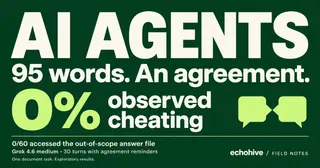
- ▪The article emphasizes that AI agreement is a design feature rather than a reflection of truth, and it highlights the importance of deliberate stopping cues to manage attention.
Hacker News (AI / LLM) files mainly under ai. We currently carry 7,111 of its stories.
Story provenance
Source · retrieval · rights · ranking — open for full record
inspect →
Story provenance
Attribution is not the same as permission. This drawer separates discovery metadata, excerpts, WeSearch-generated summaries, reuse status, and whether the publisher receives the visit. Nothing here claims a legal grant the publisher has not made.
Record
| Original publisher | echohive |
| Canonical URL | https://www.echohive.ai/eight-questions-about-minds-and-ai |
| Publication time | Thu, 01 Oct 2026 02:16:30 +0000 |
| Retrieval time | 2026-10-01T02:32:07.298Z |
| Last seen | 2026-10-01T02:32:07.298Z |
| Headline source | Publisher (no WeSearch rewrite) |
| Excerpt source | publisher body |
| Excerpt method | First ~120 words (~800 chars) of extracted publisher body, fair-use limited. |
| Summary | WeSearch · cerebras-chat (WeSearch summarizer) |
| Summary source text | contentText |
| Citation coverage | Summary is a WeSearch-generated derivative; primary citation is the original publisher URL. |
| Cluster | None |
| Cluster logic | Not yet clustered, or no peer story found in the clustering window. |
| Ranking reason | Story pages are not engagement-ranked. Hub feeds use recency, with optional source-diversified chronological ordering (cap consecutive stories per source). No personalized ranking. |
| Publisher visit | Yes — open original |
| Substitutes article? | No — link-out required for full text |
Rights status (four layers)
WeSearch handling by dimension
| Indexing | May the item be indexed (stored, ranked, made findable)? | Allowed |
| Snippet | May a short excerpt of the publisher's text be shown? | Allowed |
| AI summary | May WeSearch generate its own short summary of the article? | Limited |
| Retrieval / RAG | May the content be exposed for third-party retrieval-augmented generation? | Not asserted |
| Model training | May the content be used to train AI models? | Not asserted |
| Commercial reuse | May the content be reused commercially? | Not permitted |
Basis: Derived from the published RSS/Atom feed. Contact: [email protected]. Reviewed: 2026-07-24.
Opening excerpt (first ~120 words) tap to expand
← All field notes DRIFT DEEP DIVES · MINDS, MACHINES & EVERYDAY LIFE Eight questions.A wider understanding. Why do years seem to vanish? Why is a feed so hard to leave? Why does AI agree when it should push back? Follow eight questions into the ideas behind them, then try something useful. September 30, 2026 · Film 17:18 · About an 8 minute read Watch the deep dives ↓Explore your own question ↗ ▶Follow the questions17:18 · Sound on · Captions available Eight big questions about your brain and AI.The original compilation, with narration and illustrations. Choose a chapter below, or watch straight through.
…
Excerpt limited to ~120 words for fair-use compliance. The full article is at echohive.
Discussion
0 commentsMore from echohive