
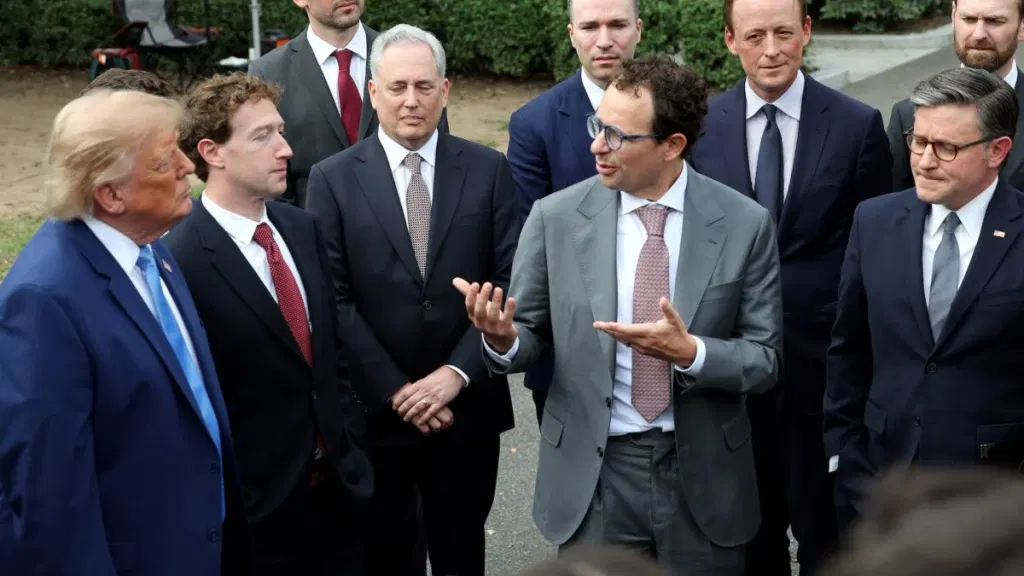
A Guide to Which AI CEOs Now Say ‘Super Intelligence’ and Which Don’t
The article examines the growing divide among AI executives regarding the adoption of the term 'Super Intelligence' following a directive from U.S. President Donald Trump. While some leaders like Sam Altman continue to use the standard term 'AI', others such as Jeff Bezos have embraced the new phrasing. The piece criticizes the industry's willingness to align with the President's terminology despite the semantic inaccuracy and political implications.
- ▪President Donald Trump has insisted on using the term 'Super Intelligence' instead of 'artificial intelligence' and labeled those who refuse as enemies.
- ▪Sam Altman, CEO of OpenAI, has not adopted the new term and continues to refer to the technology as AI.
- ▪Jeff Bezos, CEO of Project Prometheus, has publicly supported the use of 'Super Intelligence' in an interview with Fox News.
- ▪Dario Amodei, CEO of Anthropic, attended the September 29 White House meeting where the terminology shift was discussed but has remained largely quiet since.
Gizmodo files mainly under tech. We currently carry 1,982 of its stories.
Story provenance
Source · retrieval · rights · ranking — open for full record
inspect →
Story provenance
Attribution is not the same as permission. This drawer separates discovery metadata, excerpts, WeSearch-generated summaries, reuse status, and whether the publisher receives the visit. Nothing here claims a legal grant the publisher has not made.
Record
| Original publisher | Gizmodo |
| Canonical URL | https://gizmodo.com/a-guide-to-which-ai-ceos-now-say-super-intelligence-and-which-dont-2000824804 |
| Publication time | Mon, 12 Oct 2026 09:30:32 +0000 |
| Retrieval time | 2026-10-12T09:41:23.830Z |
| Last seen | 2026-10-12T09:41:23.830Z |
| Headline source | Publisher (no WeSearch rewrite) |
| Excerpt source | publisher body |
| Excerpt method | First ~120 words (~800 chars) of extracted publisher body, fair-use limited. |
| Summary | WeSearch · cerebras-chat (WeSearch summarizer) |
| Summary source text | contentText |
| Citation coverage | Summary is a WeSearch-generated derivative; primary citation is the original publisher URL. |
| Cluster | pD3NBGni69oh |
| Cluster logic | Grouped by semantic title/content similarity across sources within a rolling window. Same-publisher template collisions are excluded from coverage comparison. |
| Ranking reason | Story pages are not engagement-ranked. Hub feeds use recency, with optional source-diversified chronological ordering (cap consecutive stories per source). No personalized ranking. |
| Publisher visit | Yes — open original |
| Substitutes article? | No — link-out required for full text |
Rights status (four layers)
WeSearch handling by dimension
| Indexing | May the item be indexed (stored, ranked, made findable)? | Allowed |
| Snippet | May a short excerpt of the publisher's text be shown? | Allowed |
| AI summary | May WeSearch generate its own short summary of the article? | Limited |
| Retrieval / RAG | May the content be exposed for third-party retrieval-augmented generation? | Not asserted |
| Model training | May the content be used to train AI models? | Not asserted |
| Commercial reuse | May the content be reused commercially? | Not permitted |
Basis: Derived from the published RSS/Atom feed. Contact: [email protected]. Reviewed: 2026-07-24.
Opening excerpt (first ~120 words) tap to expand
Artificial intelligence or AI started out in the 1950s as an observation about the potential capabilities of computer systems. It evolved into an area of inquiry within computer science. Eventually, when some of the technologies most associated with AI began to have commercial applications, it became generally understood that AI mostly refers to neural networks, deep learning, LLMs and the revenue-generating applications—notably chatbots, image generators, and coding applications—derived from and associated with…
Excerpt limited to ~120 words for fair-use compliance. The full article is at Gizmodo.