
A Man Who Named AI: John McCarthy and the End of the Code–Data Divide
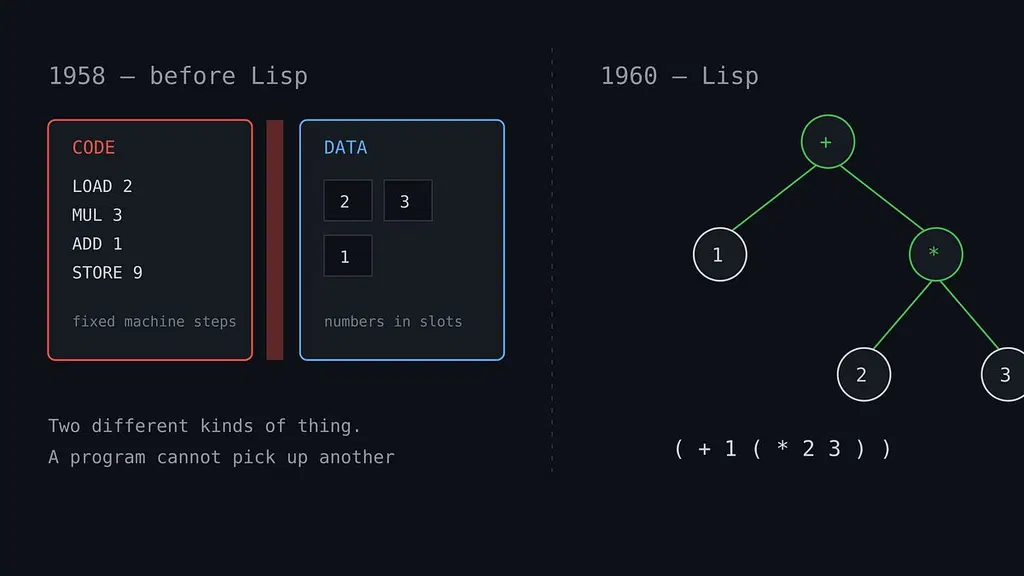
John McCarthy, who coined the term artificial intelligence, fundamentally shifted computing from mere calculation to the generation of new facts. He achieved this by developing Lisp, a language where code and data are unified, allowing machines to manipulate information dynamically. His innovations, including garbage collection and the concept of code as data, remain standard practices in modern programming languages.
- ▪John McCarthy is credited with coining the term artificial intelligence and is responsible for foundational concepts like Lisp and garbage collection.
- ▪McCarthy's work enabled computers to generate new facts from existing data rather than simply performing numerical calculations.
- ▪The Lisp programming language treats code and data as the same entity, eliminating the traditional separation between parsing and execution.
- ▪Garbage collection, invented by McCarthy to manage memory in Lisp, is now a standard feature in major languages such as Java, Python, and Go.
Hacker News (AI / LLM) files mainly under ai. We currently carry 5,684 of its stories.
Story provenance
Source · retrieval · rights · ranking — open for full record
inspect →
Story provenance
Attribution is not the same as permission. This drawer separates discovery metadata, excerpts, WeSearch-generated summaries, reuse status, and whether the publisher receives the visit. Nothing here claims a legal grant the publisher has not made.
Record
| Original publisher | Hacker News (AI / LLM) |
| Canonical URL | https://nirmalutwani.substack.com/p/week-06-john-mccarthy-the-man-who |
| Publication time | Sun, 20 Sep 2026 05:30:43 +0000 |
| Retrieval time | 2026-09-20T05:43:47.241Z |
| Last seen | 2026-09-20T05:43:47.241Z |
| Headline source | Publisher (no WeSearch rewrite) |
| Excerpt source | publisher body |
| Excerpt method | First ~120 words (~800 chars) of extracted publisher body, fair-use limited. |
| Summary | WeSearch · cerebras-chat (WeSearch summarizer) |
| Summary source text | contentText |
| Citation coverage | Summary is a WeSearch-generated derivative; primary citation is the original publisher URL. |
| Cluster | krrzY413RTzR · 1 stories |
| Cluster logic | Grouped by semantic title/content similarity across sources within a rolling window. Same-publisher template collisions are excluded from coverage comparison. |
| Ranking reason | Story pages are not engagement-ranked. Hub feeds use recency, with optional source-diversified chronological ordering (cap consecutive stories per source). No personalized ranking. |
| Publisher visit | Yes — open original |
| Substitutes article? | No — link-out required for full text |
Rights status (four layers)
WeSearch handling by dimension
| Indexing | May the item be indexed (stored, ranked, made findable)? | Allowed |
| Snippet | May a short excerpt of the publisher's text be shown? | Allowed |
| AI summary | May WeSearch generate its own short summary of the article? | Limited |
| Retrieval / RAG | May the content be exposed for third-party retrieval-augmented generation? | Not asserted |
| Model training | May the content be used to train AI models? | Not asserted |
| Commercial reuse | May the content be reused commercially? | Not permitted |
Basis: Derived from the published RSS/Atom feed. Contact: [email protected]. Reviewed: 2026-07-24.
Opening excerpt (first ~120 words) tap to expand
The Man Who Named AI: John McCarthy and the End of the Code–Data DivideWeek 06 of the Turing Award Series: how one person got machines to generate new facts instead of just calculating.Nirmal UtwaniJul 13, 2026ShareTracing some history of artificial intelligence, I was looking forward to this chapter. John McCarthy coined the term artificial intelligence. He is also directly or indirectly responsible for Lisp, macros, garbage collection, time sharing, and code as data. He is the quintessential computer scientist.Before McCarthy, computing was mostly calculation, not generation. You fed the machine numbers and it handed numbers back. He was one of the first to get a machine to create new facts out of facts it already had. Socrates is a man. All men are mortal. So Socrates is mortal.
…
Excerpt limited to ~120 words for fair-use compliance. The full article is at Hacker News (AI / LLM).
Discussion
0 commentsMore from Hacker News (AI / LLM)


