
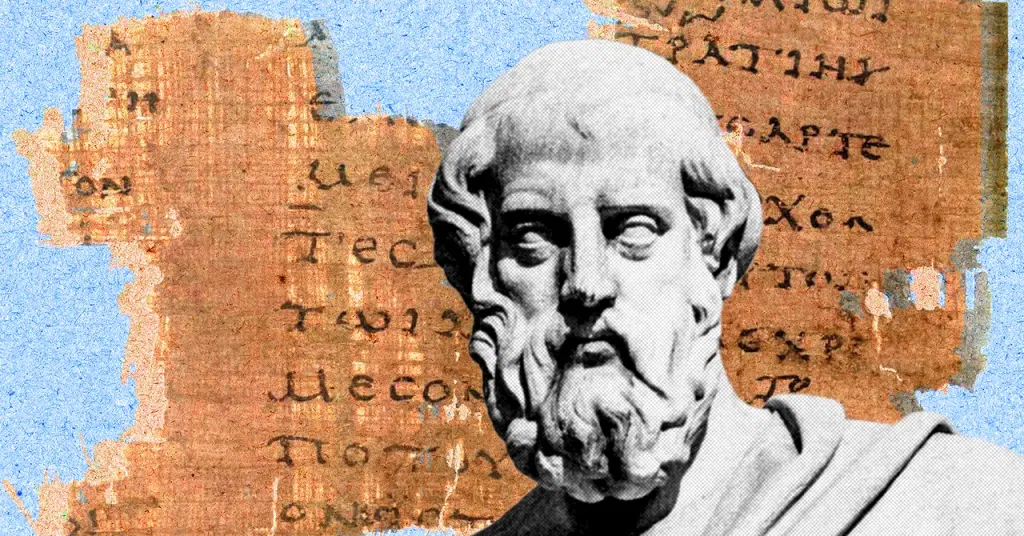
A New Chatbot Wants to Unlock the Secrets in Tattered Ancient Greek Records
Though many are so damaged that their meaning is probably lost, scholars have the ability to restore the rest by methodically filling in missing words or phrases. To accelerate that laborious task, researchers have turned to artificial intelligence.On Wednesday, the Austrian Academy of Science will release “the world’s first advanced large language model for Ancient Greek,” developed in partnership with French AI lab Mistral and technology services firm Sail Reply. The model, Apollo, is trained on roughly 600 million historical Greek words drawn from manuscripts, papyri, and inscriptions.The model will be freely available to academics through a chatbot interface.
- ▪Though many are so damaged that their meaning is probably lost, scholars have the ability to restore the rest by methodically filling in missing words or phrases.
- ▪To accelerate that laborious task, researchers have turned to artificial intelligence.On Wednesday, the Austrian Academy of Science will release “the world’s first advanced large language model for Ancient Greek,” developed in partnership w
- ▪The model, Apollo, is trained on roughly 600 million historical Greek words drawn from manuscripts, papyri, and inscriptions.The model will be freely available to academics through a chatbot interface.
WIRED files mainly under tech. We currently carry 883 of its stories.
Story provenance
Source · retrieval · rights · ranking — open for full record
inspect →
Story provenance
Attribution is not the same as permission. This drawer separates discovery metadata, excerpts, WeSearch-generated summaries, reuse status, and whether the publisher receives the visit. Nothing here claims a legal grant the publisher has not made.
Record
| Original publisher | WIRED |
| Canonical URL | https://www.wired.com/story/apollo-ai-model-ancient-greek-secrets-papyrus/ |
| Publication time | Tue, 22 Sep 2026 09:30:00 +0000 |
| Retrieval time | 2026-09-22T09:33:50.077Z |
| Last seen | 2026-09-22T09:33:50.077Z |
| Headline source | Publisher (no WeSearch rewrite) |
| Excerpt source | publisher body |
| Excerpt method | First ~120 words (~800 chars) of extracted publisher body, fair-use limited. |
| Summary | WeSearch · cerebras-chat (WeSearch summarizer) |
| Summary source text | contentText |
| Citation coverage | Summary is a WeSearch-generated derivative; primary citation is the original publisher URL. |
| Cluster | rj0W4Z40BNuh · 1 stories |
| Cluster logic | Grouped by semantic title/content similarity across sources within a rolling window. Same-publisher template collisions are excluded from coverage comparison. |
| Ranking reason | Story pages are not engagement-ranked. Hub feeds use recency, with optional source-diversified chronological ordering (cap consecutive stories per source). No personalized ranking. |
| Publisher visit | Yes — open original |
| Substitutes article? | No — link-out required for full text |
Rights status (four layers)
WeSearch handling by dimension
| Indexing | May the item be indexed (stored, ranked, made findable)? | Allowed |
| Snippet | May a short excerpt of the publisher's text be shown? | Allowed |
| AI summary | May WeSearch generate its own short summary of the article? | Limited |
| Retrieval / RAG | May the content be exposed for third-party retrieval-augmented generation? | Not asserted |
| Model training | May the content be used to train AI models? | Not asserted |
| Commercial reuse | May the content be reused commercially? | Not permitted |
Basis: Derived from the published RSS/Atom feed. Contact: [email protected]. Reviewed: 2026-07-24.
Opening excerpt (first ~120 words) tap to expand
Joel KhaliliBusinessSep 22, 2026 5:30 AMA New Chatbot Wants to Unlock the Secrets in Tattered Ancient Greek RecordsIn the hope of uncovering new details about ancient life, researchers have developed a large language model that fills in the gaps in papyrus fragments.Photo-Illustration: WIRED Staff; Getty ImagesCommentLoaderSave StorySave this storyCommentLoaderSave StorySave this storyAcademic libraries across the globe are stuffed with hundreds of thousands of Ancient Greek papyrus fragments. Though many are so damaged that their meaning is probably lost, scholars have the ability to restore the rest by methodically filling in missing words or phrases.
…
Excerpt limited to ~120 words for fair-use compliance. The full article is at WIRED.
Discussion
0 commentsMore from WIRED


