Abusing SQL to Play DOOM
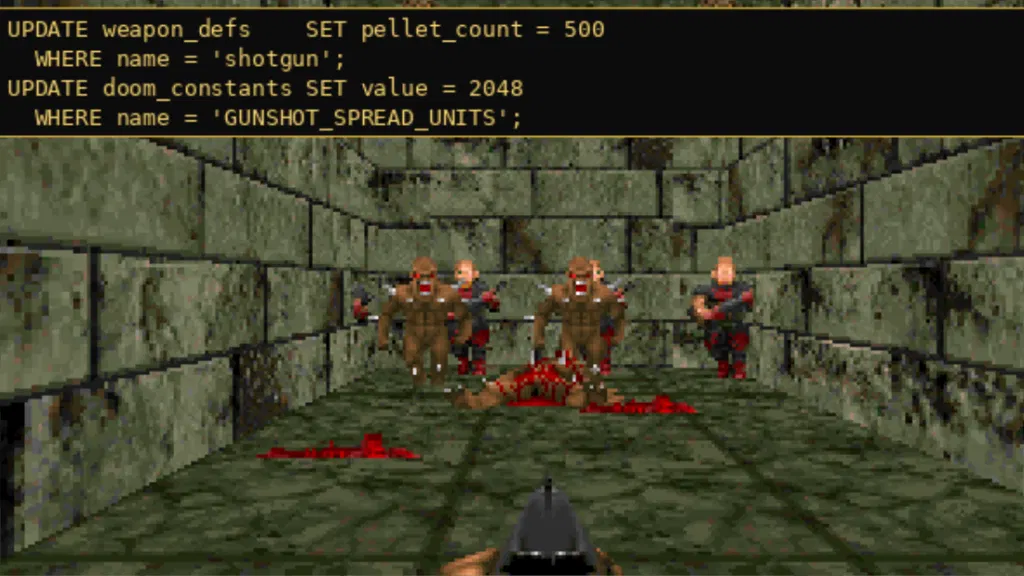
A group at CedarDB has successfully ported the original DOOM game to the SQL programming language to demonstrate its general-purpose capabilities. The project utilizes complex SQL queries to handle data storage, timing, and image rendering, with only a small amount of Python used for input and display. This implementation highlights how DOOM's original data-heavy rendering techniques align well with SQL's strengths in data transformation.
- ▪The CedarDB team ported the original DOOM game to SQL to showcase the language's versatility beyond simple data management.
- ▪The rendering process for the game consists of 1300 lines of SQL code spread across 89 common table expressions.
- ▪A small portion of Python is used to manage keyboard inputs, timing, and the display of the generated bitmap.
- ▪The project's source code is available on GitHub for those interested in exploring this unique implementation.
- ▪DOOM is considered a suitable candidate for SQL because its pre-graphics-card era rendering relies heavily on data transformations.
Hackaday files mainly under tech. We currently carry 457 of its stories.
Story provenance
Source · retrieval · rights · ranking — open for full record
inspect →
Story provenance
Attribution is not the same as permission. This drawer separates discovery metadata, excerpts, WeSearch-generated summaries, reuse status, and whether the publisher receives the visit. Nothing here claims a legal grant the publisher has not made.
Record
| Original publisher | Hackaday |
| Canonical URL | https://hackaday.com/2026/09/25/abusing-sql-to-play-doom/ |
| Publication time | Sat, 26 Sep 2026 05:00:05 +0000 |
| Retrieval time | 2026-09-26T05:01:00.000Z |
| Last seen | 2026-09-26T05:01:00.000Z |
| Headline source | Publisher (no WeSearch rewrite) |
| Excerpt source | publisher body |
| Excerpt method | First ~120 words (~800 chars) of extracted publisher body, fair-use limited. |
| Summary | WeSearch · cerebras-chat (WeSearch summarizer) |
| Summary source text | contentText |
| Citation coverage | Summary is a WeSearch-generated derivative; primary citation is the original publisher URL. |
| Cluster | HHNy2RE8EKyz · 1 stories |
| Cluster logic | Grouped by semantic title/content similarity across sources within a rolling window. Same-publisher template collisions are excluded from coverage comparison. |
| Ranking reason | Story pages are not engagement-ranked. Hub feeds use recency, with optional source-diversified chronological ordering (cap consecutive stories per source). No personalized ranking. |
| Publisher visit | Yes — open original |
| Substitutes article? | No — link-out required for full text |
Rights status (four layers)
WeSearch handling by dimension
| Indexing | May the item be indexed (stored, ranked, made findable)? | Allowed |
| Snippet | May a short excerpt of the publisher's text be shown? | Allowed |
| AI summary | May WeSearch generate its own short summary of the article? | Limited |
| Retrieval / RAG | May the content be exposed for third-party retrieval-augmented generation? | Not asserted |
| Model training | May the content be used to train AI models? | Not asserted |
| Commercial reuse | May the content be reused commercially? | Not permitted |
Basis: Derived from the published RSS/Atom feed. Contact: [email protected]. Reviewed: 2026-07-24.
Opening excerpt (first ~120 words) tap to expand
Abusing SQL To Play DOOM No comments by: Bryan Cockfield September 25, 2026 Title: Copy Short Link: Copy Most laypeople who encounter SQL think of it purely as a tool for managing large datasets. While that is certainly what it was designed for, SQL is still a programming language at its core. It includes many of the features found in general-purpose languages like C or Python, and although it wasn’t built for general-purpose work, it can handle a surprising range of tasks that programmers might not expect to use it for. To demonstrate its capabilities, and perhaps to show off their skills with SQL, a group at CedarDB ported the original DOOM to this language.
…
Excerpt limited to ~120 words for fair-use compliance. The full article is at Hackaday.
Discussion
0 commentsMore from Hackaday