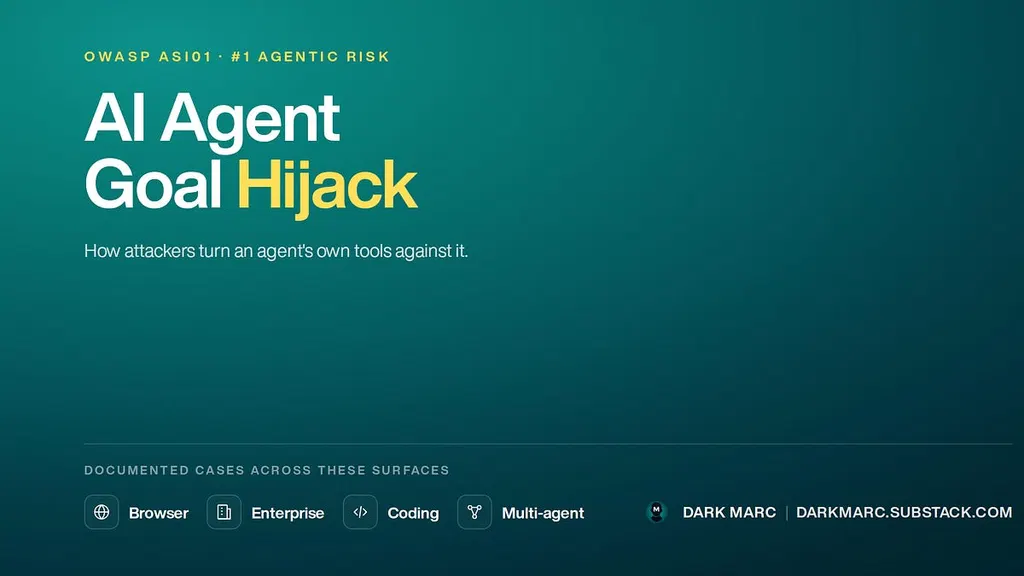
AI Agent Goal Hijack: How Attackers Turn an Agent's Own Tools Against It
AI Agent Goal Hijack: How Attackers Redirect an Agent's Goals, Planning, and BehaviorDark MarcSep 19, 202653ShareAI agents are being handed real power faster than they can be secured, and attackers are turning their own tools against them.An agent works by taking actions. To reach what the agent receives, an attacker needs access to the user or to whatever hands the agent its request. The agent goes out for it, then reads whatever it finds, so leaving text where the agent will look is enough.The deeper problem is what the agent does with that content once it has it.
- ▪AI Agent Goal Hijack: How Attackers Redirect an Agent's Goals, Planning, and BehaviorDark MarcSep 19, 202653ShareAI agents are being handed real power faster than they can be secured, and attackers are turning their own tools against them.A
- ▪To reach what the agent receives, an attacker needs access to the user or to whatever hands the agent its request.
- ▪The agent goes out for it, then reads whatever it finds, so leaving text where the agent will look is enough.The deeper problem is what the agent does with that content once it has it.
Hacker News (AI / LLM) files mainly under ai. We currently carry 6,191 of its stories.
Story provenance
Source · retrieval · rights · ranking — open for full record
inspect →
Story provenance
Attribution is not the same as permission. This drawer separates discovery metadata, excerpts, WeSearch-generated summaries, reuse status, and whether the publisher receives the visit. Nothing here claims a legal grant the publisher has not made.
Record
| Original publisher | Hacker News (AI / LLM) |
| Canonical URL | https://darkmarc.substack.com/p/hijacking-ai-agents-how-an-agents |
| Publication time | Wed, 23 Sep 2026 21:30:50 +0000 |
| Retrieval time | 2026-09-23T21:39:35.306Z |
| Last seen | 2026-09-23T21:39:35.306Z |
| Headline source | Publisher (no WeSearch rewrite) |
| Excerpt source | publisher body |
| Excerpt method | First ~120 words (~800 chars) of extracted publisher body, fair-use limited. |
| Summary | WeSearch · cerebras-chat (WeSearch summarizer) |
| Summary source text | contentText |
| Citation coverage | Summary is a WeSearch-generated derivative; primary citation is the original publisher URL. |
| Cluster | BotI4gS0mmkE · 1 stories |
| Cluster logic | Grouped by semantic title/content similarity across sources within a rolling window. Same-publisher template collisions are excluded from coverage comparison. |
| Ranking reason | Story pages are not engagement-ranked. Hub feeds use recency, with optional source-diversified chronological ordering (cap consecutive stories per source). No personalized ranking. |
| Publisher visit | Yes — open original |
| Substitutes article? | No — link-out required for full text |
Rights status (four layers)
WeSearch handling by dimension
| Indexing | May the item be indexed (stored, ranked, made findable)? | Allowed |
| Snippet | May a short excerpt of the publisher's text be shown? | Allowed |
| AI summary | May WeSearch generate its own short summary of the article? | Limited |
| Retrieval / RAG | May the content be exposed for third-party retrieval-augmented generation? | Not asserted |
| Model training | May the content be used to train AI models? | Not asserted |
| Commercial reuse | May the content be reused commercially? | Not permitted |
Basis: Derived from the published RSS/Atom feed. Contact: [email protected]. Reviewed: 2026-07-24.
Opening excerpt (first ~120 words) tap to expand
AI Agent Goal Hijack: How Attackers Redirect an Agent's Goals, Planning, and BehaviorDark MarcSep 19, 202653ShareAI agents are being handed real power faster than they can be secured, and attackers are turning their own tools against them.An agent works by taking actions. Depending on what it is connected to, it can read files, send messages, run code, move money, or call other services, often with no person clearing each step.Content reaches an agent in two ways, which behave differently under attack:Received: the prompt or request handed to it directly.Retrieved: the content it fetches on its own while working, a web page, a document, an email, another agent’s output.Either channel can carry an attack, but they are not equally exposed.
…
Excerpt limited to ~120 words for fair-use compliance. The full article is at Hacker News (AI / LLM).
Discussion
0 commentsMore from Hacker News (AI / LLM)