
AI Was Supposed to Make Software Cheaper. So Why Is It More Expensive Now?
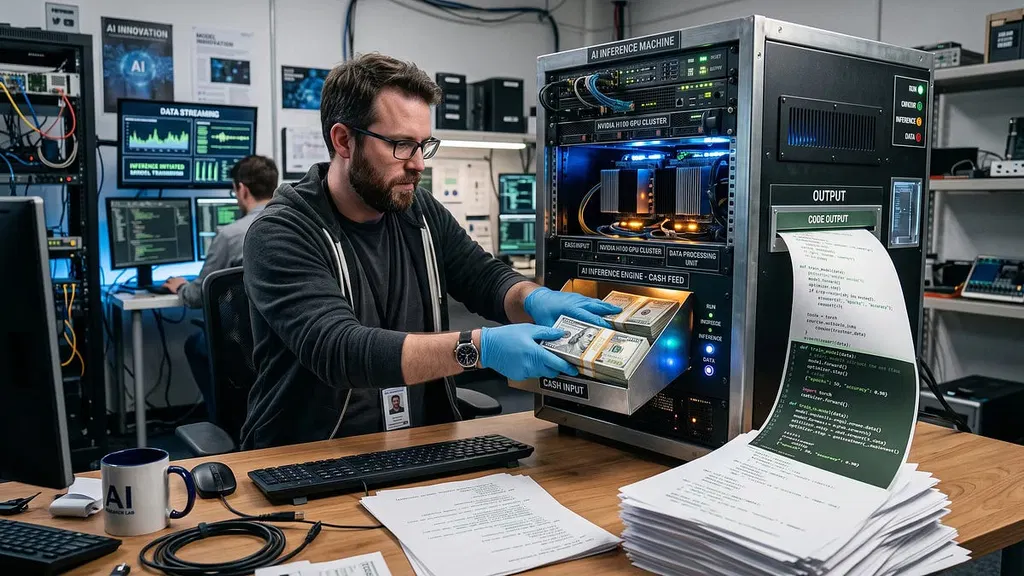
Despite AI significantly accelerating software development, enterprise software costs have risen due to high inference expenses and increased feature expectations. Companies like Cursor have shifted to usage-based pricing models, leading to higher costs for customers as they pass through the substantial expenses of running AI models. The article argues that software is priced based on value to the buyer rather than production cost, meaning productivity gains are often absorbed by expanded scope rather than lower prices.
- ▪Anysphere reached $4 billion in annualized revenue by June 2026, with model inference costs consuming 40 to 70 cents of every revenue dollar.
- ▪Cursor transitioned from flat request-based billing to usage credits in June 2025, resulting in customer complaints about surprise charges and subsequent pricing adjustments.
- ▪Seventy-nine percent of IT leaders reported hitting a price increase at renewal in the last twelve months, indicating a broad trend of rising software costs.
- ▪Software pricing has historically tracked buyer value rather than production cost, a pattern that has persisted through previous productivity jumps like the adoption of AWS and Rails.
Hacker News (AI / LLM) files mainly under ai. We currently carry 4,683 of its stories.
Story provenance
Source · retrieval · rights · ranking — open for full record
inspect →
Story provenance
Attribution is not the same as permission. This drawer separates discovery metadata, excerpts, WeSearch-generated summaries, reuse status, and whether the publisher receives the visit. Nothing here claims a legal grant the publisher has not made.
Record
| Original publisher | Hacker News (AI / LLM) |
| Canonical URL | https://galratner.substack.com/p/ai-was-supposed-to-make-software |
| Publication time | Sun, 13 Sep 2026 17:40:17 +0000 |
| Retrieval time | 2026-09-13T17:46:50.681Z |
| Last seen | 2026-09-13T17:46:50.681Z |
| Headline source | Publisher (no WeSearch rewrite) |
| Excerpt source | publisher body |
| Excerpt method | First ~120 words (~800 chars) of extracted publisher body, fair-use limited. |
| Summary | WeSearch · cerebras-chat (WeSearch summarizer) |
| Summary source text | contentText |
| Citation coverage | Summary is a WeSearch-generated derivative; primary citation is the original publisher URL. |
| Cluster | QmBsOUi1bpeL · 1 stories |
| Cluster logic | Grouped by semantic title/content similarity across sources within a rolling window. Same-publisher template collisions are excluded from coverage comparison. |
| Ranking reason | Story pages are not engagement-ranked. Hub feeds use recency, with optional source-diversified chronological ordering (cap consecutive stories per source). No personalized ranking. |
| Publisher visit | Yes — open original |
| Substitutes article? | No — link-out required for full text |
Rights status (four layers)
WeSearch handling by dimension
| Indexing | May the item be indexed (stored, ranked, made findable)? | Allowed |
| Snippet | May a short excerpt of the publisher's text be shown? | Allowed |
| AI summary | May WeSearch generate its own short summary of the article? | Limited |
| Retrieval / RAG | May the content be exposed for third-party retrieval-augmented generation? | Not asserted |
| Model training | May the content be used to train AI models? | Not asserted |
| Commercial reuse | May the content be reused commercially? | Not permitted |
Basis: Derived from the published RSS/Atom feed. Contact: [email protected]. Reviewed: 2026-07-24.
Opening excerpt (first ~120 words) tap to expand
AI Was Supposed to Make Software Cheaper. So Why Is It More Expensive Now?Code has never been faster to produce, and enterprise systems have never cost more. The reason is sitting in the inference bill.Gal RatnerSep 13, 20261ShareAnysphere reached roughly $4 billion in annualized revenue by June 2026, about three quarters of it enterprise, up from $100 million sixteen months earlier. It crossed $100 million faster than any application-layer SaaS product on record, by the better part of a year. SpaceX priced the whole company at $60 billion.Reporting through 2025 put its model inference costs at forty to seventy cents of every revenue dollar. That puts gross margin somewhere in the 30 to 50 percent range. Software has run at 70 to 80 percent for four decades.
…
Excerpt limited to ~120 words for fair-use compliance. The full article is at Hacker News (AI / LLM).
Discussion
0 commentsMore from Hacker News (AI / LLM)


