Analyst on China's spent rocket stages: "Things only continue to get worse"
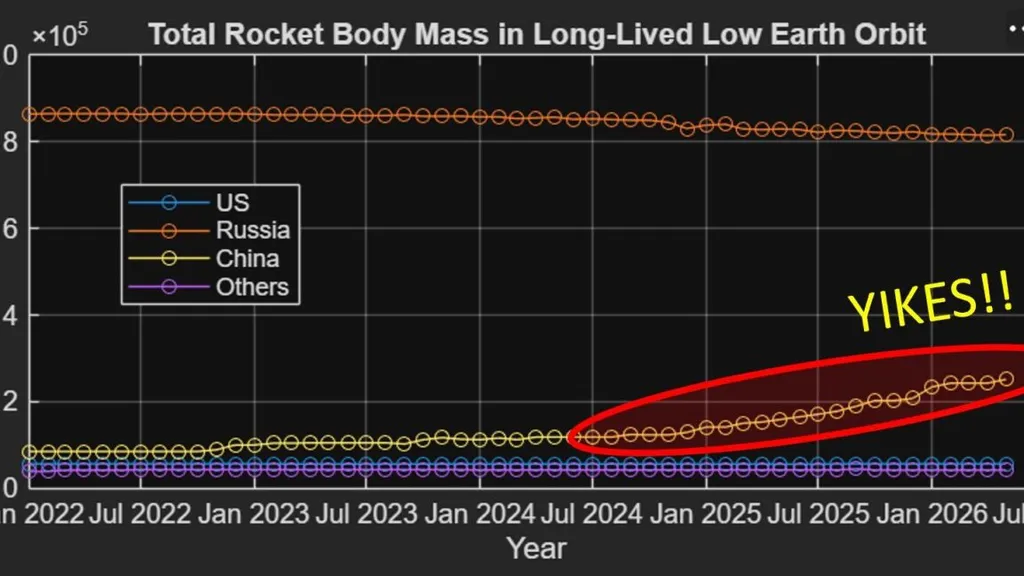
China's rapid increase in rocket launches has led to a significant rise in the mass of spent rocket stages in orbit. This growth poses a risk to space sustainability, as these upper stages are often abandoned in long-lived orbits. Experts warn that if China does not adopt better disposal practices, the situation will worsen, contributing to an already congested space environment.
- ▪China launched a record total of 93 rockets last year, marking it as the second-most productive space power.
- ▪The mass of Chinese rocket bodies in long-lived orbits has increased from less than 100 metric tons to 252 in the past five years.
- ▪Experts emphasize that abandoning rocket bodies in orbit is not a best practice and could lead to increased space debris.
Ars Technica files mainly under tech. We currently carry 170 of its stories.
Story provenance
Source · retrieval · rights · ranking — open for full record
inspect →
Story provenance
Attribution is not the same as permission. This drawer separates discovery metadata, excerpts, WeSearch-generated summaries, reuse status, and whether the publisher receives the visit. Nothing here claims a legal grant the publisher has not made.
Record
| Original publisher | Ars Technica |
| Canonical URL | https://arstechnica.com/space/2026/05/analyst-on-chinas-spent-rocket-stages-things-only-continue-to-get-worse/ |
| Publication time | Tue, 26 May 2026 13:57:30 +0000 |
| Retrieval time | 2026-05-26T14:07:49.536Z |
| Last seen | 2026-05-26T14:07:49.536Z |
| Headline source | Publisher (no WeSearch rewrite) |
| Excerpt source | publisher body |
| Excerpt method | First ~120 words (~800 chars) of extracted publisher body, fair-use limited. |
| Summary | WeSearch · cerebras-chat (WeSearch summarizer) |
| Summary source text | contentText |
| Citation coverage | Summary is a WeSearch-generated derivative; primary citation is the original publisher URL. |
| Cluster | 1WOMLVAPwcfN |
| Cluster logic | Grouped by semantic title/content similarity across sources within a rolling window. Same-publisher template collisions are excluded from coverage comparison. |
| Ranking reason | Story pages are not engagement-ranked. Hub feeds use recency, with optional source-diversified chronological ordering (cap consecutive stories per source). No personalized ranking. |
| Publisher visit | Yes — open original |
| Substitutes article? | No — link-out required for full text |
Rights status (four layers)
WeSearch handling by dimension
| Indexing | May the item be indexed (stored, ranked, made findable)? | Allowed |
| Snippet | May a short excerpt of the publisher's text be shown? | Allowed |
| AI summary | May WeSearch generate its own short summary of the article? | Limited |
| Retrieval / RAG | May the content be exposed for third-party retrieval-augmented generation? | Not asserted |
| Model training | May the content be used to train AI models? | Not asserted |
| Commercial reuse | May the content be reused commercially? | Not permitted |
Basis: Derived from the published RSS/Atom feed. Contact: [email protected]. Reviewed: 2026-07-24.
Opening excerpt (first ~120 words) tap to expand
Space junk Analyst on China’s spent rocket stages: “Things only continue to get worse” Spent upper stages are the most dangerous kind of space debris. Eric Berger – May 26, 2026 9:57 am | 2 Growth in rocket body mass in long-lived orbits since January 2022. Credit: Jim Shell Growth in rocket body mass in long-lived orbits since January 2022. Credit: Jim Shell Text settings Story text Size Small Standard Large Width * Standard Wide Links Standard Orange * Subscribers only Learn more Minimize to nav Up until a decade ago, China had never launched as many as 20 orbital rockets a year. But beginning in 2022, the Asian country launched 64 rockets and last year reached a record total of 93, marking it as the second-most productive space power in the world.
…
Excerpt limited to ~120 words for fair-use compliance. The full article is at Ars Technica.
Discussion
0 commentsMore from Ars Technica