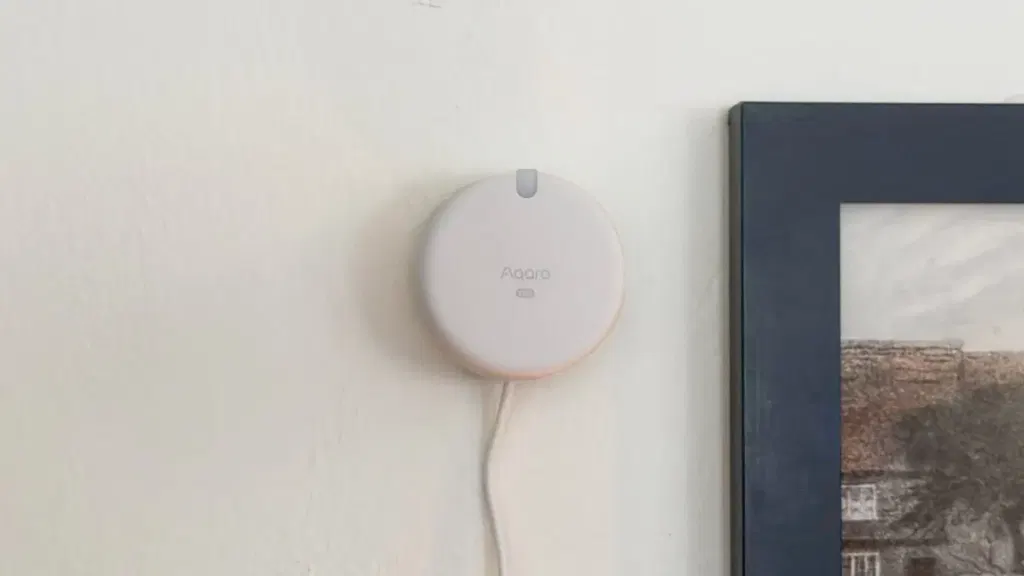
Aqara Multi-Sensor FP400 Review: Not Quite the mmWave of the Future
The Aqara Multi-Sensor FP400 is an $80 mmWave sensor that uses high-frequency radio signals to detect human presence and breathing, allowing for precise smart home automations. While it improves on its predecessor by tracking up to ten people and supporting Matter, Thread, and Zigbee, it lacks battery power and the posture detection features initially promised. Reviewers describe the device as a fun but flawed gadget that offers only modest improvements over the three-year-old FP2 model.
- ▪The FP400 can track up to 10 people simultaneously and uses mmWave technology to detect subtle movements like breathing.
- ▪The device requires constant power via a USB-C cable and does not have a built-in battery.
- ▪Aqara confirmed that posture detection features will not be included in the consumer FP400 but are planned for a future FP400 Pro model.
- ▪The sensor supports Matter, Thread, and Zigbee protocols and does not require an internet connection for daily operation.
Gizmodo files mainly under tech. We currently carry 1,161 of its stories.
Story provenance
Source · retrieval · rights · ranking — open for full record
inspect →
Story provenance
Attribution is not the same as permission. This drawer separates discovery metadata, excerpts, WeSearch-generated summaries, reuse status, and whether the publisher receives the visit. Nothing here claims a legal grant the publisher has not made.
Record
| Original publisher | Gizmodo |
| Canonical URL | https://gizmodo.com/aqara-multi-sensor-fp400-review-not-quite-the-mmwave-of-the-future-2000804454 |
| Publication time | Sun, 20 Sep 2026 12:30:57 +0000 |
| Retrieval time | 2026-09-20T12:33:46.371Z |
| Last seen | 2026-09-20T12:33:46.371Z |
| Headline source | Publisher (no WeSearch rewrite) |
| Excerpt source | publisher body |
| Excerpt method | First ~120 words (~800 chars) of extracted publisher body, fair-use limited. |
| Summary | WeSearch · cerebras-chat (WeSearch summarizer) |
| Summary source text | contentText |
| Citation coverage | Summary is a WeSearch-generated derivative; primary citation is the original publisher URL. |
| Cluster | pYguGGIuEGs8 · 1 stories |
| Cluster logic | Grouped by semantic title/content similarity across sources within a rolling window. Same-publisher template collisions are excluded from coverage comparison. |
| Ranking reason | Story pages are not engagement-ranked. Hub feeds use recency, with optional source-diversified chronological ordering (cap consecutive stories per source). No personalized ranking. |
| Publisher visit | Yes — open original |
| Substitutes article? | No — link-out required for full text |
Rights status (four layers)
WeSearch handling by dimension
| Indexing | May the item be indexed (stored, ranked, made findable)? | Allowed |
| Snippet | May a short excerpt of the publisher's text be shown? | Allowed |
| AI summary | May WeSearch generate its own short summary of the article? | Limited |
| Retrieval / RAG | May the content be exposed for third-party retrieval-augmented generation? | Not asserted |
| Model training | May the content be used to train AI models? | Not asserted |
| Commercial reuse | May the content be reused commercially? | Not permitted |
Basis: Derived from the published RSS/Atom feed. Contact: [email protected]. Reviewed: 2026-07-24.
Opening excerpt (first ~120 words) tap to expand
One of the promises of the smart home is total automation that lets your body be a trigger for getting things done. Lights that illuminate when you enter a room and reliably blink off when you leave, perhaps, or a stereo that only turns on when you sit in a specific chair. That’s actually something you’ve been able to do in recent years, thanks to mmWave sensors like Aqara’s new $80 Spatial Multi-Sensor FP400. Unlike simple passive infrared (PIR) motion and occupancy sensors, mmWave devices can precisely detect whether a person is in the room, even if they’re not moving.
…
Excerpt limited to ~120 words for fair-use compliance. The full article is at Gizmodo.
Discussion
0 commentsMore from Gizmodo