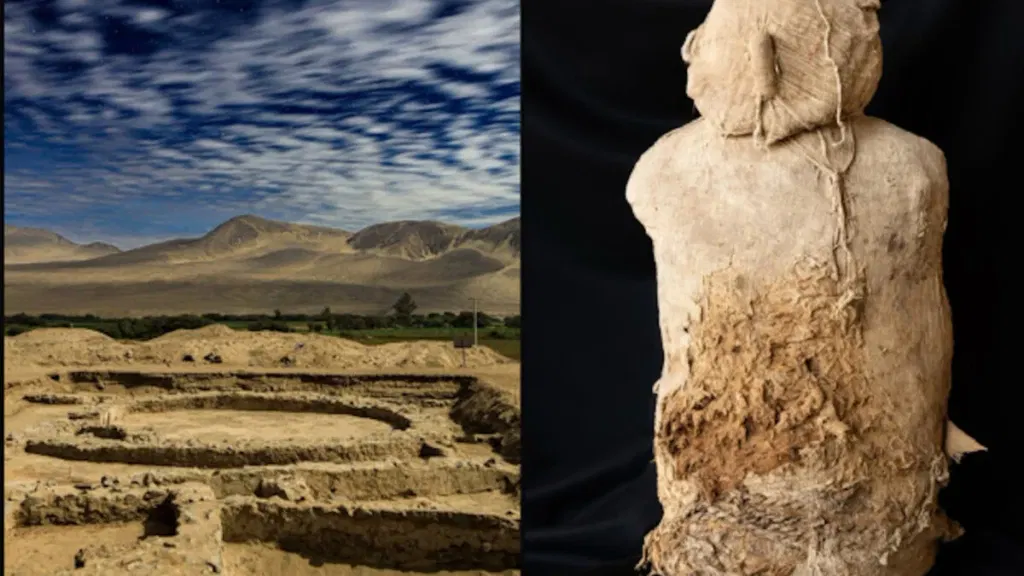
Archaeologists Found 4 Nazca Mummies in the Wrong Place. It Could Turn the Story of an Ancient Empire ‘Upside Down’
Peru’s archaeological record is arguably one of the most pillaged in the world. Corina Kellner, a professor of biological anthropology at Northern Arizona University, stumbled upon just that in 2022 while excavating Huaca del Loro, a large site along the southern coast of Peru dating back to the Nasca, a civilization that occupied the region between 1 and 750 CE. Kellner and her colleagues found the mummified remains of four individuals, bound in cloth, that had somehow remained undisturbed for over 1,000 years.
- ▪Peru’s archaeological record is arguably one of the most pillaged in the world.
- ▪Corina Kellner, a professor of biological anthropology at Northern Arizona University, stumbled upon just that in 2022 while excavating Huaca del Loro, a large site along the southern coast of Peru dating back to the Nasca, a civilization t
- ▪Kellner and her colleagues found the mummified remains of four individuals, bound in cloth, that had somehow remained undisturbed for over 1,000 years.
Gizmodo files mainly under tech. We currently carry 1,538 of its stories.
Story provenance
Source · retrieval · rights · ranking — open for full record
inspect →
Story provenance
Attribution is not the same as permission. This drawer separates discovery metadata, excerpts, WeSearch-generated summaries, reuse status, and whether the publisher receives the visit. Nothing here claims a legal grant the publisher has not made.
Record
| Original publisher | Gizmodo |
| Canonical URL | https://gizmodo.com/archaeologists-found-4-nazca-mummies-in-the-wrong-place-it-could-turn-the-story-of-an-ancient-empire-upside-down-2000820434 |
| Publication time | Thu, 01 Oct 2026 19:15:05 +0000 |
| Retrieval time | 2026-10-01T19:17:19.389Z |
| Last seen | 2026-10-01T19:17:19.389Z |
| Headline source | Publisher (no WeSearch rewrite) |
| Excerpt source | publisher body |
| Excerpt method | First ~120 words (~800 chars) of extracted publisher body, fair-use limited. |
| Summary | WeSearch · cerebras-chat (WeSearch summarizer) |
| Summary source text | contentText |
| Citation coverage | Summary is a WeSearch-generated derivative; primary citation is the original publisher URL. |
| Cluster | trD8BnPPr0zd · 1 stories |
| Cluster logic | Grouped by semantic title/content similarity across sources within a rolling window. Same-publisher template collisions are excluded from coverage comparison. |
| Ranking reason | Story pages are not engagement-ranked. Hub feeds use recency, with optional source-diversified chronological ordering (cap consecutive stories per source). No personalized ranking. |
| Publisher visit | Yes — open original |
| Substitutes article? | No — link-out required for full text |
Rights status (four layers)
WeSearch handling by dimension
| Indexing | May the item be indexed (stored, ranked, made findable)? | Allowed |
| Snippet | May a short excerpt of the publisher's text be shown? | Allowed |
| AI summary | May WeSearch generate its own short summary of the article? | Limited |
| Retrieval / RAG | May the content be exposed for third-party retrieval-augmented generation? | Not asserted |
| Model training | May the content be used to train AI models? | Not asserted |
| Commercial reuse | May the content be reused commercially? | Not permitted |
Basis: Derived from the published RSS/Atom feed. Contact: [email protected]. Reviewed: 2026-07-24.
Opening excerpt (first ~120 words) tap to expand
Peru’s archaeological record is arguably one of the most pillaged in the world. For centuries, thousands of its pre-Columbian artifacts have been looted, first by Old World conquistadors, then by black market marauders and their local accomplices, known as huaqueros, an indigenous Quechua word that now has effectively come to mean “grave robbers.” So, it’s saying something when researchers manage to uncover a sacred site that is eerily intact. Corina Kellner, a professor of biological anthropology at Northern Arizona University, stumbled upon just that in 2022 while excavating Huaca del Loro, a large site along the southern coast of Peru dating back to the Nasca, a civilization that occupied the region between 1 and 750 CE.
…
Excerpt limited to ~120 words for fair-use compliance. The full article is at Gizmodo.
Discussion
0 commentsMore from Gizmodo