Are Vector Databases Enough for Modern AI Workloads? Y/N
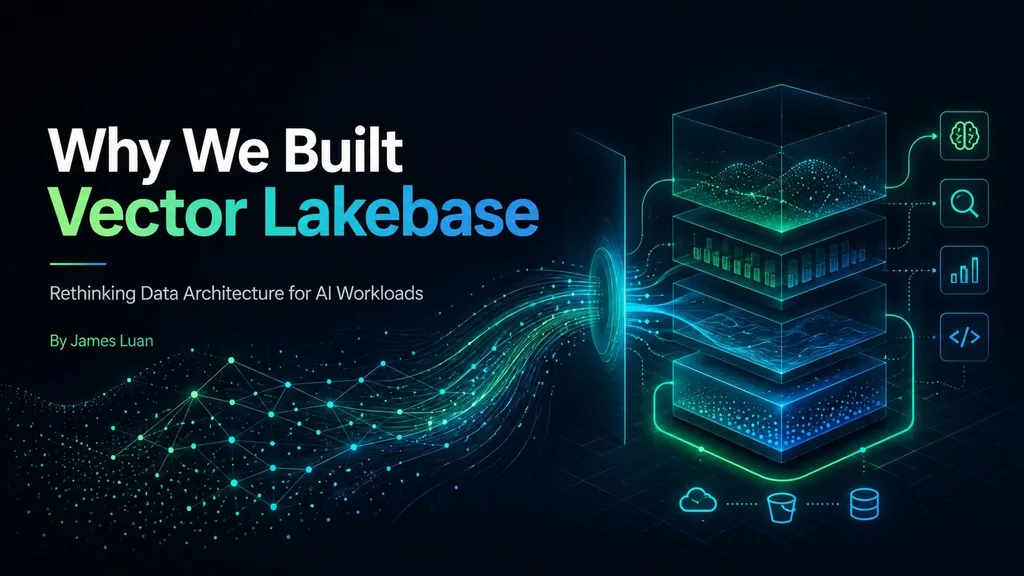
Zilliz has introduced Vector Lakebase, evolving from a vector database to a unified data foundation for AI workloads. This transition has raised questions about the future of vector databases, but Zilliz clarifies that they are not becoming obsolete. Instead, Vector Lakebase addresses the growing need for more comprehensive data management in AI applications.
- ▪Zilliz Vector Lakebase is now available in public preview.
- ▪The introduction of Vector Lakebase signifies an evolution in data architecture for AI workloads.
- ▪Vector databases remain a foundational layer in the AI stack, with increasing adoption.
Hacker News (AI / LLM) files mainly under ai. We currently carry 2,620 of its stories.
Story provenance
Source · retrieval · rights · ranking — open for full record
inspect →
Attribution is not the same as permission. This drawer separates discovery metadata, excerpts, WeSearch-generated summaries, reuse status, and whether the publisher receives the visit. Nothing here claims a legal grant the publisher has not made.
Record
| Original publisher | Zilliz |
| Canonical URL | https://zilliz.com/blog/why-we-built-vector-lakebase |
| Publication time | Wed, 27 May 2026 19:33:39 +0000 |
| Retrieval time | 2026-05-27T19:38:03.746Z |
| Last seen | 2026-05-27T19:38:03.746Z |
| Headline source | Publisher (no WeSearch rewrite) |
| Excerpt source | publisher body |
| Excerpt method | First ~120 words (~800 chars) of extracted publisher body, fair-use limited. |
| Summary | WeSearch · cerebras-chat (WeSearch summarizer) |
| Summary source text | contentText |
| Citation coverage | Summary is a WeSearch-generated derivative; primary citation is the original publisher URL. |
| Cluster | ustK4cGENBvV |
| Cluster logic | Grouped by semantic title/content similarity across sources within a rolling window. Same-publisher template collisions are excluded from coverage comparison. |
| Ranking reason | Story pages are not engagement-ranked. Hub feeds use recency, with optional source-diversified chronological ordering (cap consecutive stories per source). No personalized ranking. |
| Publisher visit | Yes — open original |
| Substitutes article? | No — link-out required for full text |
Rights status (four layers)
WeSearch handling by dimension
| Indexing | May the item be indexed (stored, ranked, made findable)? | Allowed |
| Snippet | May a short excerpt of the publisher's text be shown? | Allowed |
| AI summary | May WeSearch generate its own short summary of the article? | Limited |
| Retrieval / RAG | May the content be exposed for third-party retrieval-augmented generation? | Not asserted |
| Model training | May the content be used to train AI models? | Not asserted |
| Commercial reuse | May the content be reused commercially? | Not permitted |
Basis: Derived from the published RSS/Atom feed. Contact: [email protected]. Reviewed: 2026-07-24.
Opening excerpt (first ~120 words) tap to expand
BlogWhy We Built Vector Lakebase: Rethinking Unstructured Data Architecture for AICopy pageWhy We Built Vector Lakebase: Rethinking Unstructured Data Architecture for AIMay 26, 202619 min readJames LuanContentMobile internet already went through this cycle onceRetrieval solved the first problem, not the final oneFrom retrieval systems to continuous systems: CS/CDWhy existing architectures eventually hit their limitsWhat we mean by Vector LakebaseThe cost of separating storage and compute and how we address itI/O amplificationVector Lakebase: one data foundation, multiple compute modesResource scheduling becomes part of the Vector LakebaseExternal Collection: meeting data where it already livesWhat defines the first generation of Vector LakebaseVector databases are not disappearingZilliz…
Excerpt limited to ~120 words for fair-use compliance. The full article is at Zilliz.
Discussion
0 commentsMore from Zilliz