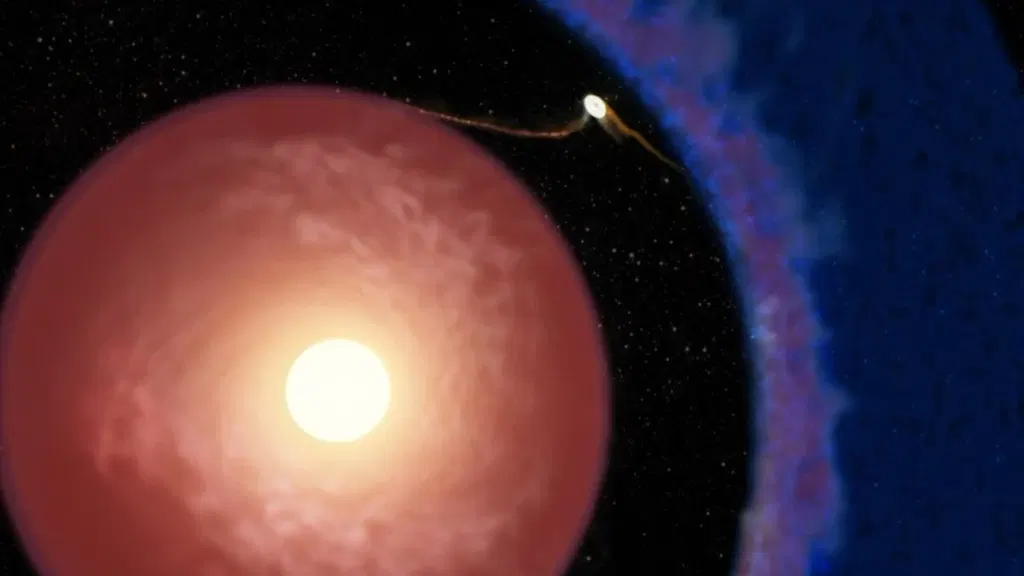
Astronomers Just Found the Youngest Planet Ever Seen. It Shouldn’t Be So Huge
Astronomers have confirmed the discovery of Elias 2-24 b, the youngest known planet, which is less than a million years old. This Jupiter-sized object is located significantly farther from its host star than Jupiter is from the Sun, challenging existing models of planet formation. The finding, published in The Astrophysical Journal Letters, provides a rare opportunity to study the earliest stages of planetary evolution.
- ▪Elias 2-24 b is the youngest planet ever discovered, with an estimated age of less than one million years.
- ▪The planet is located approximately 11 times farther from its host star than Jupiter is from the Sun, which contradicts current formation timelines.
- ▪Researchers confirmed the planet's existence by analyzing archival observations from the W. M. Keck Observatory between 2018 and 2020.
- ▪The discovery highlights the limitations of current theoretical models, which struggle to explain how such a massive planet forms so quickly at such a distance.
- ▪Future observations with NASA's Nancy Grace Roman Space Telescope are expected to make detecting similar infant planets easier.
Gizmodo files mainly under tech. We currently carry 1,141 of its stories.
Story provenance
Source · retrieval · rights · ranking — open for full record
inspect →
Story provenance
Attribution is not the same as permission. This drawer separates discovery metadata, excerpts, WeSearch-generated summaries, reuse status, and whether the publisher receives the visit. Nothing here claims a legal grant the publisher has not made.
Record
| Original publisher | Gizmodo |
| Canonical URL | https://gizmodo.com/astronomers-just-found-the-youngest-planet-ever-seen-it-shouldnt-be-so-huge-2000813928 |
| Publication time | Fri, 18 Sep 2026 16:30:03 +0000 |
| Retrieval time | 2026-09-18T16:33:45.369Z |
| Last seen | 2026-09-18T16:33:45.369Z |
| Headline source | Publisher (no WeSearch rewrite) |
| Excerpt source | publisher body |
| Excerpt method | First ~120 words (~800 chars) of extracted publisher body, fair-use limited. |
| Summary | WeSearch · cerebras-chat (WeSearch summarizer) |
| Summary source text | contentText |
| Citation coverage | Summary is a WeSearch-generated derivative; primary citation is the original publisher URL. |
| Cluster | Se7AbK9HilK- · 1 stories |
| Cluster logic | Grouped by semantic title/content similarity across sources within a rolling window. Same-publisher template collisions are excluded from coverage comparison. |
| Ranking reason | Story pages are not engagement-ranked. Hub feeds use recency, with optional source-diversified chronological ordering (cap consecutive stories per source). No personalized ranking. |
| Publisher visit | Yes — open original |
| Substitutes article? | No — link-out required for full text |
Rights status (four layers)
WeSearch handling by dimension
| Indexing | May the item be indexed (stored, ranked, made findable)? | Allowed |
| Snippet | May a short excerpt of the publisher's text be shown? | Allowed |
| AI summary | May WeSearch generate its own short summary of the article? | Limited |
| Retrieval / RAG | May the content be exposed for third-party retrieval-augmented generation? | Not asserted |
| Model training | May the content be used to train AI models? | Not asserted |
| Commercial reuse | May the content be reused commercially? | Not permitted |
Basis: Derived from the published RSS/Atom feed. Contact: [email protected]. Reviewed: 2026-07-24.
Opening excerpt (first ~120 words) tap to expand
For a decade, astronomers have debated whether a planet is taking shape in the dusty disk surrounding Elias 2-24, a young star located about 450 light years from Earth. The first clue was a gap in the disk spotted by the ALMA observatory in Chile, followed by the European Southern Observatory’s detection of a faint point of light sitting in that gap. There was a problem, however. According to planet formation models, it takes about 5 million years for a Jupiter-sized planet to form at Jupiter’s distance from the Sun. The farther a planet is from its star, the longer it takes to grow. But this glowing dot was roughly 11 times farther from Elias 2-24 than Jupiter is from the Sun, and it was already behaving like a forming planet.
…
Excerpt limited to ~120 words for fair-use compliance. The full article is at Gizmodo.
Discussion
0 commentsMore from Gizmodo