
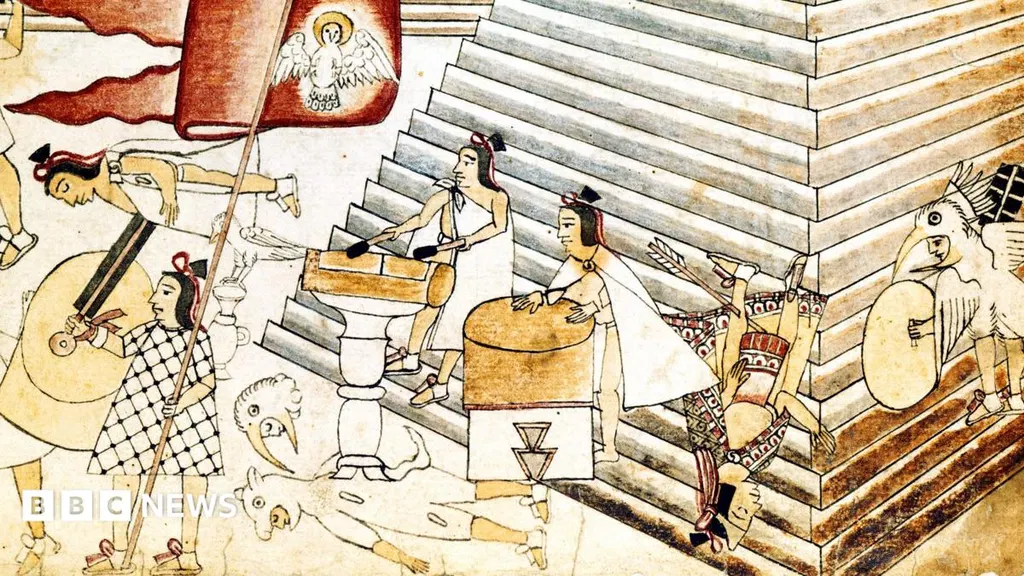
Aztec document goes on display in Mexico after 186 years abroad
The Codex Azcatitlán, a 16th-century Aztec manuscript, is being displayed in Mexico for the first time in 186 years. France lent the document to mark 200 years of diplomatic relations between the two nations. In exchange, Mexico is lending the Codex Boturini to France for a temporary exhibition.
- ▪The Codex Azcatitlán has been held in France's Bibliothèque Nationale since 1898.
- ▪The temporary exchange of the two codices was agreed upon by Mexican President Claudia Sheinbaum and French President Emmanuel Macron.
- ▪The Codex Azcatitlán will be exhibited at the National Museum of Anthropology in Mexico City.
- ▪Mexico successfully repatriated more than 2,000 historical objects last year.
- ▪The Codex Boturini depicts the migration of the Aztecs to Lake Texcoco.
BBC News — World publishes from United Kingdom and files mainly under world. We currently carry 978 of its stories.
Story provenance
Source · retrieval · rights · ranking — open for full record
inspect →
Story provenance
Attribution is not the same as permission. This drawer separates discovery metadata, excerpts, WeSearch-generated summaries, reuse status, and whether the publisher receives the visit. Nothing here claims a legal grant the publisher has not made.
Record
| Original publisher | BBC News — World |
| Canonical URL | https://www.bbc.co.uk/news/articles/ck980qyy6d2zo?at_medium=RSS&at_campaign=rss |
| Publication time | Thu, 17 Sep 2026 11:00:41 GMT |
| Retrieval time | 2026-09-17T11:18:44.478Z |
| Last seen | 2026-09-17T11:18:44.478Z |
| Headline source | Publisher (no WeSearch rewrite) |
| Excerpt source | publisher body |
| Excerpt method | First ~120 words (~800 chars) of extracted publisher body, fair-use limited. |
| Summary | WeSearch · cerebras-chat (WeSearch summarizer) |
| Summary source text | contentText |
| Citation coverage | Summary is a WeSearch-generated derivative; primary citation is the original publisher URL. |
| Cluster | ZPSBEYNfY5MW · 1 stories |
| Cluster logic | Grouped by semantic title/content similarity across sources within a rolling window. Same-publisher template collisions are excluded from coverage comparison. |
| Ranking reason | Story pages are not engagement-ranked. Hub feeds use recency, with optional source-diversified chronological ordering (cap consecutive stories per source). No personalized ranking. |
| Publisher visit | Yes — open original |
| Substitutes article? | No — link-out required for full text |
Rights status (four layers)
WeSearch handling by dimension
| Indexing | May the item be indexed (stored, ranked, made findable)? | Allowed |
| Snippet | May a short excerpt of the publisher's text be shown? | Allowed |
| AI summary | May WeSearch generate its own short summary of the article? | Limited |
| Retrieval / RAG | May the content be exposed for third-party retrieval-augmented generation? | Not asserted |
| Model training | May the content be used to train AI models? | Not asserted |
| Commercial reuse | May the content be reused commercially? | Not permitted |
Basis: Derived from the published RSS/Atom feed. Contact: [email protected]. Reviewed: 2026-07-24.
Opening excerpt (first ~120 words) tap to expand
Aztec document goes on display in Mexico after 186 years abroadImage source, API/Gamma-Rapho via Getty ImagesImage caption, Codex Azcatitlán tells the story of the Aztecs, including their battle to defend Tenochtitlán from the Spanish conquistadorsByVanessa BuschschlüterLatin America online editorPublished17 minutes agoA centuries-old document telling the story of the Aztec civilisation and its fall after the arrival of the Spanish conquistadors in pictograms is going on display in Mexico for the first time in 186 years.The manuscript, known as Codex Azcatitlán, has been held in France's Bibliothèque Nationale since 1898, but had already spent decades outside of Mexico before that.It is thought to have been drawn in the 16th Century - a few years after the arrival of the conquistadors in…
Excerpt limited to ~120 words for fair-use compliance. The full article is at BBC News — World.
Discussion
0 commentsMore from BBC News — World


