Best-Ever Brainstem Map Created by Indian Scientists
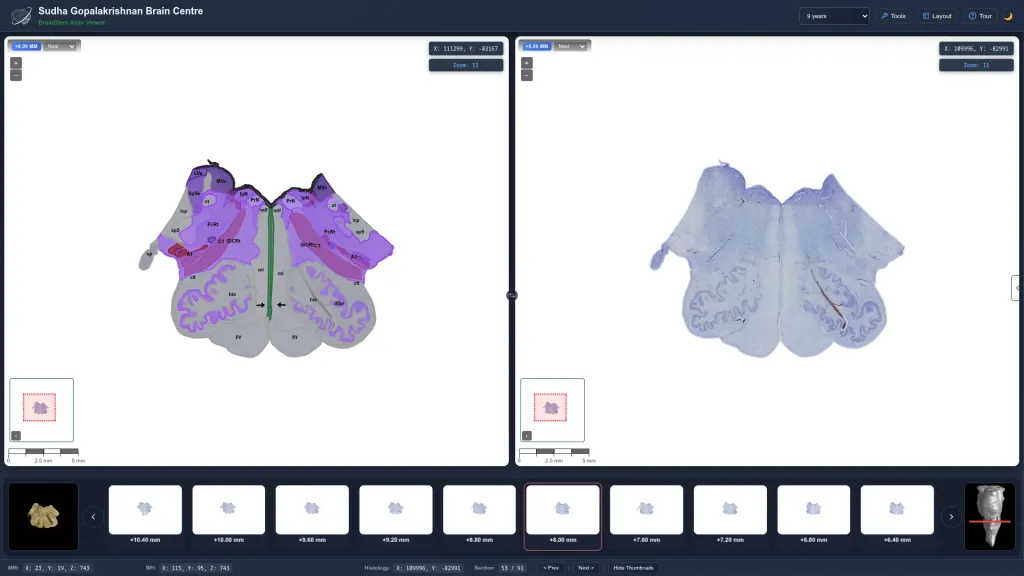
Indian scientists at the Sudha Gopalakrishnan Brain Centre have created the most detailed map of the brainstem to date. The map was created using a high-resolution microscope and a combination of MRI and BFI scans, providing vital data for neurological research. This breakthrough could help advance research on a wide range of neurological diseases, including Parkinson's and Alzheimer's.
- ▪The brainstem is a critical part of the brain, and even slight damage to it can be fatal.
- ▪The new map was created using three brainstem samples from a 45-week-old fetus, a 9-year-old, and a 54-year-old.
- ▪The research provides a 3D model of the brainstem that can be explored in a browser, giving scientists a valuable tool for studying neurological diseases.
Hackaday files mainly under tech. We currently carry 219 of its stories.
Story provenance
Source · retrieval · rights · ranking — open for full record
inspect →
Story provenance
Attribution is not the same as permission. This drawer separates discovery metadata, excerpts, WeSearch-generated summaries, reuse status, and whether the publisher receives the visit. Nothing here claims a legal grant the publisher has not made.
Record
| Original publisher | Hackaday |
| Canonical URL | https://hackaday.com/2026/07/30/best-ever-brainstem-map-created-by-indian-scientists/ |
| Publication time | Fri, 31 Jul 2026 02:00:12 +0000 |
| Retrieval time | 2026-07-31T02:02:32.941Z |
| Last seen | 2026-07-31T02:02:32.941Z |
| Headline source | Publisher (no WeSearch rewrite) |
| Excerpt source | publisher body |
| Excerpt method | First ~120 words (~800 chars) of extracted publisher body, fair-use limited. |
| Summary | WeSearch · cerebras-chat (WeSearch summarizer) |
| Summary source text | contentText |
| Citation coverage | Summary is a WeSearch-generated derivative; primary citation is the original publisher URL. |
| Cluster | bbrqp_sFAo4p · 1 stories |
| Cluster logic | Grouped by semantic title/content similarity across sources within a rolling window. Same-publisher template collisions are excluded from coverage comparison. |
| Ranking reason | Story pages are not engagement-ranked. Hub feeds use recency, with optional source-diversified chronological ordering (cap consecutive stories per source). No personalized ranking. |
| Publisher visit | Yes — open original |
| Substitutes article? | No — link-out required for full text |
Rights status (four layers)
WeSearch handling by dimension
| Indexing | May the item be indexed (stored, ranked, made findable)? | Allowed |
| Snippet | May a short excerpt of the publisher's text be shown? | Allowed |
| AI summary | May WeSearch generate its own short summary of the article? | Limited |
| Retrieval / RAG | May the content be exposed for third-party retrieval-augmented generation? | Not asserted |
| Model training | May the content be used to train AI models? | Not asserted |
| Commercial reuse | May the content be reused commercially? | Not permitted |
Basis: Derived from the published RSS/Atom feed. Contact: [email protected]. Reviewed: 2026-07-24.
Opening excerpt (first ~120 words) tap to expand
Best-Ever Brainstem Map Created By Indian Scientists No comments by: Julian Scheffers July 30, 2026 Title: Copy Short Link: Copy The elusive brainstem is a small, yet critical part of our brain: the slightest damage to it could prove fatal. But how it works is not fully understood today. Indian Scientists at SGBC (Sudha Gopalakrishnan Brain Centre) work to change that by producing the most detailed map of it ever seen. Instead of more costly methods, this map was created with a high-resolution microscope. Starting with three samples, (45W fetus, 9Y and 54Y) the brain stems were imaged using MRI and BFI (Block Face Imaging), then sliced into 20/40µm pieces, imaged, annotated using in-house software and added to the dataset.
…
Excerpt limited to ~120 words for fair-use compliance. The full article is at Hackaday.
Discussion
0 commentsMore from Hackaday