Big Oil Perfected Sideways Drilling. A Startup Wants to Do the Same With Nuclear Waste
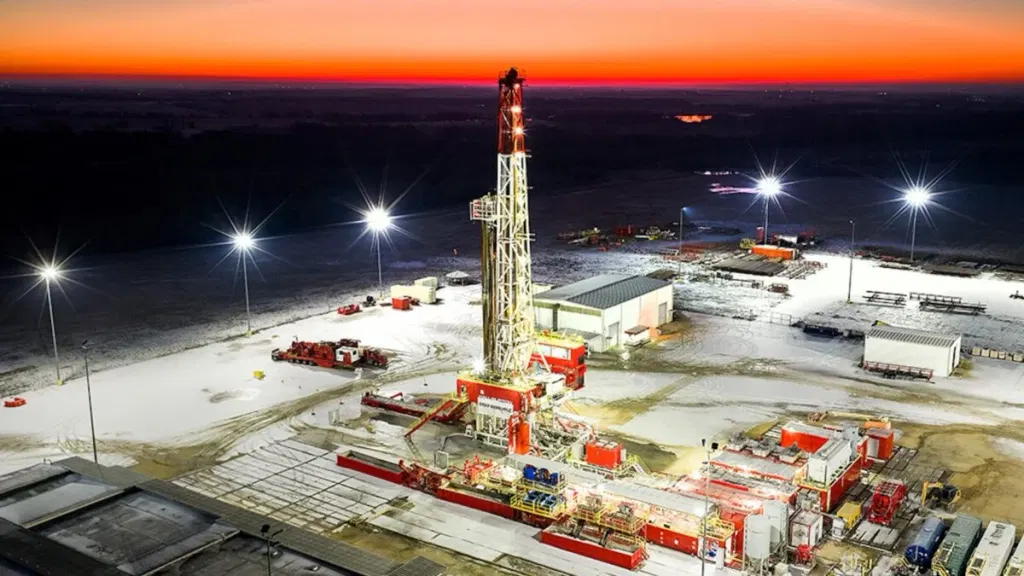
The Texas Railroad Commission has approved a permit for Deep Isolation and Halliburton to test a method of storing nuclear waste in deep horizontal boreholes. This pilot project aims to isolate radioactive canisters in geologically stable bedrock far from drinking water sources. The initiative addresses the growing volume of spent nuclear fuel in the United States, though no federal repository is currently approved.
- ▪The Texas Railroad Commission approved a permit for Deep Isolation and Halliburton to conduct a non-nuclear feasibility test near Cameron, Texas.
- ▪The proposed method involves drilling boreholes 0.75 to 2 miles deep and then drilling horizontally to store waste in stable bedrock layers.
- ▪Deep Isolation states that each horizontal borehole repository can store six years of waste from a steam-powered reactor or ten years from a pressurized water reactor.
- ▪The project is supported by an international research team and utilizes a universal canister system developed with UC Berkeley and Lawrence Berkeley National Laboratory.
- ▪Currently, there is no federally approved site in the United States for the permanent burial of nuclear waste.
Gizmodo files mainly under tech. We currently carry 1,572 of its stories.
Story provenance
Source · retrieval · rights · ranking — open for full record
inspect →
Story provenance
Attribution is not the same as permission. This drawer separates discovery metadata, excerpts, WeSearch-generated summaries, reuse status, and whether the publisher receives the visit. Nothing here claims a legal grant the publisher has not made.
Record
| Original publisher | Gizmodo |
| Canonical URL | https://gizmodo.com/big-oil-perfected-sideways-drilling-a-startup-wants-to-do-the-same-with-nuclear-waste-2000820952 |
| Publication time | Fri, 02 Oct 2026 18:55:36 +0000 |
| Retrieval time | 2026-10-02T19:01:16.624Z |
| Last seen | 2026-10-02T19:01:16.624Z |
| Headline source | Publisher (no WeSearch rewrite) |
| Excerpt source | publisher body |
| Excerpt method | First ~120 words (~800 chars) of extracted publisher body, fair-use limited. |
| Summary | WeSearch · cerebras-chat (WeSearch summarizer) |
| Summary source text | contentText |
| Citation coverage | Summary is a WeSearch-generated derivative; primary citation is the original publisher URL. |
| Cluster | 0rmxr4sPND4X · 1 stories |
| Cluster logic | Grouped by semantic title/content similarity across sources within a rolling window. Same-publisher template collisions are excluded from coverage comparison. |
| Ranking reason | Story pages are not engagement-ranked. Hub feeds use recency, with optional source-diversified chronological ordering (cap consecutive stories per source). No personalized ranking. |
| Publisher visit | Yes — open original |
| Substitutes article? | No — link-out required for full text |
Rights status (four layers)
WeSearch handling by dimension
| Indexing | May the item be indexed (stored, ranked, made findable)? | Allowed |
| Snippet | May a short excerpt of the publisher's text be shown? | Allowed |
| AI summary | May WeSearch generate its own short summary of the article? | Limited |
| Retrieval / RAG | May the content be exposed for third-party retrieval-augmented generation? | Not asserted |
| Model training | May the content be used to train AI models? | Not asserted |
| Commercial reuse | May the content be reused commercially? | Not permitted |
Basis: Derived from the published RSS/Atom feed. Contact: [email protected]. Reviewed: 2026-07-24.
Opening excerpt (first ~120 words) tap to expand
The thorny puzzle of how to store nuclear waste that will pose a danger to humanity for at least the next 10,000 years has historically been the kind of thing that governments turn to science fiction to help solve. Back in the 1980s, for example, the Department of Energy (DOE) considered burying spent radioactive fuel within eldritch concrete monuments—isolated foreboding structures built to last as long as Stonehenge, with ominous pictograms and even a new cross-cultural mythology inspired by the ideas of Isaac Asimov and Arsen…
Excerpt limited to ~120 words for fair-use compliance. The full article is at Gizmodo.
Discussion
0 commentsMore from Gizmodo