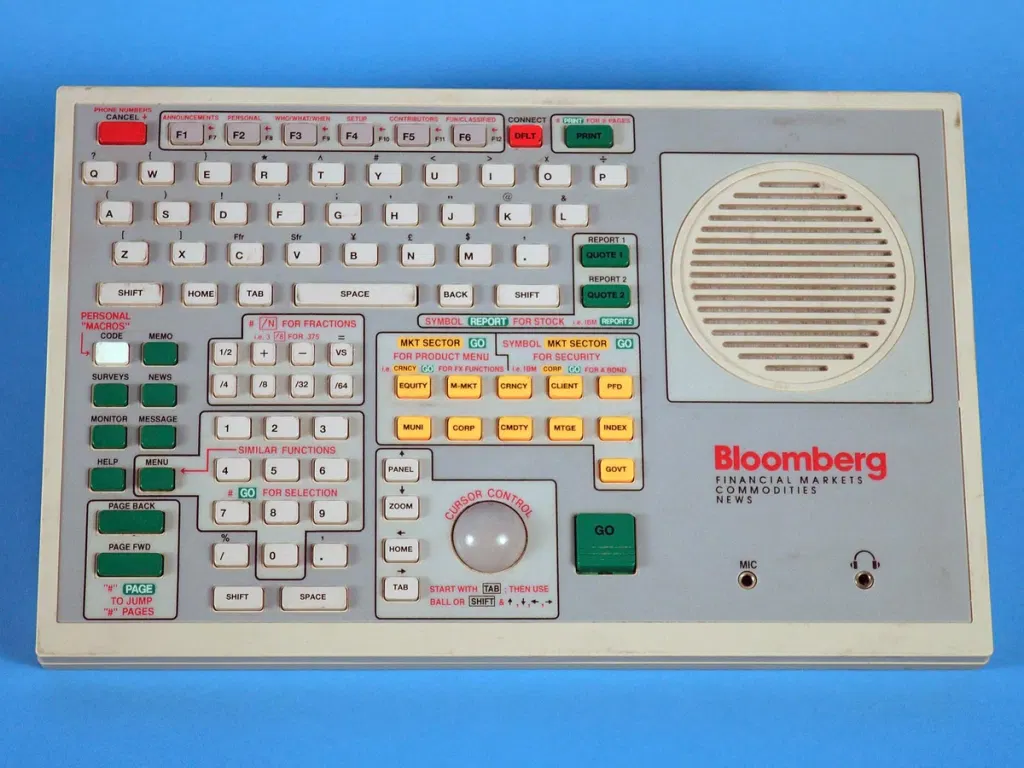
Bloomberg Terminals in repose
The article explores the history and design evolution of the Bloomberg Terminal, highlighting its origins as a specialized tool for financial traders in the 1980s. It details how the device relied on a proprietary closed network and distinctive hardware, such as the hand-assembled 'Chiclet' keyboard, before transitioning to more standard designs as the internet became commercially available. The piece reflects on how the shift to software-based access has altered the material culture and symbolic power associated with financial work.
- ▪The original Bloomberg Terminal keyboard, known as the Chiclet, was hand-assembled and connected to a dedicated phone line rather than the commercial internet.
- ▪Bloomberg built its own closed network with centralized computers to process data because the internet was not yet commercially available in the 1980s.
- ▪The company switched to a more standard keyboard design in 1994 as industry standards converged toward the Internet.
- ▪A current Bloomberg Terminal subscription costs upwards of $32,000 per year and includes the hardware for free.
- ▪The transition to Open Bloomberg allowed users to work from any location, reducing the dependency on fixed physical terminals.
2 outlets in our directory ran this story, first to last over 9 hours. All of the coverage we found sits in one bucket: centre. That one-sidedness is itself worth noticing.
- ▪ A Brief History of the Bloomberg Terminal — IEEE Spectrum
Boing Boing files mainly under tech. We currently carry 701 of its stories.
Story provenance
Source · retrieval · rights · ranking — open for full record
inspect →
Story provenance
Attribution is not the same as permission. This drawer separates discovery metadata, excerpts, WeSearch-generated summaries, reuse status, and whether the publisher receives the visit. Nothing here claims a legal grant the publisher has not made.
Record
| Original publisher | Boing Boing |
| Canonical URL | https://boingboing.net/2026/09/30/bloomberg-terminals-in-repose.html |
| Publication time | Thu, 01 Oct 2026 00:11:04 +0000 |
| Retrieval time | 2026-10-01T01:02:06.009Z |
| Last seen | 2026-10-01T01:02:06.009Z |
| Headline source | Publisher (no WeSearch rewrite) |
| Excerpt source | publisher body |
| Excerpt method | First ~120 words (~800 chars) of extracted publisher body, fair-use limited. |
| Summary | WeSearch · cerebras-chat (WeSearch summarizer) |
| Summary source text | contentText |
| Citation coverage | Summary is a WeSearch-generated derivative; primary citation is the original publisher URL. |
| Cluster | i8_80b6886N3 · 2 stories |
| Cluster logic | Grouped by semantic title/content similarity across sources within a rolling window. Same-publisher template collisions are excluded from coverage comparison. |
| Ranking reason | Story pages are not engagement-ranked. Hub feeds use recency, with optional source-diversified chronological ordering (cap consecutive stories per source). No personalized ranking. |
| Publisher visit | Yes — open original |
| Substitutes article? | No — link-out required for full text |
Rights status (four layers)
WeSearch handling by dimension
| Indexing | May the item be indexed (stored, ranked, made findable)? | Allowed |
| Snippet | May a short excerpt of the publisher's text be shown? | Allowed |
| AI summary | May WeSearch generate its own short summary of the article? | Limited |
| Retrieval / RAG | May the content be exposed for third-party retrieval-augmented generation? | Not asserted |
| Model training | May the content be used to train AI models? | Not asserted |
| Commercial reuse | May the content be reused commercially? | Not permitted |
Basis: Derived from the published RSS/Atom feed. Contact: [email protected]. Reviewed: 2026-07-24.
Opening excerpt (first ~120 words) tap to expand
Bloomberg Terminals in repose Rob Beschizza 5:11 pm Wed Sep 30, 2026 An early 90s terminal. Photo: National Museum of American History/Smithsonian Institution Back in the day, when writing on the Internet was new and cool, I wanted a keyboard that had specialized keys for useful tasks such as multiple copy/paste, blockquote wrapping, and the all-important Curators' Code symbols. In essence, a Bloomberg Terminal for blogging. A Blogberg terminal! For IEEE Spectrum, Allison Marsh offers A Brief History of the Bloomberg Terminal and how it first empowered traders and analysts in the 1980s. The Bloomberg Terminal's keyboard was designed with traders and analysts in mind. The function keys were color-coded and given labels specifying their usage, so that users didn't have to remember.
…
Excerpt limited to ~120 words for fair-use compliance. The full article is at Boing Boing.
Discussion
0 commentsMore from Boing Boing