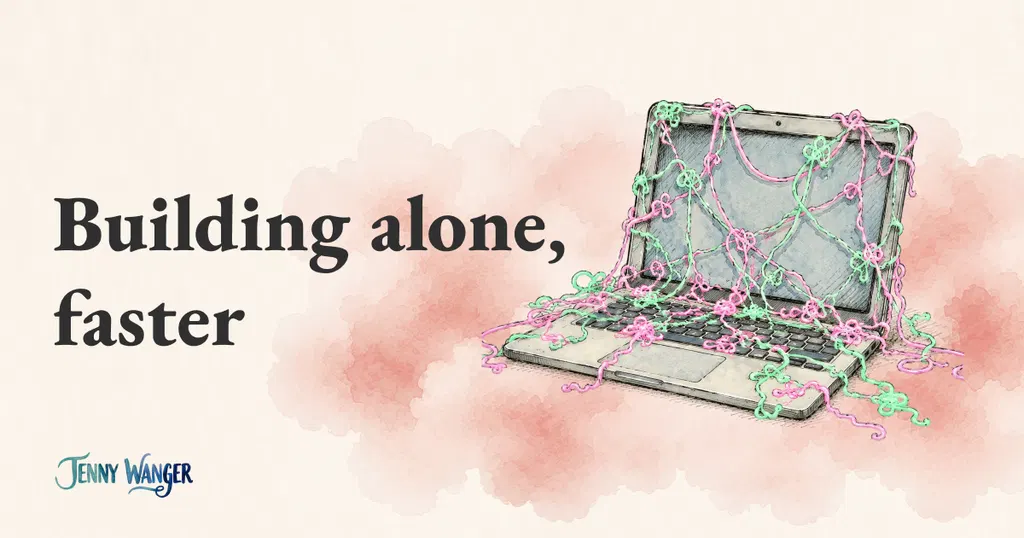
Building alone, faster: a panel on what AI is doing to the product trio
A recent panel in Denver explored how AI is causing product designers, engineers, and product managers to work in isolation rather than as a collaborative trio. Panelists discussed the immediate speed benefits of individual AI usage but warned that this approach creates significant technical and design debt. The consensus suggests that while AI allows for faster prototyping, successful long-term product development still requires distinct disciplinary expertise and collaboration.
- ▪The panel was hosted by AI & Product Colorado in Denver on September 14, 2026, to discuss the blurring of roles between PMs, designers, and engineers due to AI.
- ▪Panelist Jake Taylor argued that despite AI tools, the traditional trio of disciplines is still necessary to build successful products and respect professional boundaries.
- ▪Jason Fletchall noted that AI allows fractional consultants to handle initial customer discovery and prototyping without immediate developer involvement, but dedicated teams are needed for scaling.
- ▪Jenny Wanger highlighted that the tendency to defer collaboration to later stages creates significant debt, as individuals prioritize immediate speed over comprehensive team input.
Hacker News (AI / LLM) files mainly under ai. We currently carry 7,810 of its stories.
Story provenance
Source · retrieval · rights · ranking — open for full record
inspect →
Story provenance
Attribution is not the same as permission. This drawer separates discovery metadata, excerpts, WeSearch-generated summaries, reuse status, and whether the publisher receives the visit. Nothing here claims a legal grant the publisher has not made.
Record
| Original publisher | Jenny Wanger |
| Canonical URL | https://jennywanger.com/articles/building-alone-faster/ |
| Publication time | Thu, 08 Oct 2026 01:44:29 +0000 |
| Retrieval time | 2026-10-08T01:54:49.869Z |
| Last seen | 2026-10-08T01:54:49.869Z |
| Headline source | Publisher (no WeSearch rewrite) |
| Excerpt source | publisher body |
| Excerpt method | First ~120 words (~800 chars) of extracted publisher body, fair-use limited. |
| Summary | WeSearch · cerebras-chat (WeSearch summarizer) |
| Summary source text | contentText |
| Citation coverage | Summary is a WeSearch-generated derivative; primary citation is the original publisher URL. |
| Cluster | 6NxakJjQULwy · 1 stories |
| Cluster logic | Grouped by semantic title/content similarity across sources within a rolling window. Same-publisher template collisions are excluded from coverage comparison. |
| Ranking reason | Story pages are not engagement-ranked. Hub feeds use recency, with optional source-diversified chronological ordering (cap consecutive stories per source). No personalized ranking. |
| Publisher visit | Yes — open original |
| Substitutes article? | No — link-out required for full text |
Rights status (four layers)
WeSearch handling by dimension
| Indexing | May the item be indexed (stored, ranked, made findable)? | Allowed |
| Snippet | May a short excerpt of the publisher's text be shown? | Allowed |
| AI summary | May WeSearch generate its own short summary of the article? | Limited |
| Retrieval / RAG | May the content be exposed for third-party retrieval-augmented generation? | Not asserted |
| Model training | May the content be used to train AI models? | Not asserted |
| Commercial reuse | May the content be reused commercially? | Not permitted |
Basis: Derived from the published RSS/Atom feed. Contact: [email protected]. Reviewed: 2026-07-24.
Opening excerpt (first ~120 words) tap to expand
Building alone, faster: a panel on what AI is doing to the product trio October 1, 2026 AI is still single-player. A Denver panel on what that’s doing to designers, engineers, and PMs. On September 14 I joined a panel in Denver called “Blurred Lines,” hosted by AI & Product Colorado. The premise came from our moderator, Lauri Hofherr. Over the past year she kept meeting engineers writing PRDs, product managers coding prototypes, and designers doing all of the above. She’d billed the event as “Everyone’s a little bit PM now.” To kick things off, she read one of my LinkedIn posts back to the room: Design: Why do PMs think what AI built is usable?Engineering: Why do designers think what AI built is shippable?PMs: Why does engineering not want to move faster and code with AI? AI is still…
Excerpt limited to ~120 words for fair-use compliance. The full article is at Jenny Wanger.
Discussion
0 commentsMore from Jenny Wanger