
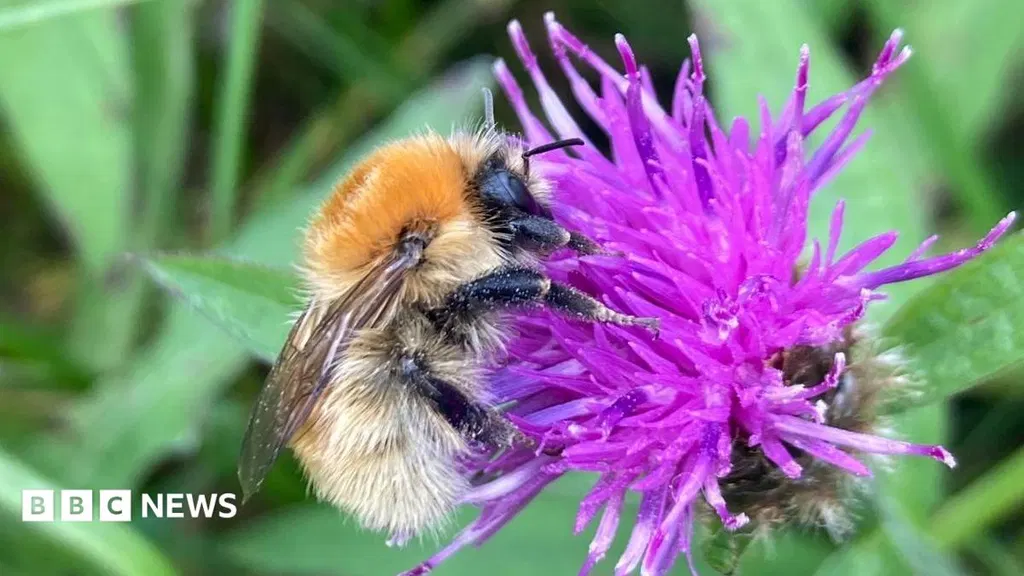
Bumblebee project seeking to help rare species
The Bumblebee Conservation Trust and the University of Cambridge have launched a £907,000 three-year project to recover the rare Moss carder bumblebee. The initiative will focus on specific landscapes in Cornwall, Kent, and the North Pennines to trial habitat interventions and study the species' behavior. This effort is supported by over £530,000 in funding from Natural England's Species Recovery Programme.
- ▪The project aims to recover the Moss carder, which is described as one of the UK's most threatened bumblebee species.
- ▪Funding for the scheme totals £907,000, with more than £530,000 provided by Natural England's Species Recovery Programme.
- ▪The conservation work will take place in Cornwall, Kent, and the North Pennines over a three-year period.
- ▪Moss carder bumblebees are particularly vulnerable to habitat loss because they typically forage closer to their nests than other species.
- ▪The project involves working with landowners to trial small-scale habitat interventions to support the species.
BBC News — Science publishes from United Kingdom and files mainly under science. We currently carry 267 of its stories.
Story provenance
Source · retrieval · rights · ranking — open for full record
inspect →
Story provenance
Attribution is not the same as permission. This drawer separates discovery metadata, excerpts, WeSearch-generated summaries, reuse status, and whether the publisher receives the visit. Nothing here claims a legal grant the publisher has not made.
Record
| Original publisher | BBC News — Science |
| Canonical URL | https://www.bbc.co.uk/news/articles/cmq5x129zqx1o?at_medium=RSS&at_campaign=rss |
| Publication time | Sun, 27 Sep 2026 06:12:48 GMT |
| Retrieval time | 2026-09-27T06:15:40.988Z |
| Last seen | 2026-09-27T06:15:40.988Z |
| Headline source | Publisher (no WeSearch rewrite) |
| Excerpt source | publisher body |
| Excerpt method | First ~120 words (~800 chars) of extracted publisher body, fair-use limited. |
| Summary | WeSearch · cerebras-chat (WeSearch summarizer) |
| Summary source text | contentText |
| Citation coverage | Summary is a WeSearch-generated derivative; primary citation is the original publisher URL. |
| Cluster | 9FueBtk4CKLd · 1 stories |
| Cluster logic | Grouped by semantic title/content similarity across sources within a rolling window. Same-publisher template collisions are excluded from coverage comparison. |
| Ranking reason | Story pages are not engagement-ranked. Hub feeds use recency, with optional source-diversified chronological ordering (cap consecutive stories per source). No personalized ranking. |
| Publisher visit | Yes — open original |
| Substitutes article? | No — link-out required for full text |
Rights status (four layers)
WeSearch handling by dimension
| Indexing | May the item be indexed (stored, ranked, made findable)? | Allowed |
| Snippet | May a short excerpt of the publisher's text be shown? | Allowed |
| AI summary | May WeSearch generate its own short summary of the article? | Limited |
| Retrieval / RAG | May the content be exposed for third-party retrieval-augmented generation? | Not asserted |
| Model training | May the content be used to train AI models? | Not asserted |
| Commercial reuse | May the content be reused commercially? | Not permitted |
Basis: Derived from the published RSS/Atom feed. Contact: [email protected]. Reviewed: 2026-07-24.
Opening excerpt (first ~120 words) tap to expand
Bumblebee project seeking to help rare speciesImage source, Bumblebee Conservation TrustImage caption, The project will focus on Cornwall, Kent and the North PenninesByChloe ParkmanSouth WestPublished2 minutes agoA project is under way to try and help one of the UK's "most threatened" species of bumblebee.The Bumblebee Conservation Trust is leading a £907,000 three-year scheme alongside the University of Cambridge to recover the Moss carder species.It said the initiative would focus on landscapes across Cornwall's coastal grasslands, dunes and heathland as well as grazing marshes and sea walls in Kent and the upland fringe landscape of the North Pennines.During the project, the trust said it would work with landowners to trial "small-scale habitat interventions" to identify those which…
Excerpt limited to ~120 words for fair-use compliance. The full article is at BBC News — Science.
Discussion
0 commentsMore from BBC News — Science


