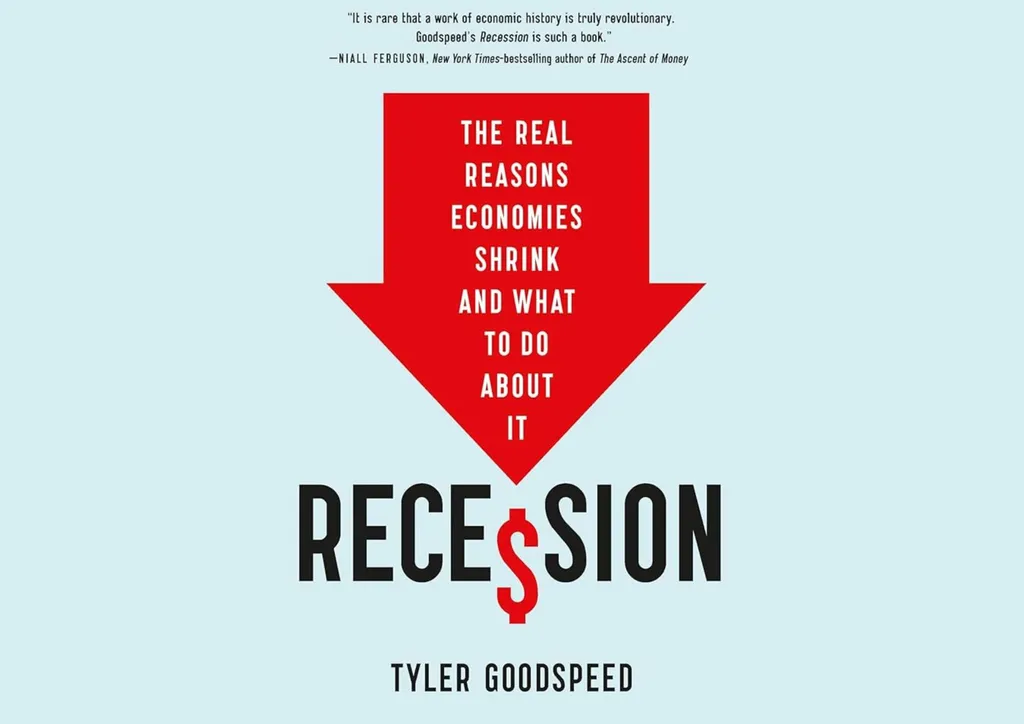
Busting up the Boom-Bust Cycle
Tyler Goodspeed's book 'Recession: The Real Reasons Economies Shrink and What to Do About It' challenges the traditional concept of the business cycle, arguing that economic contractions are not cyclical but driven by external shocks and government missteps. He contends that recessions are better understood as unique events rather than predictable phases of a repeating pattern. Goodspeed also suggests that narrative biases influence how we interpret economic downturns as necessary corrections.
- ▪Tyler Goodspeed argues that recessions are typically caused by unforeseen external shocks such as wars, pandemics, or natural disasters.
- ▪He claims that government interventions often exacerbate economic contractions rather than mitigate them.
- ▪Goodspeed finds little evidence of consistent business cycle patterns in historical economic data.
- ▪He critiques the reliability of traditional business cycle indicators developed by the National Bureau of Economic Research.
- ▪The book suggests that cultural narratives shape the belief that recessions serve a cleansing function in the economy.
Washington Free Beacon files mainly under politics. We currently carry 146 of its stories.
Story provenance
Source · retrieval · rights · ranking — open for full record
inspect →
Story provenance
Attribution is not the same as permission. This drawer separates discovery metadata, excerpts, WeSearch-generated summaries, reuse status, and whether the publisher receives the visit. Nothing here claims a legal grant the publisher has not made.
Record
| Original publisher | Washington Free Beacon |
| Canonical URL | https://freebeacon.com/culture/busting-up-the-boom-bust-cycle/ |
| Publication time | Sun, 17 May 2026 09:01:53 +0000 |
| Retrieval time | 2026-05-17T09:07:12.954Z |
| Last seen | 2026-05-17T09:07:12.954Z |
| Headline source | Publisher (no WeSearch rewrite) |
| Excerpt source | publisher body |
| Excerpt method | First ~120 words (~800 chars) of extracted publisher body, fair-use limited. |
| Summary | WeSearch · cerebras-chat (WeSearch summarizer) |
| Summary source text | contentText |
| Citation coverage | Summary is a WeSearch-generated derivative; primary citation is the original publisher URL. |
| Cluster | kwbTsiLGEcyJ |
| Cluster logic | Grouped by semantic title/content similarity across sources within a rolling window. Same-publisher template collisions are excluded from coverage comparison. |
| Ranking reason | Story pages are not engagement-ranked. Hub feeds use recency, with optional source-diversified chronological ordering (cap consecutive stories per source). No personalized ranking. |
| Publisher visit | Yes — open original |
| Substitutes article? | No — link-out required for full text |
Rights status (four layers)
WeSearch handling by dimension
| Indexing | May the item be indexed (stored, ranked, made findable)? | Allowed |
| Snippet | May a short excerpt of the publisher's text be shown? | Allowed |
| AI summary | May WeSearch generate its own short summary of the article? | Limited |
| Retrieval / RAG | May the content be exposed for third-party retrieval-augmented generation? | Not asserted |
| Model training | May the content be used to train AI models? | Not asserted |
| Commercial reuse | May the content be reused commercially? | Not permitted |
Basis: Derived from the published RSS/Atom feed. Contact: [email protected]. Reviewed: 2026-07-24.
Opening excerpt (first ~120 words) tap to expand
Culture Busting up the Boom-Bust Cycle REVIEW: ‘Recession: The Real Reasons Economies Shrink and What to Do About It’ by Tyler Goodspeed Samuel Gregg May 17, 2026 image/svg+xml .st0{fill:none;stroke:#384f61;stroke-width:2;stroke-linecap:round;stroke-linejoin:round;stroke-miterlimit:10;} .st1{fill:none;stroke:#384f61;stroke-width:2;stroke-linejoin:round;stroke-miterlimit:10;} Throughout the 1920s and '30s, many economists were preoccupied by a topic given poignancy by the dramatic economic ups and downs experienced by most Western countries following the carnage of the First World War.
…
Excerpt limited to ~120 words for fair-use compliance. The full article is at Washington Free Beacon.
Discussion
0 commentsMore from Washington Free Beacon