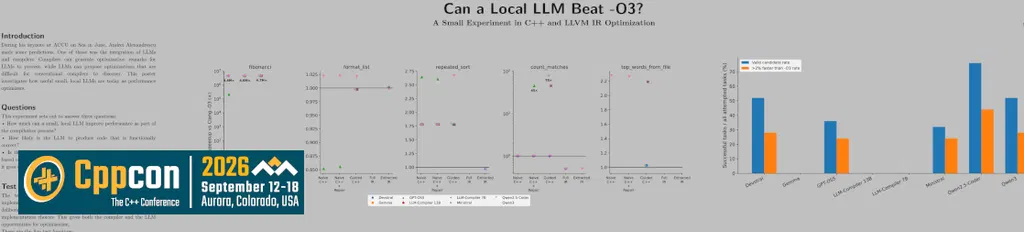
Can a local LLM beat -O3?
Tijl Vercaemer explores the potential of local Large Language Models to enhance code optimization by integrating them into the Clang/LLVM compilation pipeline. The study benchmarks five C++ functions to determine if LLMs can outperform standard compiler flags like -O3 in both performance and functional correctness. While the experiments reveal specific failure modes and limitations for smaller local models, the author notes that larger cloud-based models show significantly better results for LLVM IR optimization.
- ▪The experiment utilized five specific C++ benchmark functions designed to test various optimization scenarios such as recursion, string concatenation, and data structure selection.
- ▪The author found that while -O3 is a reasonable starting point, it does not always produce the most efficient binary, highlighting the need for measurement to determine optimal flags.
- ▪Local LLMs were tested on both LLVM Intermediate Representation and C++ source code to evaluate their ability to propose optimizations that conventional compilers might miss.
- ▪The author acknowledges that the initial test cases contained deliberately inefficient choices, which may have skewed results compared to code requiring more subtle low-level compiler tweaks.
- ▪A follow-up post indicates that larger cloud models perform drastically better than local models, making LLVM IR optimization a more viable approach with advanced AI.
Hacker News (AI / LLM) files mainly under ai. We currently carry 4,743 of its stories.
Story provenance
Source · retrieval · rights · ranking — open for full record
inspect →
Story provenance
Attribution is not the same as permission. This drawer separates discovery metadata, excerpts, WeSearch-generated summaries, reuse status, and whether the publisher receives the visit. Nothing here claims a legal grant the publisher has not made.
Record
| Original publisher | tijl.blog |
| Canonical URL | https://tijl.blog/posts/cppcon-local/ |
| Publication time | Mon, 14 Sep 2026 04:51:36 +0000 |
| Retrieval time | 2026-09-14T04:56:52.489Z |
| Last seen | 2026-09-14T04:56:52.489Z |
| Headline source | Publisher (no WeSearch rewrite) |
| Excerpt source | publisher body |
| Excerpt method | First ~120 words (~800 chars) of extracted publisher body, fair-use limited. |
| Summary | WeSearch · cerebras-chat (WeSearch summarizer) |
| Summary source text | contentText |
| Citation coverage | Summary is a WeSearch-generated derivative; primary citation is the original publisher URL. |
| Cluster | 7Ms8qmz38Y1O · 1 stories |
| Cluster logic | Grouped by semantic title/content similarity across sources within a rolling window. Same-publisher template collisions are excluded from coverage comparison. |
| Ranking reason | Story pages are not engagement-ranked. Hub feeds use recency, with optional source-diversified chronological ordering (cap consecutive stories per source). No personalized ranking. |
| Publisher visit | Yes — open original |
| Substitutes article? | No — link-out required for full text |
Rights status (four layers)
WeSearch handling by dimension
| Indexing | May the item be indexed (stored, ranked, made findable)? | Allowed |
| Snippet | May a short excerpt of the publisher's text be shown? | Allowed |
| AI summary | May WeSearch generate its own short summary of the article? | Limited |
| Retrieval / RAG | May the content be exposed for third-party retrieval-augmented generation? | Not asserted |
| Model training | May the content be used to train AI models? | Not asserted |
| Commercial reuse | May the content be reused commercially? | Not permitted |
Basis: Derived from the published RSS/Atom feed. Contact: [email protected]. Reviewed: 2026-07-24.
Opening excerpt (first ~120 words) tap to expand
Home Posts Can a local LLM beat -O3? September 13, 2026 · 13 min · Tijl Vercaemer Table of Contents The benchmark programs How much does the compiler matter? How I measured performance The optimization strategies The models Results What did the LLM actually do? Failure modes Limitations Conclusions During his keynote at ACCU on Sea in June, Andrei Alexandrescu made some predictions. One of those was the integration of LLMs and compilers. Compilers can generate optimization remarks for LLMs to process. And LLMs can propose optimizations that are difficult for a conventional compiler to discover. If you haven’t yet, I very much recommend you to watch Andrei’s talk.
…
Excerpt limited to ~120 words for fair-use compliance. The full article is at tijl.blog.
Discussion
0 commentsMore from tijl.blog