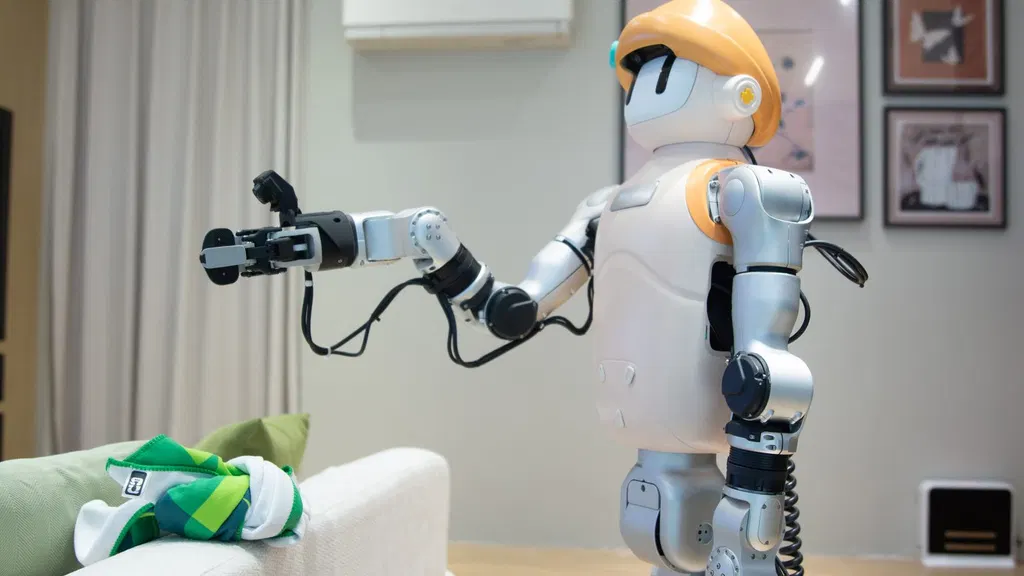
China is training a robot future — one folded shirt at a time
China is leveraging localized data collection to advance its robotics industry, focusing on training robots in real-world environments. By mobilizing large workforces to gather movement data, Chinese companies aim to overcome training bottlenecks faced by their U.S. counterparts. This approach not only enhances the development of physical AI but also provides economic opportunities for local residents.
- ▪Chinese tech companies are collecting millions of hours of human movement data in homes and factories.
- ▪JD.com plans to generate 10 million hours of robotics training data over the next two years by paying residents to film themselves doing chores.
- ▪Robotics developers are using head-mounted cameras and wrist sensors to gather data from factory workers.
Rest of World files mainly under tech. We currently carry 35 of its stories.
Story provenance
Source · retrieval · rights · ranking — open for full record
inspect →
Story provenance
Attribution is not the same as permission. This drawer separates discovery metadata, excerpts, WeSearch-generated summaries, reuse status, and whether the publisher receives the visit. Nothing here claims a legal grant the publisher has not made.
Record
| Original publisher | Rest of World |
| Canonical URL | https://restofworld.org/2026/china-ai-robotics-training-data/?utm_source=rss&utm_medium=rss&utm_campaign=feeds |
| Publication time | Wed, 03 Jun 2026 10:00:00 +0000 |
| Retrieval time | 2026-06-03T10:07:01.531Z |
| Last seen | 2026-06-03T10:07:01.531Z |
| Headline source | Publisher (no WeSearch rewrite) |
| Excerpt source | publisher body |
| Excerpt method | First ~120 words (~800 chars) of extracted publisher body, fair-use limited. |
| Summary | WeSearch · cerebras-chat (WeSearch summarizer) |
| Summary source text | contentText |
| Citation coverage | Summary is a WeSearch-generated derivative; primary citation is the original publisher URL. |
| Cluster | vw5MryOhsRJp |
| Cluster logic | Grouped by semantic title/content similarity across sources within a rolling window. Same-publisher template collisions are excluded from coverage comparison. |
| Ranking reason | Story pages are not engagement-ranked. Hub feeds use recency, with optional source-diversified chronological ordering (cap consecutive stories per source). No personalized ranking. |
| Publisher visit | Yes — open original |
| Substitutes article? | No — link-out required for full text |
Rights status (four layers)
WeSearch handling by dimension
| Indexing | May the item be indexed (stored, ranked, made findable)? | Allowed |
| Snippet | May a short excerpt of the publisher's text be shown? | Allowed |
| AI summary | May WeSearch generate its own short summary of the article? | Limited |
| Retrieval / RAG | May the content be exposed for third-party retrieval-augmented generation? | Not asserted |
| Model training | May the content be used to train AI models? | Not asserted |
| Commercial reuse | May the content be reused commercially? | Not permitted |
Basis: Derived from the published RSS/Atom feed. Contact: [email protected]. Reviewed: 2026-07-24.
Opening excerpt (first ~120 words) tap to expand
Innovation China is training a robot future — one folded shirt at a time Localized, low-cost data harvested in homes and factories gives China a scaling edge over the research-heavy and outsourced U.S. approach. Ying Tang/NurPhoto via Getty Images Ying Tang/NurPhoto via Getty Images By Viola Zhou 3 June 2026 Chinese tech companies are mobilizing massive local workforces to record millions of hours of human movement data within homes and factories.This localized, low-cost data ecosystem provides a significant scaling advantage over the research-heavy and outsourced U.S. model.By rapidly building these vast data sets, China aims to overcome global training bottlenecks and lead the development of physical AI.
…
Excerpt limited to ~120 words for fair-use compliance. The full article is at Rest of World.
Discussion
0 commentsMore from Rest of World