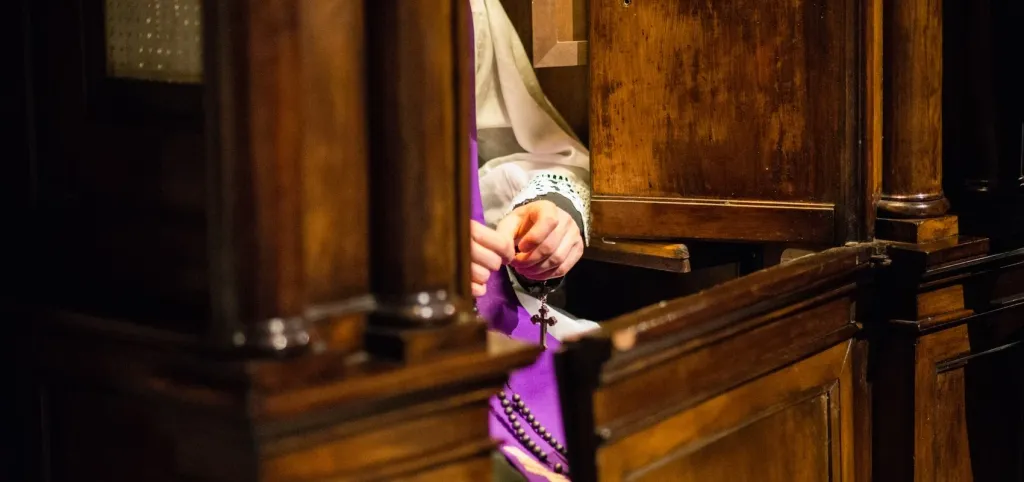
Confession Isn’t Therapy
The article discusses the decline in regular confession among Catholics since the 1970s. It highlights a shift from viewing confession as a routine spiritual practice to a more therapeutic approach focused on personal encounters and emotional processing. This change has led to many Catholics only seeking confession during significant moral crises rather than as a regular part of their spiritual lives.
- ▪Frequent confession was once a normal practice among Catholics, occurring monthly or even weekly.
- ▪The emphasis on confession shifted after the Second Vatican Council, focusing more on reconciliation and personal encounter rather than routine confession of sins.
- ▪Many Catholics now approach confession only after major moral failures, reflecting a significant change in how the sacrament is perceived.
First Things files mainly under religion. We currently carry 17 of its stories.
Story provenance
Source · retrieval · rights · ranking — open for full record
inspect →
Story provenance
Attribution is not the same as permission. This drawer separates discovery metadata, excerpts, WeSearch-generated summaries, reuse status, and whether the publisher receives the visit. Nothing here claims a legal grant the publisher has not made.
Record
| Original publisher | First Things |
| Canonical URL | https://firstthings.com/confession-isnt-therapy/ |
| Publication time | Wed, 20 May 2026 05:00:00 +0000 |
| Retrieval time | 2026-05-20T05:04:59.770Z |
| Last seen | 2026-05-20T05:04:59.770Z |
| Headline source | Publisher (no WeSearch rewrite) |
| Excerpt source | publisher body |
| Excerpt method | First ~120 words (~800 chars) of extracted publisher body, fair-use limited. |
| Summary | WeSearch · cerebras-chat (WeSearch summarizer) |
| Summary source text | contentText |
| Citation coverage | Summary is a WeSearch-generated derivative; primary citation is the original publisher URL. |
| Cluster | lUc3ttKUAKar |
| Cluster logic | Grouped by semantic title/content similarity across sources within a rolling window. Same-publisher template collisions are excluded from coverage comparison. |
| Ranking reason | Story pages are not engagement-ranked. Hub feeds use recency, with optional source-diversified chronological ordering (cap consecutive stories per source). No personalized ranking. |
| Publisher visit | Yes — open original |
| Substitutes article? | No — link-out required for full text |
Rights status (four layers)
WeSearch handling by dimension
| Indexing | May the item be indexed (stored, ranked, made findable)? | Allowed |
| Snippet | May a short excerpt of the publisher's text be shown? | Allowed |
| AI summary | May WeSearch generate its own short summary of the article? | Limited |
| Retrieval / RAG | May the content be exposed for third-party retrieval-augmented generation? | Not asserted |
| Model training | May the content be used to train AI models? | Not asserted |
| Commercial reuse | May the content be reused commercially? | Not permitted |
Basis: Derived from the published RSS/Atom feed. Contact: [email protected]. Reviewed: 2026-07-24.
Opening excerpt (first ~120 words) tap to expand
Confession Isn’t Therapy Thomas Petri May 20, 2026 Share Article Frequent confession was once normal—monthly, biweekly, or even weekly. But it became rarer among Catholics formed from the 1970s through the 1990s. Today, many Catholics go to confession only after major moral failures or when life feels spiritually overwhelming. Strictly speaking, confession is only required for mortal sins, and there was an emphasis on that fact in seminary formation and catechesis after the Second Vatican Council. Some years ago, a friend reported to me that her parish priest tersely instructed the faithful, “Don’t waste my time in the confessional with your little sins.” Historically, however, many Catholics confessed venial sins regularly.
…
Excerpt limited to ~120 words for fair-use compliance. The full article is at First Things.
Discussion
0 commentsMore from First Things