Creating a Supersonic Trebuchet
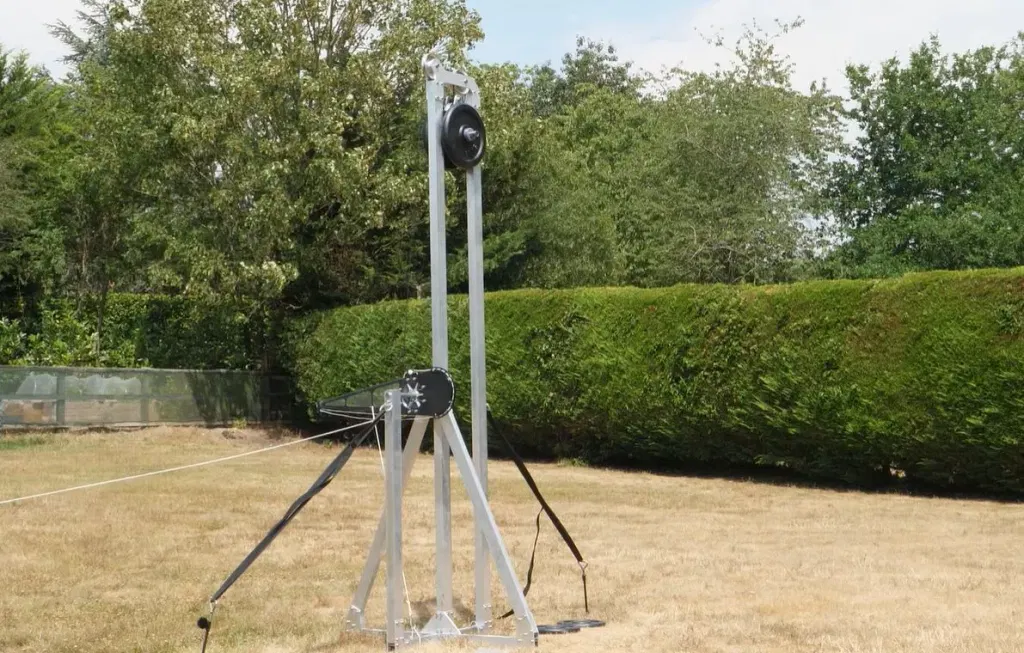
Modern engineers have modified the medieval trebuchet to achieve supersonic projectile speeds. By winding the projectile rope around the arm and adding a gearing system, the launch mechanism required a precise 0.0025‑second release window controlled by a drum latch. Tests with a 40 kg weight and a 4‑gram projectile finally broke the sound barrier, reaching 1,249 km/h.
- ▪The trebuchet was upgraded with a rope‑wound arm and a gearing system to improve energy transfer.
- ▪A latch inside the drum releases the projectile when enough rope unwinds, requiring a 0.0025 second release window.
- ▪Initial tests with a 10 kg weight reached 528 km/h and later 634 km/h, while a 40 kg weight initially fell short of supersonic speed at 1,152 km/h.
- ▪After redesigns, a 40 kg weight and 4 gram projectile achieved 2,342 rpm arm speed and a launch velocity of 1,249 km/h, breaking the sound barrier.
Hackaday files mainly under tech. We currently carry 309 of its stories.
Story provenance
Source · retrieval · rights · ranking — open for full record
inspect →
Story provenance
Attribution is not the same as permission. This drawer separates discovery metadata, excerpts, WeSearch-generated summaries, reuse status, and whether the publisher receives the visit. Nothing here claims a legal grant the publisher has not made.
Record
| Original publisher | Hackaday |
| Canonical URL | https://hackaday.com/2026/08/09/creating-a-supersonic-trebuchet/ |
| Publication time | Mon, 10 Aug 2026 05:00:41 +0000 |
| Retrieval time | 2026-08-10T05:05:47.409Z |
| Last seen | 2026-08-10T05:05:47.409Z |
| Headline source | Publisher (no WeSearch rewrite) |
| Excerpt source | publisher body |
| Excerpt method | First ~120 words (~800 chars) of extracted publisher body, fair-use limited. |
| Summary | WeSearch · cerebras-chat (WeSearch summarizer) |
| Summary source text | contentText |
| Citation coverage | Summary is a WeSearch-generated derivative; primary citation is the original publisher URL. |
| Cluster | 2U1EmFrHV-l1 · 1 stories |
| Cluster logic | Grouped by semantic title/content similarity across sources within a rolling window. Same-publisher template collisions are excluded from coverage comparison. |
| Ranking reason | Story pages are not engagement-ranked. Hub feeds use recency, with optional source-diversified chronological ordering (cap consecutive stories per source). No personalized ranking. |
| Publisher visit | Yes — open original |
| Substitutes article? | No — link-out required for full text |
Rights status (four layers)
WeSearch handling by dimension
| Indexing | May the item be indexed (stored, ranked, made findable)? | Allowed |
| Snippet | May a short excerpt of the publisher's text be shown? | Allowed |
| AI summary | May WeSearch generate its own short summary of the article? | Limited |
| Retrieval / RAG | May the content be exposed for third-party retrieval-augmented generation? | Not asserted |
| Model training | May the content be used to train AI models? | Not asserted |
| Commercial reuse | May the content be reused commercially? | Not permitted |
Basis: Derived from the published RSS/Atom feed. Contact: [email protected]. Reviewed: 2026-07-24.
Opening excerpt (first ~120 words) tap to expand
Creating A Supersonic Trebuchet No comments by: Maya Posch August 9, 2026 Title: Copy Short Link: Copy As awesome as trebuchets are, the fact that medieval engineers didn’t create versions capable of launching supersonic projectiles is a bit of a bummer. Fortunately it’s possible to correct this oversight with modern insights and technologies, as [Tom Stanton] demonstrates in a recent video. While a traditional trebuchet is fairly straightforward, using a heavy weight moving an arm around a pivot that has the projectile attached to the other side, a few tweaks can make it much more lethal. One change is to have the projectile’s rope wound around the arm, forcing an additional pass around the arm to gain velocity.
…
Excerpt limited to ~120 words for fair-use compliance. The full article is at Hackaday.
Discussion
0 commentsMore from Hackaday