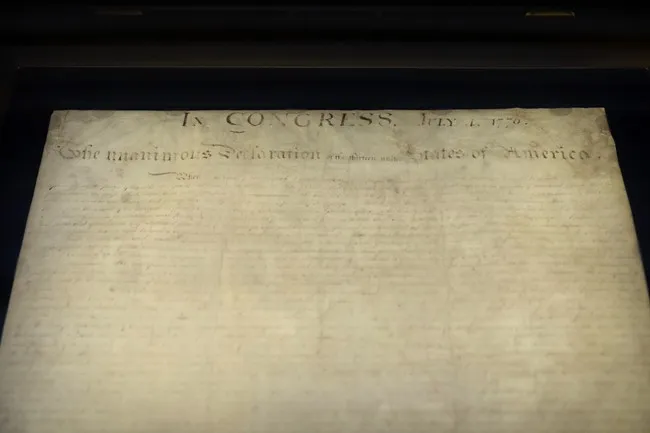
Did Thomas Jefferson Come Up With 'Life, Liberty and the Pursuit of Happiness'? No, John Locke Did.
The phrase 'life, liberty and the pursuit of happiness' is often attributed to Thomas Jefferson, but its origins can be traced back to John Locke. Jefferson acknowledged that his work on the Declaration of Independence was influenced by Locke's writings, particularly his ideas on natural rights and government. Locke's philosophy emphasized the importance of property and the formation of communities for the preservation of life and liberty.
- ▪Thomas Jefferson borrowed ideas from John Locke when writing the Declaration of Independence.
- ▪Locke's philosophy highlighted the significance of natural rights and the role of government in protecting them.
- ▪Jefferson aimed to express the common sentiments of his time rather than introduce entirely new principles.
PJ Media files mainly under politics. We currently carry 676 of its stories.
Story provenance
Source · retrieval · rights · ranking — open for full record
inspect →
Story provenance
Attribution is not the same as permission. This drawer separates discovery metadata, excerpts, WeSearch-generated summaries, reuse status, and whether the publisher receives the visit. Nothing here claims a legal grant the publisher has not made.
Record
| Original publisher | PJ Media |
| Canonical URL | https://pjmedia.com/david-barrow/2026/06/03/did-thomas-jefferson-come-up-with-life-liberty-and-the-pursuit-of-happiness-no-john-locke-did-n4953555 |
| Publication time | Wed, 03 Jun 2026 23:55:10 -0400 |
| Retrieval time | 2026-06-04T04:55:14.523Z |
| Last seen | 2026-06-04T04:55:34.876Z |
| Headline source | Publisher (no WeSearch rewrite) |
| Excerpt source | publisher body |
| Excerpt method | First ~120 words (~800 chars) of extracted publisher body, fair-use limited. |
| Summary | WeSearch · cerebras-chat (WeSearch summarizer) |
| Summary source text | contentText |
| Citation coverage | Summary is a WeSearch-generated derivative; primary citation is the original publisher URL. |
| Cluster | L5hEYkhPh9rZ |
| Cluster logic | Grouped by semantic title/content similarity across sources within a rolling window. Same-publisher template collisions are excluded from coverage comparison. |
| Ranking reason | Story pages are not engagement-ranked. Hub feeds use recency, with optional source-diversified chronological ordering (cap consecutive stories per source). No personalized ranking. |
| Publisher visit | Yes — open original |
| Substitutes article? | No — link-out required for full text |
Rights status (four layers)
WeSearch handling by dimension
| Indexing | May the item be indexed (stored, ranked, made findable)? | Allowed |
| Snippet | May a short excerpt of the publisher's text be shown? | Allowed |
| AI summary | May WeSearch generate its own short summary of the article? | Limited |
| Retrieval / RAG | May the content be exposed for third-party retrieval-augmented generation? | Not asserted |
| Model training | May the content be used to train AI models? | Not asserted |
| Commercial reuse | May the content be reused commercially? | Not permitted |
Basis: Derived from the published RSS/Atom feed. Contact: [email protected]. Reviewed: 2026-07-24.
Opening excerpt (first ~120 words) tap to expand
Did Thomas Jefferson Come Up With 'Life, Liberty and the Pursuit of Happiness'? No, John Locke Did. David Churchill Barrow | 11:55 PM on June 03, 2026 AP Photo/Mark Schiefelbein "We hold these truths to be self-evident, that all men are created equal, that they are endowed by their Creator with certain unalienable rights, that among these are life, liberty and the pursuit of happiness." Advertisement googletag.cmd.push(function () { googletag.display("div-gpt-300x250_3"); //googletag.pubads().refresh([gptAdSlot["div-gpt-300x250_3"]]) }); Thomas Jefferson thought of Francis Bacon, John Locke, and Isaac Newton as “the greatest three people who ever lived, without exception.” All three have portraits hanging in Monticello.
…
Excerpt limited to ~120 words for fair-use compliance. The full article is at PJ Media.
Discussion
0 commentsMore from PJ Media