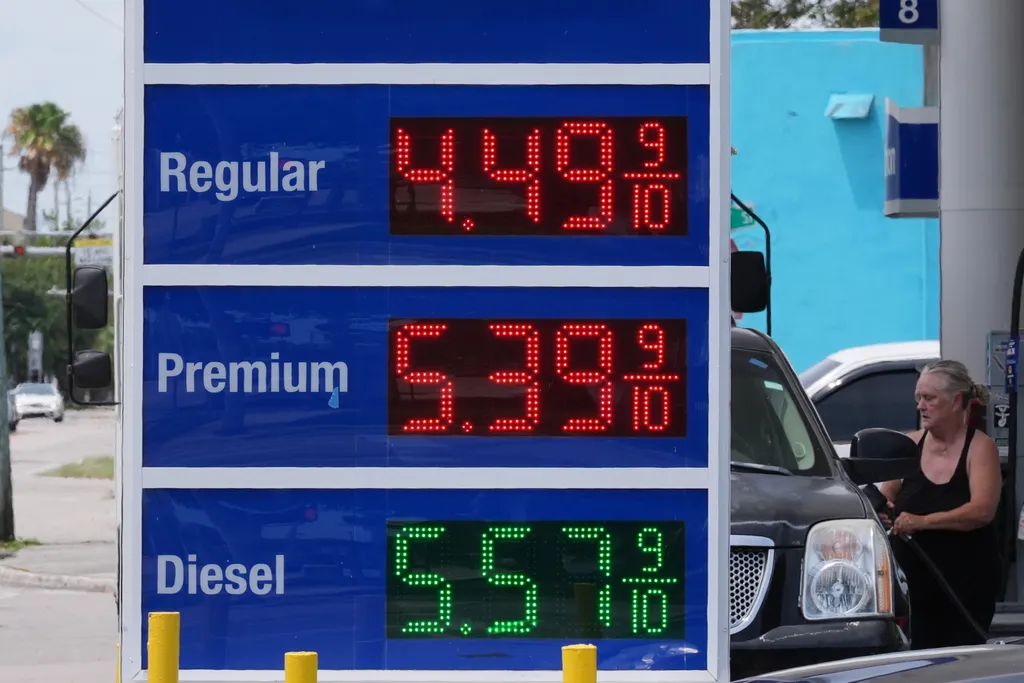
Don't Blame Credit Card Fees for Pain at the Pump
Gas prices are currently high, nearing $4.50 per gallon. While some attribute this to credit card fees, the reality is that geopolitical issues and climate litigation play a more significant role. Policymakers are urged to focus on these real causes rather than imposing regulations on credit card fees, which could harm consumers.
- ▪Gas prices are nearly $4.50 per gallon according to the American Automobile Association.
- ▪Credit card interchange fees are a minor component of gas prices and do not significantly impact overall costs.
- ▪Policymakers are encouraged to address the real causes of high gas prices, such as climate litigation, rather than focusing on credit card fees.
Real Clear Policy files mainly under politics. We currently carry 170 of its stories.
Story provenance
Source · retrieval · rights · ranking — open for full record
inspect →
Story provenance
Attribution is not the same as permission. This drawer separates discovery metadata, excerpts, WeSearch-generated summaries, reuse status, and whether the publisher receives the visit. Nothing here claims a legal grant the publisher has not made.
Record
| Original publisher | Real Clear Policy |
| Canonical URL | https://www.realclearpolicy.com/2026/05/27/dont_blame_credit_card_fees_for_pain_at_the_pump_1185114.html |
| Publication time | Wed, 27 May 2026 08:16:05 -0500 |
| Retrieval time | 2026-05-27T13:18:00.799Z |
| Last seen | 2026-05-27T13:18:00.799Z |
| Headline source | Publisher (no WeSearch rewrite) |
| Excerpt source | publisher body |
| Excerpt method | First ~120 words (~800 chars) of extracted publisher body, fair-use limited. |
| Summary | WeSearch · cerebras-chat (WeSearch summarizer) |
| Summary source text | contentText |
| Citation coverage | Summary is a WeSearch-generated derivative; primary citation is the original publisher URL. |
| Cluster | 0PsJ3Swyp1hS |
| Cluster logic | Grouped by semantic title/content similarity across sources within a rolling window. Same-publisher template collisions are excluded from coverage comparison. |
| Ranking reason | Story pages are not engagement-ranked. Hub feeds use recency, with optional source-diversified chronological ordering (cap consecutive stories per source). No personalized ranking. |
| Publisher visit | Yes — open original |
| Substitutes article? | No — link-out required for full text |
Rights status (four layers)
WeSearch handling by dimension
| Indexing | May the item be indexed (stored, ranked, made findable)? | Allowed |
| Snippet | May a short excerpt of the publisher's text be shown? | Allowed |
| AI summary | May WeSearch generate its own short summary of the article? | Limited |
| Retrieval / RAG | May the content be exposed for third-party retrieval-augmented generation? | Not asserted |
| Model training | May the content be used to train AI models? | Not asserted |
| Commercial reuse | May the content be reused commercially? | Not permitted |
Basis: Derived from the published RSS/Atom feed. Contact: [email protected]. Reviewed: 2026-07-24.
Opening excerpt (first ~120 words) tap to expand
Gas prices are extraordinarily high—and rising. The price at the pump per gallon is now nearly $4.50 according to the American Automobile Association. These skyrocketing prices have a lot to do with geopolitical issues, as well as out-of-control climate litigation and more mundane causes like seasonal fluctuation. Some imply that credit card interchange fees—which are paid by merchants to support payment networks—are a major part of the price of gas. For example, Merchants Payments Coalition Executive Committee member and National Association of Convenience Stores General Counsel Doug Kantor recently stated that credit card issuers “are collecting more on every gallon and profiteering on the backs of American motorists.
…
Excerpt limited to ~120 words for fair-use compliance. The full article is at Real Clear Policy.
Discussion
0 commentsMore from Real Clear Policy