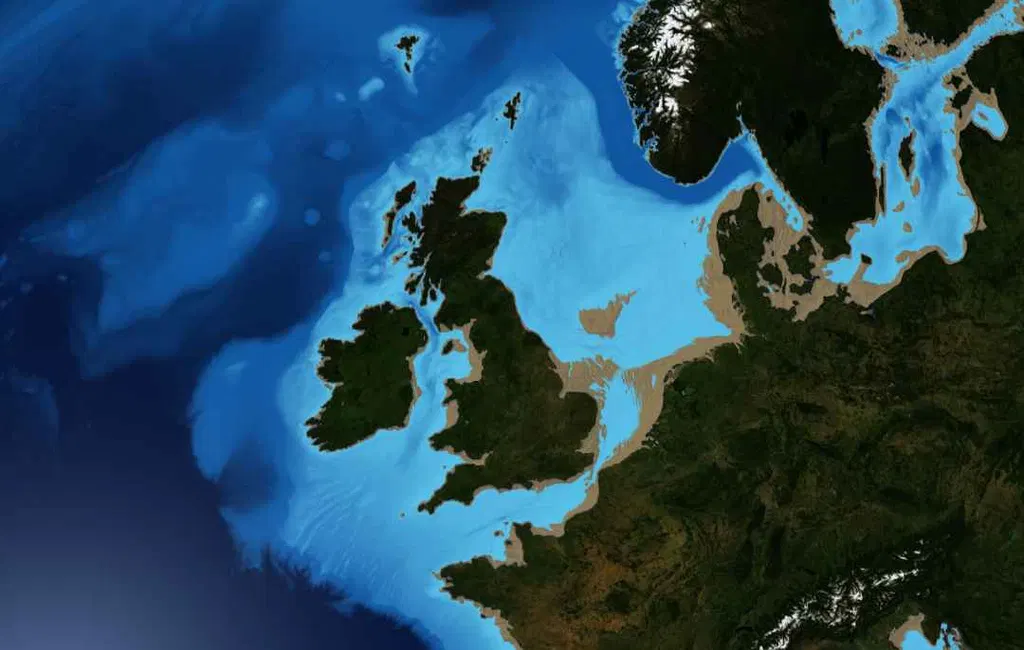
Drain the oceans and flood the land with this sea level simulator
Sliding Shores is a non-commercial interactive tool that allows users to visualize the effects of changing global sea levels on a 3D globe. By adjusting a slider, viewers can see coastlines retreat or submerge in real time, ranging from draining the oceans to flooding Mount Everest. The visualization aims to provide a tactile understanding of how thin the layer of habitable land is and how dramatically surface area ratios shift across geological time.
- ▪Sliding Shores is a personal, non-commercial science visualization created by Richard Franklin.
- ▪The tool uses the Etopo 2022 Global Relief Model to render Earth as a 3D globe with adjustable sea levels.
- ▪Users can set sea levels from -11,000 meters to +8,849 meters to observe real-time changes in coastlines.
- ▪The visualization includes presets for historical ice age levels and future scenarios like the 2100 worst case.
- ▪The tool does not account for local variables such as high tides, storm surges, or existing sea walls.
Boing Boing files mainly under tech. We currently carry 664 of its stories.
Story provenance
Source · retrieval · rights · ranking — open for full record
inspect →
Story provenance
Attribution is not the same as permission. This drawer separates discovery metadata, excerpts, WeSearch-generated summaries, reuse status, and whether the publisher receives the visit. Nothing here claims a legal grant the publisher has not made.
Record
| Original publisher | Boing Boing |
| Canonical URL | https://boingboing.net/2026/09/27/drain-the-oceans-and-flood-the-land-with-this-sea-level-simulator.html |
| Publication time | Mon, 28 Sep 2026 00:26:20 +0000 |
| Retrieval time | 2026-09-28T00:56:06.734Z |
| Last seen | 2026-09-28T00:56:06.734Z |
| Headline source | Publisher (no WeSearch rewrite) |
| Excerpt source | publisher body |
| Excerpt method | First ~120 words (~800 chars) of extracted publisher body, fair-use limited. |
| Summary | WeSearch · cerebras-chat (WeSearch summarizer) |
| Summary source text | contentText |
| Citation coverage | Summary is a WeSearch-generated derivative; primary citation is the original publisher URL. |
| Cluster | tmcRG3rCBhm5 · 1 stories |
| Cluster logic | Grouped by semantic title/content similarity across sources within a rolling window. Same-publisher template collisions are excluded from coverage comparison. |
| Ranking reason | Story pages are not engagement-ranked. Hub feeds use recency, with optional source-diversified chronological ordering (cap consecutive stories per source). No personalized ranking. |
| Publisher visit | Yes — open original |
| Substitutes article? | No — link-out required for full text |
Rights status (four layers)
WeSearch handling by dimension
| Indexing | May the item be indexed (stored, ranked, made findable)? | Allowed |
| Snippet | May a short excerpt of the publisher's text be shown? | Allowed |
| AI summary | May WeSearch generate its own short summary of the article? | Limited |
| Retrieval / RAG | May the content be exposed for third-party retrieval-augmented generation? | Not asserted |
| Model training | May the content be used to train AI models? | Not asserted |
| Commercial reuse | May the content be reused commercially? | Not permitted |
Basis: Derived from the published RSS/Atom feed. Contact: [email protected]. Reviewed: 2026-07-24.
Opening excerpt (first ~120 words) tap to expand
Drain the oceans and flood the land with this sea level simulator Rob Beschizza 5:26 pm Sun Sep 27, 2026 Boil off 100 feet and we get Doggerland back! You've surely seen interactive maps showing the effects of the sea level rising, but Sliding Shores makes a game of it: you get a beautifully-rendered globe and a slider to raise or lower the oceans. There's a load of presets, from "oceans drained" to "drown Everest," a feat not even Waterworld managed. Historical ones include the height of the ice age; more credibly ominous futures include "2100 worst case" and "West Antarctic collapse." It's the work of Richard Franklin . Sliding Shores is a personal, non-commercial science visualisation.
…
Excerpt limited to ~120 words for fair-use compliance. The full article is at Boing Boing.
Discussion
0 commentsMore from Boing Boing