
Elusive ‘Geoneutrinos’ Are Building a New Map of Earth’s Volatile Interior
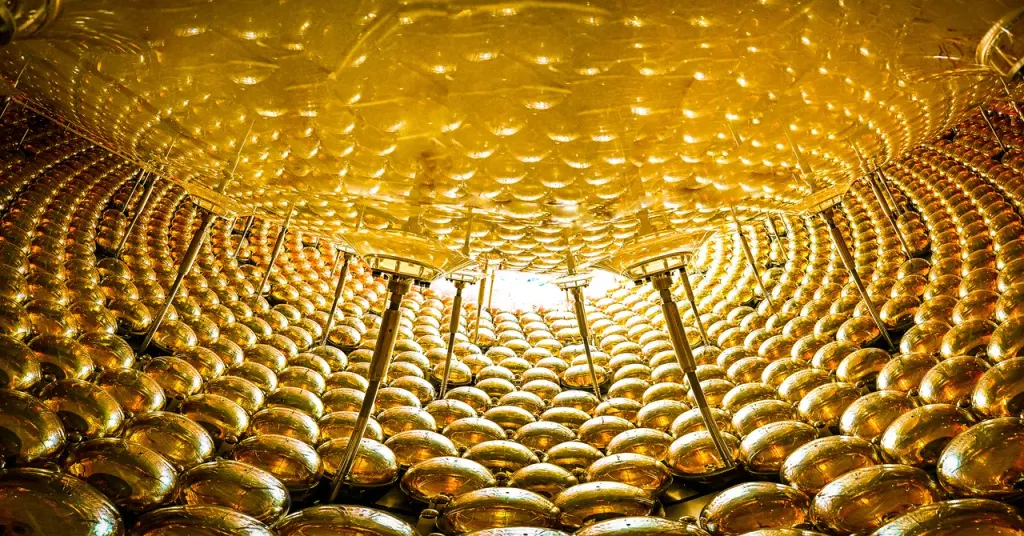
“Splashdown,” Depatie says over a radio as he steps into an inflatable raft waiting below.Normally, the cavern is one of the darkest places on Earth, but today it is lit up for maintenance, offering us a rare chance to see inside. I peer through the hatch at Depatie as he paddles over to examine the submerged experiment. He’s inspecting a house-sized detector built to catch some of the most elusive particles known to physics: neutrinos.This is the SNO+ neutrino experiment, buried deep within the Creighton mine at Snolab, an underground physics laboratory in Sudbury, Canada.
- ▪“Splashdown,” Depatie says over a radio as he steps into an inflatable raft waiting below.Normally, the cavern is one of the darkest places on Earth, but today it is lit up for maintenance, offering us a rare chance to see inside.
- ▪I peer through the hatch at Depatie as he paddles over to examine the submerged experiment.
- ▪He’s inspecting a house-sized detector built to catch some of the most elusive particles known to physics: neutrinos.This is the SNO+ neutrino experiment, buried deep within the Creighton mine at Snolab, an underground physics laboratory in
WIRED files mainly under tech. We currently carry 1,023 of its stories.
Story provenance
Source · retrieval · rights · ranking — open for full record
inspect →
Story provenance
Attribution is not the same as permission. This drawer separates discovery metadata, excerpts, WeSearch-generated summaries, reuse status, and whether the publisher receives the visit. Nothing here claims a legal grant the publisher has not made.
Record
| Original publisher | WIRED |
| Canonical URL | https://www.wired.com/story/elusive-geoneutrinos-are-building-a-new-map-of-earths-volatile-interior/ |
| Publication time | Sun, 04 Oct 2026 09:00:00 +0000 |
| Retrieval time | 2026-10-04T09:03:33.641Z |
| Last seen | 2026-10-04T09:03:43.281Z |
| Headline source | Publisher (no WeSearch rewrite) |
| Excerpt source | publisher body |
| Excerpt method | First ~120 words (~800 chars) of extracted publisher body, fair-use limited. |
| Summary | WeSearch · cerebras-chat (WeSearch summarizer) |
| Summary source text | contentText |
| Citation coverage | Summary is a WeSearch-generated derivative; primary citation is the original publisher URL. |
| Cluster | VEPp4kR5AfrC · 1 stories |
| Cluster logic | Grouped by semantic title/content similarity across sources within a rolling window. Same-publisher template collisions are excluded from coverage comparison. |
| Ranking reason | Story pages are not engagement-ranked. Hub feeds use recency, with optional source-diversified chronological ordering (cap consecutive stories per source). No personalized ranking. |
| Publisher visit | Yes — open original |
| Substitutes article? | No — link-out required for full text |
Rights status (four layers)
WeSearch handling by dimension
| Indexing | May the item be indexed (stored, ranked, made findable)? | Allowed |
| Snippet | May a short excerpt of the publisher's text be shown? | Allowed |
| AI summary | May WeSearch generate its own short summary of the article? | Limited |
| Retrieval / RAG | May the content be exposed for third-party retrieval-augmented generation? | Not asserted |
| Model training | May the content be used to train AI models? | Not asserted |
| Commercial reuse | May the content be reused commercially? | Not permitted |
Basis: Derived from the published RSS/Atom feed. Contact: [email protected]. Reviewed: 2026-07-24.
Opening excerpt (first ~120 words) tap to expand
James DinneenScienceOct 4, 2026 5:00 AMElusive ‘Geoneutrinos’ Are Building a New Map of Earth’s Volatile InteriorA global network of detectors are reporting some of the most substantial measurements yet of neutrinos created deep underground by the radioactive elements that power our planet’s tectonic activity.The JUNO experiment, located outside the city of Guangzhou in China, is expected to report its first geoneutrino detections this year.Courtesy of JUNO CollaborationCommentLoaderSave StorySave this storyCommentLoaderSave StorySave this storyThe original version of this story appeared in Quanta Magazine.In a laboratory 2 kilometers underground, a crane lowers Matt Depatie, a detector technologist, through a hatch into a white-walled cavern filled with about 7,000 tons of ultrapure…
Excerpt limited to ~120 words for fair-use compliance. The full article is at WIRED.
Discussion
0 commentsMore from WIRED


