
Epidermolysis Bullosa: New Therapies Bring Hope, Healing
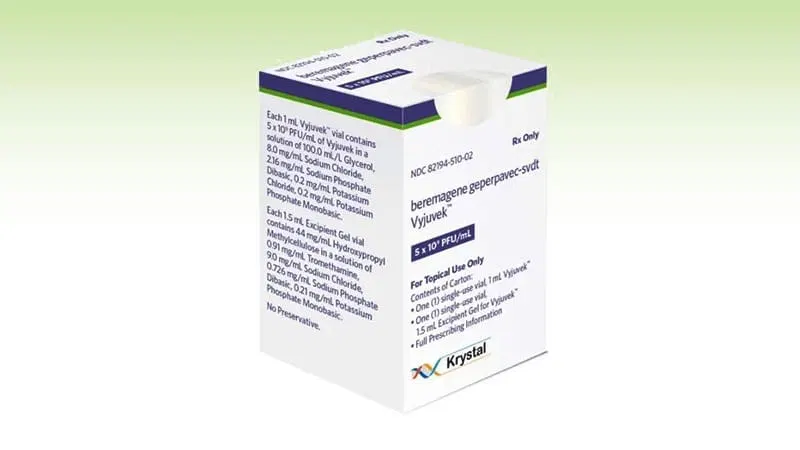
Recent FDA approvals have transformed the treatment approach for epidermolysis bullosa (EB), shifting from supportive care to targeted therapies. New treatments like B-VEC and pz-cel focus on correcting genetic defects and enhancing wound healing. Pediatric dermatologists emphasize the importance of proper application techniques and overall patient health to maximize treatment efficacy.
- ▪B-VEC was approved by the FDA in 2023 for recessive and dominant dystrophic EB, with expanded approval for newborns in 2025.
- ▪Pz-cel received FDA approval in April 2025 and requires careful patient management during treatment.
- ▪A topical gel containing birch bark triterpenes was approved in 2023 for patients with junctional or dystrophic EB.
Medscape files mainly under health. We currently carry 231 of its stories.
Story provenance
Source · retrieval · rights · ranking — open for full record
inspect →
Story provenance
Attribution is not the same as permission. This drawer separates discovery metadata, excerpts, WeSearch-generated summaries, reuse status, and whether the publisher receives the visit. Nothing here claims a legal grant the publisher has not made.
Record
| Original publisher | Medscape |
| Canonical URL | https://www.medscape.com/viewarticle/epidermolysis-bullosa-new-therapies-target-genetics-wound-2026a1000gyy?src=rss |
| Publication time | Mon, 25 May 2026 03:24:39 EDT |
| Retrieval time | 2026-05-25T07:37:36.533Z |
| Last seen | 2026-05-25T07:37:36.533Z |
| Headline source | Publisher (no WeSearch rewrite) |
| Excerpt source | publisher body |
| Excerpt method | First ~120 words (~800 chars) of extracted publisher body, fair-use limited. |
| Summary | WeSearch · cerebras-chat (WeSearch summarizer) |
| Summary source text | contentText |
| Citation coverage | Summary is a WeSearch-generated derivative; primary citation is the original publisher URL. |
| Cluster | P0JZ_BzV7S3I |
| Cluster logic | Grouped by semantic title/content similarity across sources within a rolling window. Same-publisher template collisions are excluded from coverage comparison. |
| Ranking reason | Story pages are not engagement-ranked. Hub feeds use recency, with optional source-diversified chronological ordering (cap consecutive stories per source). No personalized ranking. |
| Publisher visit | Yes — open original |
| Substitutes article? | No — link-out required for full text |
Rights status (four layers)
WeSearch handling by dimension
| Indexing | May the item be indexed (stored, ranked, made findable)? | Allowed |
| Snippet | May a short excerpt of the publisher's text be shown? | Allowed |
| AI summary | May WeSearch generate its own short summary of the article? | Limited |
| Retrieval / RAG | May the content be exposed for third-party retrieval-augmented generation? | Not asserted |
| Model training | May the content be used to train AI models? | Not asserted |
| Commercial reuse | May the content be reused commercially? | Not permitted |
Basis: Derived from the published RSS/Atom feed. Contact: [email protected]. Reviewed: 2026-07-24.
Opening excerpt (first ~120 words) tap to expand
Denver — Thanks to treatments approved by the FDA in recent years, pediatric dermatologists’ strategy for epidermolysis bullosa (EB) has shifted from providing supportive care to correcting underlying causes and boosting wound healing, Emily Gorrell, DO, said at the annual Society for Pediatric Dermatology Pre-AAD meeting.Before 2022, she said, management of EB’s cutaneous manifestations was limited to managing pain and itching, preventing and treating infections, supporting wound healing, and watching for squamous cell carcinomas, which are often aggressive in the context of EB.
…
Excerpt limited to ~120 words for fair-use compliance. The full article is at Medscape.
Discussion
0 commentsMore from Medscape


