Every fast write moves work somewhere else
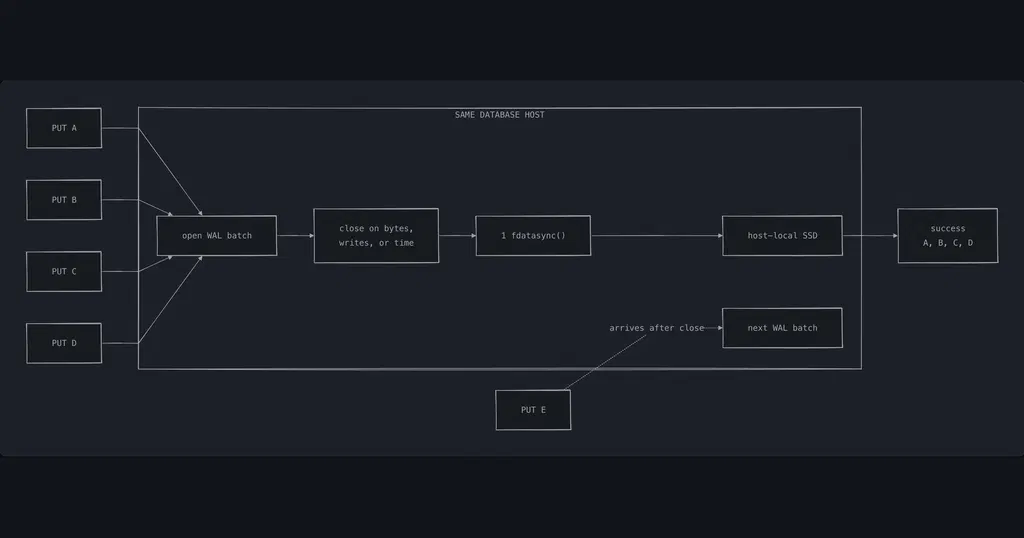
Every storage engine must decide what must finish before it tells a client that a write succeeded, with options ranging from returning after copying bytes into memory to waiting for a network volume or several database servers to save their copies. The choice of when to return affects latency and durability, as returning after memory is fast but can lose the write in the event of a machine crash. Newer storage designs built around object storage make this choice especially interesting, as they can use a host-local NVMe SSD for a write-ahead log or cache and organize data with a log-structured merge tree layout.
- ▪The quickest answer for a storage engine to return after a write is to copy the bytes into memory, but this can result in data loss in the event of a machine crash.
- ▪Waiting for a local SSD to sync can survive a process or kernel crash, but not the loss of the device or host.
- ▪Newer storage designs built around object storage can use a host-local NVMe SSD for a write-ahead log or cache and organize data with a log-structured merge tree layout.
- ▪Object storage can own the durable copies of data while compute comes and goes, and writing new immutable files avoids small random updates to shared disk pages.
Hacker News (Front Page) files mainly under programming. We currently carry 1,309 of its stories. Top-voted stories on Hacker News.
Story provenance
Source · retrieval · rights · ranking — open for full record
inspect →
Story provenance
Attribution is not the same as permission. This drawer separates discovery metadata, excerpts, WeSearch-generated summaries, reuse status, and whether the publisher receives the visit. Nothing here claims a legal grant the publisher has not made.
Record
| Original publisher | Shayon Mukherjee |
| Canonical URL | https://www.shayon.dev/post/2026/220/every-fast-write-moves-work-somewhere-else/ |
| Publication time | Sun, 09 Aug 2026 15:36:52 +0000 |
| Retrieval time | 2026-08-09T16:20:42.308Z |
| Last seen | 2026-08-09T16:20:42.308Z |
| Headline source | Publisher (no WeSearch rewrite) |
| Excerpt source | publisher body |
| Excerpt method | First ~120 words (~800 chars) of extracted publisher body, fair-use limited. |
| Summary | WeSearch · cerebras-chat (WeSearch summarizer) |
| Summary source text | contentText |
| Citation coverage | Summary is a WeSearch-generated derivative; primary citation is the original publisher URL. |
| Cluster | NaxFH-kwh5QA · 1 stories |
| Cluster logic | Grouped by semantic title/content similarity across sources within a rolling window. Same-publisher template collisions are excluded from coverage comparison. |
| Ranking reason | Story pages are not engagement-ranked. Hub feeds use recency, with optional source-diversified chronological ordering (cap consecutive stories per source). No personalized ranking. |
| Publisher visit | Yes — open original |
| Substitutes article? | No — link-out required for full text |
Rights status (four layers)
WeSearch handling by dimension
| Indexing | May the item be indexed (stored, ranked, made findable)? | Allowed |
| Snippet | May a short excerpt of the publisher's text be shown? | Allowed |
| AI summary | May WeSearch generate its own short summary of the article? | Limited |
| Retrieval / RAG | May the content be exposed for third-party retrieval-augmented generation? | Not asserted |
| Model training | May the content be used to train AI models? | Not asserted |
| Commercial reuse | May the content be reused commercially? | Not permitted |
Basis: Derived from the published RSS/Atom feed. Contact: [email protected]. Reviewed: 2026-07-24.
Opening excerpt (first ~120 words) tap to expand
Every storage engine has to decide what must finish before it tells a client that a write succeeded. The quickest answer is to return after copying the bytes into memory. A local durable write waits for fdatasync() on an SSD in the database host. Keeping the write after that host disappears means waiting for a network volume, an object store, or several database servers to save their own copies.Those choices move latency and durability together because returning after memory is fast, but a machine crash can lose the write.
…
Excerpt limited to ~120 words for fair-use compliance. The full article is at Shayon Mukherjee.
Discussion
0 commentsMore from Shayon Mukherjee