
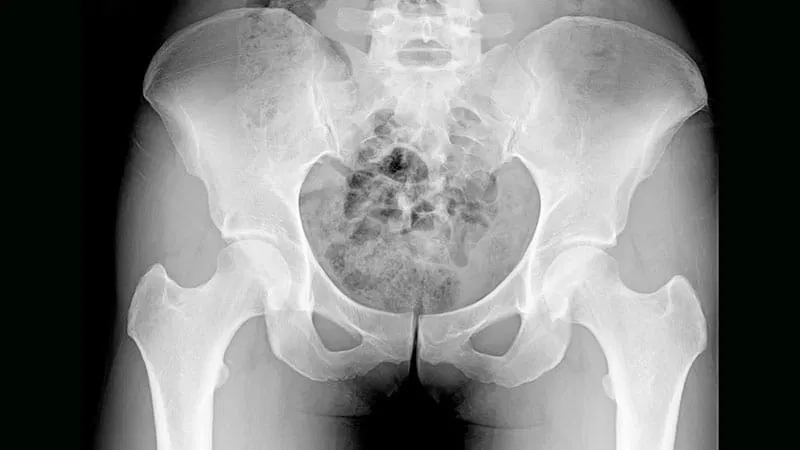
Femoral BMD May Reflect Broader Health in Older Women
New research indicates that femoral bone mineral density (BMD) may serve as a prognostic biomarker for overall health in older women. The study found that women with osteoporosis had a significantly increased risk of all-cause mortality, independent of other demographic and clinical factors. These findings emphasize the importance of assessing broader health metrics in this population.
- ▪Women with osteoporosis based on femoral BMD measurements had a 47% increased risk for all-cause mortality.
- ▪The study included nearly 3000 postmenopausal women and followed them for an average of 7.26 years.
- ▪BMD was found to be a better predictor of mortality than BMI, highlighting its potential as a marker for systemic health.
Medscape files mainly under health. We currently carry 231 of its stories.
Story provenance
Source · retrieval · rights · ranking — open for full record
inspect →
Story provenance
Attribution is not the same as permission. This drawer separates discovery metadata, excerpts, WeSearch-generated summaries, reuse status, and whether the publisher receives the visit. Nothing here claims a legal grant the publisher has not made.
Record
| Original publisher | Medscape |
| Canonical URL | https://www.medscape.com/viewarticle/bone-density-measures-give-insight-overall-health-risk-older-2026a1000hws?src=rss |
| Publication time | Fri, 29 May 2026 03:57:10 EDT |
| Retrieval time | 2026-05-29T08:19:59.400Z |
| Last seen | 2026-05-29T08:19:59.400Z |
| Headline source | Publisher (no WeSearch rewrite) |
| Excerpt source | publisher body |
| Excerpt method | First ~120 words (~800 chars) of extracted publisher body, fair-use limited. |
| Summary | WeSearch · cerebras-chat (WeSearch summarizer) |
| Summary source text | contentText |
| Citation coverage | Summary is a WeSearch-generated derivative; primary citation is the original publisher URL. |
| Cluster | 2k4tLBHTiR1p |
| Cluster logic | Grouped by semantic title/content similarity across sources within a rolling window. Same-publisher template collisions are excluded from coverage comparison. |
| Ranking reason | Story pages are not engagement-ranked. Hub feeds use recency, with optional source-diversified chronological ordering (cap consecutive stories per source). No personalized ranking. |
| Publisher visit | Yes — open original |
| Substitutes article? | No — link-out required for full text |
Rights status (four layers)
WeSearch handling by dimension
| Indexing | May the item be indexed (stored, ranked, made findable)? | Allowed |
| Snippet | May a short excerpt of the publisher's text be shown? | Allowed |
| AI summary | May WeSearch generate its own short summary of the article? | Limited |
| Retrieval / RAG | May the content be exposed for third-party retrieval-augmented generation? | Not asserted |
| Model training | May the content be used to train AI models? | Not asserted |
| Commercial reuse | May the content be reused commercially? | Not permitted |
Basis: Derived from the published RSS/Atom feed. Contact: [email protected]. Reviewed: 2026-07-24.
Opening excerpt (first ~120 words) tap to expand
Osteoporosis is a known risk factor for fractures, but new research published in Menopause suggested it may also provide insight into broader health outcomes.In an observational study, women who met criteria for osteoporosis based on femoral bone mineral density (BMD) measurements had a 47% increased risk for all-cause mortality after adjustment for demographic and clinical factors (hazard ratio [HR], 1.47; 95% CI, 1.16-1.86). Researchers also found that low BMD across four femoral regions — total femur, femoral neck, trochanter, and intertrochanteric — were associated with mortality risk.The association was strongest in total femur BMD ranges of 0.46-0.71 g/cm2 and trochanter BMD ranges of 0.33-0.54 g/cm2.“The study reveals a significant inverse correlation between femoral BMD and…
Excerpt limited to ~120 words for fair-use compliance. The full article is at Medscape.
Discussion
0 commentsMore from Medscape


