Flexible PCBs: Not Only For The Few
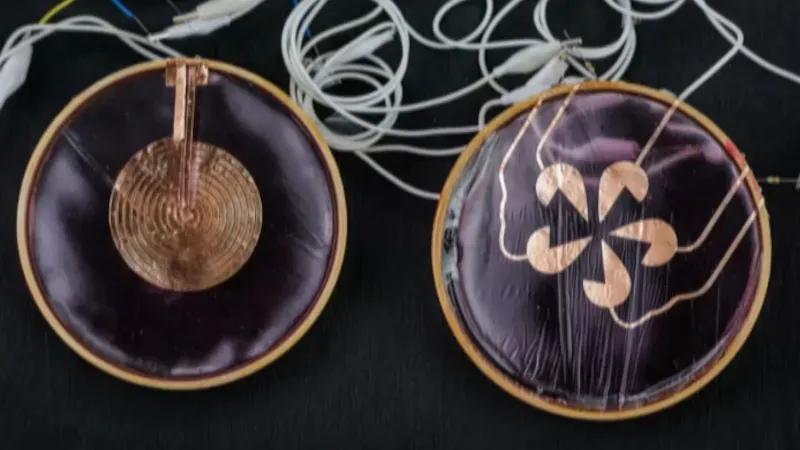
She starts with an overview of flexible electronics, detailing the techniques used with conventional polyimide substrates and etched copper. We’re particularly enamoured of a stretchable PCB made by coiling a flexible circuit round a piece of elastic. Since she’s looking for techniques accessible to everyone that don’t either cost a fortune or require dangerous chemicals we look at conductive paint and electrolysis, before arriving at using a vinyl cutter to create adhesive traces.
- ▪She starts with an overview of flexible electronics, detailing the techniques used with conventional polyimide substrates and etched copper.
- ▪We’re particularly enamoured of a stretchable PCB made by coiling a flexible circuit round a piece of elastic.
- ▪Since she’s looking for techniques accessible to everyone that don’t either cost a fortune or require dangerous chemicals we look at conductive paint and electrolysis, before arriving at using a vinyl cutter to create adhesive traces.
Hackaday files mainly under tech. We currently carry 319 of its stories.
Story provenance
Source · retrieval · rights · ranking — open for full record
inspect →
Story provenance
Attribution is not the same as permission. This drawer separates discovery metadata, excerpts, WeSearch-generated summaries, reuse status, and whether the publisher receives the visit. Nothing here claims a legal grant the publisher has not made.
Record
| Original publisher | Hackaday |
| Canonical URL | https://hackaday.com/2026/07/27/flexible-pcbs-not-only-for-the-few/ |
| Publication time | Mon, 27 Jul 2026 17:00:00 +0000 |
| Retrieval time | 2026-07-27T17:01:31.517Z |
| Last seen | 2026-07-27T17:01:31.517Z |
| Headline source | Publisher (no WeSearch rewrite) |
| Excerpt source | publisher body |
| Excerpt method | First ~120 words (~800 chars) of extracted publisher body, fair-use limited. |
| Summary | WeSearch · cerebras-chat (WeSearch summarizer) |
| Summary source text | contentText |
| Citation coverage | Summary is a WeSearch-generated derivative; primary citation is the original publisher URL. |
| Cluster | SbkzZnJer0xK |
| Cluster logic | Grouped by semantic title/content similarity across sources within a rolling window. Same-publisher template collisions are excluded from coverage comparison. |
| Ranking reason | Story pages are not engagement-ranked. Hub feeds use recency, with optional source-diversified chronological ordering (cap consecutive stories per source). No personalized ranking. |
| Publisher visit | Yes — open original |
| Substitutes article? | No — link-out required for full text |
Rights status (four layers)
WeSearch handling by dimension
| Indexing | May the item be indexed (stored, ranked, made findable)? | Allowed |
| Snippet | May a short excerpt of the publisher's text be shown? | Allowed |
| AI summary | May WeSearch generate its own short summary of the article? | Limited |
| Retrieval / RAG | May the content be exposed for third-party retrieval-augmented generation? | Not asserted |
| Model training | May the content be used to train AI models? | Not asserted |
| Commercial reuse | May the content be reused commercially? | Not permitted |
Basis: Derived from the published RSS/Atom feed. Contact: [email protected]. Reviewed: 2026-07-24.
Opening excerpt (first ~120 words) tap to expand
Flexible PCBs: Not Only For The Few No comments by: Jenny List July 27, 2026 Title: Copy Short Link: Copy Flexible printed circuit boards are a fascinating technique for making electronics venture beyond the two-dimensional, but surprisingly they’re not something many of us have worked with. [Jessica Stanley] gave a talk at the recent Electromagnetic Field event in the UK, exploring the different ways to make your electronics bend. She starts with an overview of flexible electronics, detailing the techniques used with conventional polyimide substrates and etched copper. We’re particularly enamoured of a stretchable PCB made by coiling a flexible circuit round a piece of elastic.
…
Excerpt limited to ~120 words for fair-use compliance. The full article is at Hackaday.
Discussion
0 commentsMore from Hackaday