Forget Trees, add Fins to your 3D Prints Instead
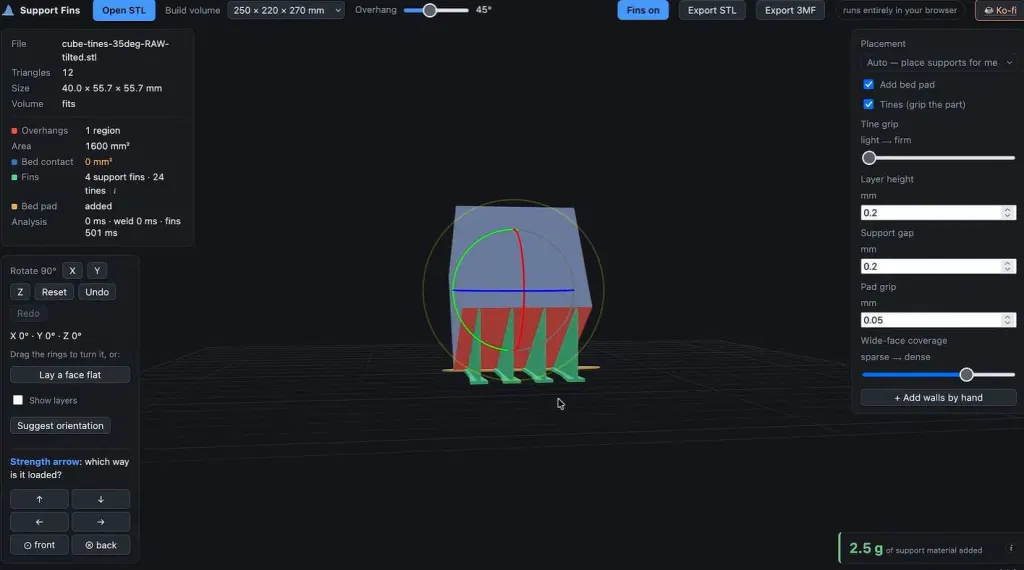
That said, [Matthew Trahan] figured that neither regular grid supports nor organic tree supports are the answer here, and that the better answer is found in fins. The problem with existing support approaches especially with FDM prints is that they can be fairly wasteful in terms of material, and they can leave serious marks on the printed object’s surface that require post-processing. These fins on the other hand are designed to require as little material as possible and snap off as cleanly as possible.
- ▪That said, [Matthew Trahan] figured that neither regular grid supports nor organic tree supports are the answer here, and that the better answer is found in fins.
- ▪The problem with existing support approaches especially with FDM prints is that they can be fairly wasteful in terms of material, and they can leave serious marks on the printed object’s surface that require post-processing.
- ▪These fins on the other hand are designed to require as little material as possible and snap off as cleanly as possible.
Hackaday files mainly under tech. We currently carry 432 of its stories.
Story provenance
Source · retrieval · rights · ranking — open for full record
inspect →
Story provenance
Attribution is not the same as permission. This drawer separates discovery metadata, excerpts, WeSearch-generated summaries, reuse status, and whether the publisher receives the visit. Nothing here claims a legal grant the publisher has not made.
Record
| Original publisher | Hackaday |
| Canonical URL | https://hackaday.com/2026/09/23/forget-trees-add-fins-to-your-3d-prints-instead/ |
| Publication time | Wed, 23 Sep 2026 17:00:20 +0000 |
| Retrieval time | 2026-09-23T17:04:30.617Z |
| Last seen | 2026-09-23T17:04:30.617Z |
| Headline source | Publisher (no WeSearch rewrite) |
| Excerpt source | publisher body |
| Excerpt method | First ~120 words (~800 chars) of extracted publisher body, fair-use limited. |
| Summary | WeSearch · cerebras-chat (WeSearch summarizer) |
| Summary source text | contentText |
| Citation coverage | Summary is a WeSearch-generated derivative; primary citation is the original publisher URL. |
| Cluster | O2JtJBc-h8Wq · 1 stories |
| Cluster logic | Grouped by semantic title/content similarity across sources within a rolling window. Same-publisher template collisions are excluded from coverage comparison. |
| Ranking reason | Story pages are not engagement-ranked. Hub feeds use recency, with optional source-diversified chronological ordering (cap consecutive stories per source). No personalized ranking. |
| Publisher visit | Yes — open original |
| Substitutes article? | No — link-out required for full text |
Rights status (four layers)
WeSearch handling by dimension
| Indexing | May the item be indexed (stored, ranked, made findable)? | Allowed |
| Snippet | May a short excerpt of the publisher's text be shown? | Allowed |
| AI summary | May WeSearch generate its own short summary of the article? | Limited |
| Retrieval / RAG | May the content be exposed for third-party retrieval-augmented generation? | Not asserted |
| Model training | May the content be used to train AI models? | Not asserted |
| Commercial reuse | May the content be reused commercially? | Not permitted |
Basis: Derived from the published RSS/Atom feed. Contact: [email protected]. Reviewed: 2026-07-24.
Opening excerpt (first ~120 words) tap to expand
Forget Trees, Add Fins To Your 3D Prints Instead No comments by: Maya Posch September 23, 2026 Title: Copy Short Link: Copy Perhaps one of the most contentious issues in 3D printing is that of supports, both because they’re an uncomfortable reminder of how gravity affects our prints and because the very idea of there being ‘one right way’ is bound to get you into some spirited discussions. That said, [Matthew Trahan] figured that neither regular grid supports nor organic tree supports are the answer here, and that the better answer is found in fins. The problem with existing support approaches especially with FDM prints is that they can be fairly wasteful in terms of material, and they can leave serious marks on the printed object’s surface that require post-processing.
…
Excerpt limited to ~120 words for fair-use compliance. The full article is at Hackaday.
Discussion
0 commentsMore from Hackaday