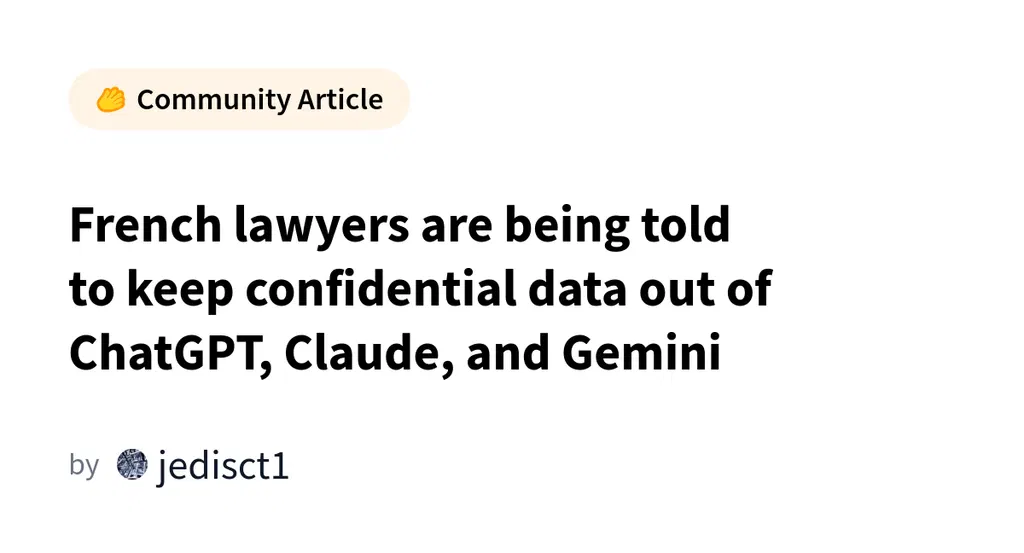
French lawyers are being told to use open source AI models for confidential data
And even enterprise plans that promise “no training” do not solve the problem. At its General Assembly on 12–13 March 2026, France’s National Bar Council (CNB), which represents French lawyers, made the rule explicit: never disclose client or case data to external generative AI services. Doing so may expose a lawyer to disciplinary or legal sanctions.
- ▪And even enterprise plans that promise “no training” do not solve the problem.
- ▪At its General Assembly on 12–13 March 2026, France’s National Bar Council (CNB), which represents French lawyers, made the rule explicit: never disclose client or case data to external generative AI services.
- ▪Doing so may expose a lawyer to disciplinary or legal sanctions.
Hacker News (AI / LLM) files mainly under ai. We currently carry 4,391 of its stories.
Story provenance
Source · retrieval · rights · ranking — open for full record
inspect →
Story provenance
Attribution is not the same as permission. This drawer separates discovery metadata, excerpts, WeSearch-generated summaries, reuse status, and whether the publisher receives the visit. Nothing here claims a legal grant the publisher has not made.
Record
| Original publisher | Huggingface |
| Canonical URL | https://huggingface.co/blog/jedisct1/lawyers-and-local-ai |
| Publication time | Tue, 11 Aug 2026 08:59:50 +0000 |
| Retrieval time | 2026-08-11T09:10:43.108Z |
| Last seen | 2026-08-11T09:10:43.108Z |
| Headline source | Publisher (no WeSearch rewrite) |
| Excerpt source | publisher body |
| Excerpt method | First ~120 words (~800 chars) of extracted publisher body, fair-use limited. |
| Summary | WeSearch · cerebras-chat (WeSearch summarizer) |
| Summary source text | contentText |
| Citation coverage | Summary is a WeSearch-generated derivative; primary citation is the original publisher URL. |
| Cluster | UStHqgwrsHJ9 · 1 stories |
| Cluster logic | Grouped by semantic title/content similarity across sources within a rolling window. Same-publisher template collisions are excluded from coverage comparison. |
| Ranking reason | Story pages are not engagement-ranked. Hub feeds use recency, with optional source-diversified chronological ordering (cap consecutive stories per source). No personalized ranking. |
| Publisher visit | Yes — open original |
| Substitutes article? | No — link-out required for full text |
Rights status (four layers)
WeSearch handling by dimension
| Indexing | May the item be indexed (stored, ranked, made findable)? | Allowed |
| Snippet | May a short excerpt of the publisher's text be shown? | Allowed |
| AI summary | May WeSearch generate its own short summary of the article? | Limited |
| Retrieval / RAG | May the content be exposed for third-party retrieval-augmented generation? | Not asserted |
| Model training | May the content be used to train AI models? | Not asserted |
| Commercial reuse | May the content be reused commercially? | Not permitted |
Basis: Derived from the published RSS/Atom feed. Contact: [email protected]. Reviewed: 2026-07-24.
Opening excerpt (first ~120 words) tap to expand
Back to Articles French lawyers are being told to keep confidential data out of ChatGPT, Claude, and Gemini Community Article Published August 9, 2026 Upvote 1 Frank Denis jedisct1 Follow French lawyers have now been told, in unusually blunt terms: do not send confidential client data to Claude, ChatGPT, Gemini, or any other proprietary cloud AI. And even enterprise plans that promise “no training” do not solve the problem. At its General Assembly on 12–13 March 2026, France’s National Bar Council (CNB), which represents French lawyers, made the rule explicit: never disclose client or case data to external generative AI services. Doing so may expose a lawyer to disciplinary or legal sanctions. The CNB rejects the standard cloud AI reassurance.
…
Excerpt limited to ~120 words for fair-use compliance. The full article is at Huggingface.
Discussion
0 commentsMore from Huggingface