From Prototype to Profit: Solving the Agentic Token-Burn Problem
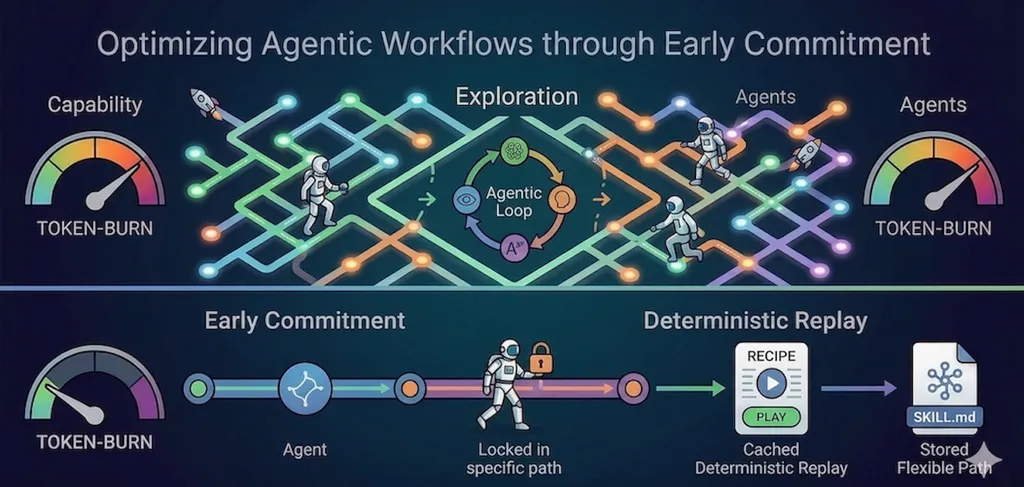
The article discusses the transition from AI prototyping to the development of profitable agentic applications. It highlights the importance of balancing agent autonomy with economic considerations, particularly in terms of token efficiency. The authors argue that while unconstrained agents can adapt to complex workflows, excessive exploration can lead to unsustainable costs.
- ▪Product and engineering teams are now shipping agentic applications that automate previously manual workflows.
- ▪The focus has shifted from proving agents can work to ensuring they are profitable and efficient in their token usage.
- ▪Rigidly constrained agents often fail to adapt to real-world scenarios, leading to objective failures.
Opening excerpt (first ~120 words) tap to expand
Agentic AI From Prototype to Profit: Solving the Agentic Token-Burn Problem Why rigidly constrained agents fail, and how to engineer token-efficient, self-adapting workflows. Rahul Vir May 23, 2026 7 min read Share Image generated with Gemini This article was co-authored by Rahul Vir and Reya Vir. The Shift from Capability to Token Efficiency We have officially moved past the AI prototyping phase. Building on the concepts in Escaping the Prototype Mirage [1], product and engineering teams across every industry are now shipping agentic applications that solve workflows previously dominated by manual grind. Building these autonomous agent prototypes is now a breeze.
…
Excerpt limited to ~120 words for fair-use compliance. The full article is at Towards Data Science.
Discussion
0 commentsMore from Towards Data Science