From Vibe Coding to AI-Assisted Engineering: Lessons from Real Projects
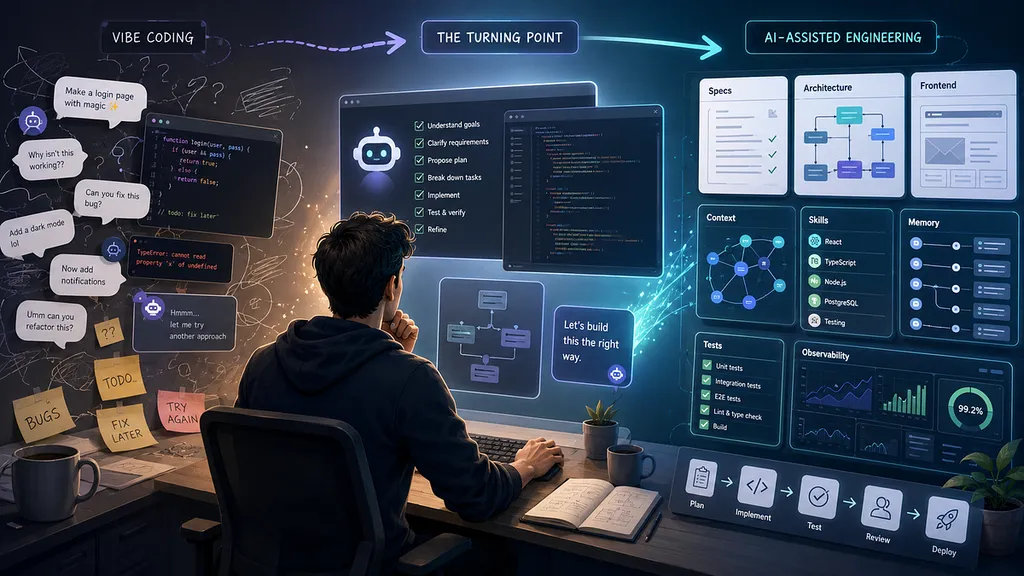
The article discusses the author's journey in integrating AI into software engineering workflows. It highlights the importance of building a robust engineering system around AI tools to enhance their effectiveness. Key lessons include the value of task refinement and the significance of creating detailed specifications before coding.
- ▪The author initially used AI tools like Copilot and Codex for coding tasks but found the results inconsistent.
- ▪A significant improvement was observed when the author utilized AI for task refinement before coding, leading to better planning and output.
- ▪The article emphasizes the transition from vague coding prompts to a more structured approach through Spec-Driven Development.
Hacker News (AI / LLM) files mainly under ai. We currently carry 2,532 of its stories.
Story provenance
Source · retrieval · rights · ranking — open for full record
inspect →
Attribution is not the same as permission. This drawer separates discovery metadata, excerpts, WeSearch-generated summaries, reuse status, and whether the publisher receives the visit. Nothing here claims a legal grant the publisher has not made.
Record
| Original publisher | Medium |
| Canonical URL | https://medium.com/@eritonsilva/from-vibe-coding-to-ai-assisted-engineering-lessons-from-real-projects-c403b85eaad1 |
| Publication time | Sun, 24 May 2026 03:13:52 +0000 |
| Retrieval time | 2026-05-24T03:27:30.037Z |
| Last seen | 2026-05-24T03:27:30.037Z |
| Headline source | Publisher (no WeSearch rewrite) |
| Excerpt source | publisher body |
| Excerpt method | First ~120 words (~800 chars) of extracted publisher body, fair-use limited. |
| Summary | WeSearch · cerebras-chat (WeSearch summarizer) |
| Summary source text | contentText |
| Citation coverage | Summary is a WeSearch-generated derivative; primary citation is the original publisher URL. |
| Cluster | 9r_-cmvsze9E |
| Cluster logic | Grouped by semantic title/content similarity across sources within a rolling window. Same-publisher template collisions are excluded from coverage comparison. |
| Ranking reason | Story pages are not engagement-ranked. Hub feeds use recency, with optional source-diversified chronological ordering (cap consecutive stories per source). No personalized ranking. |
| Publisher visit | Yes — open original |
| Substitutes article? | No — link-out required for full text |
Rights status (four layers)
WeSearch handling by dimension
| Indexing | May the item be indexed (stored, ranked, made findable)? | Allowed |
| Snippet | May a short excerpt of the publisher's text be shown? | Allowed |
| AI summary | May WeSearch generate its own short summary of the article? | Limited |
| Retrieval / RAG | May the content be exposed for third-party retrieval-augmented generation? | Not asserted |
| Model training | May the content be used to train AI models? | Not asserted |
| Commercial reuse | May the content be reused commercially? | Not permitted |
Basis: Derived from the published RSS/Atom feed. Contact: [email protected]. Reviewed: 2026-07-24.
Opening excerpt (first ~120 words) tap to expand
From Vibe Coding to AI-Assisted Engineering: Lessons From Real ProjectsEriton Silva11 min read·4 hours ago--ListenShareHow I improved my AI coding workflow with specs, context, agent skills, frontend references, and memory.Press enter or click to view image in full sizeLike many developers, I have incorporated AI into my daily software engineering routine.I use AI across different parts of the software development lifecycle: refinement, architecture, infrastructure, quality, troubleshooting, observability, monitoring, documentation, and even product thinking.At first, my approach was simple: I opened Copilot, Codex, Devin, or another AI coding assistant and asked it to fix a bug, create a feature, explain a piece of code, or generate an endpoint.It worked.But it was inconsistent.Sometimes…
Excerpt limited to ~120 words for fair-use compliance. The full article is at Medium.
Discussion
0 commentsMore from Medium