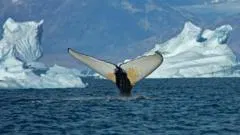
Giant whales move into Greenland waters as ice disappears
Now, as climate change warms the sea and melts that ice, they have adapted. In 2007, seven humpbacks were seen, and by 2024, there were 150 ship-based sightings of these giant whales.The first systematic aerial surveys of baleen whales - a group that includes fin, minke and humpbacks - off the East Greenland coast were carried out by the researchers during the summers of 2015 and 2024. That shift is driven by rising sea temperatures and food availability.
- ▪Now, as climate change warms the sea and melts that ice, they have adapted.
- ▪In 2007, seven humpbacks were seen, and by 2024, there were 150 ship-based sightings of these giant whales.The first systematic aerial surveys of baleen whales - a group that includes fin, minke and humpbacks - off the East Greenland coast
- ▪That shift is driven by rising sea temperatures and food availability.
BBC News — World publishes from United Kingdom and files mainly under world. We currently carry 829 of its stories.
Story provenance
Source · retrieval · rights · ranking — open for full record
inspect →
Story provenance
Attribution is not the same as permission. This drawer separates discovery metadata, excerpts, WeSearch-generated summaries, reuse status, and whether the publisher receives the visit. Nothing here claims a legal grant the publisher has not made.
Record
| Original publisher | BBC News |
| Canonical URL | https://www.bbc.co.uk/news/articles/cq6dn9gj7eno?at_medium=RSS&at_campaign=rss |
| Publication time | Thu, 20 Aug 2026 02:05:20 GMT |
| Retrieval time | 2026-08-20T02:58:24.151Z |
| Last seen | 2026-08-20T02:58:24.151Z |
| Headline source | Publisher (no WeSearch rewrite) |
| Excerpt source | publisher body |
| Excerpt method | First ~120 words (~800 chars) of extracted publisher body, fair-use limited. |
| Summary | WeSearch · cerebras-chat (WeSearch summarizer) |
| Summary source text | contentText |
| Citation coverage | Summary is a WeSearch-generated derivative; primary citation is the original publisher URL. |
| Cluster | None |
| Cluster logic | Not yet clustered, or no peer story found in the clustering window. |
| Ranking reason | Story pages are not engagement-ranked. Hub feeds use recency, with optional source-diversified chronological ordering (cap consecutive stories per source). No personalized ranking. |
| Publisher visit | Yes — open original |
| Substitutes article? | No — link-out required for full text |
Rights status (four layers)
WeSearch handling by dimension
| Indexing | May the item be indexed (stored, ranked, made findable)? | Allowed |
| Snippet | May a short excerpt of the publisher's text be shown? | Allowed |
| AI summary | May WeSearch generate its own short summary of the article? | Limited |
| Retrieval / RAG | May the content be exposed for third-party retrieval-augmented generation? | Not asserted |
| Model training | May the content be used to train AI models? | Not asserted |
| Commercial reuse | May the content be reused commercially? | Not permitted |
Basis: Derived from the published RSS/Atom feed. Contact: [email protected]. Reviewed: 2026-07-24.
Opening excerpt (first ~120 words) tap to expand
Giant whales move into Greenland waters as ice disappearsImage source, Fernando UgarteImage caption, Fin whales feed in ice-free East Greenland waters, as scientists observe from their boatsByVictoria GillScience correspondent Published52 minutes agoSea ice has been disappearing from East Greenland, allowing giant whales to take advantage and move in to previously inaccessible areas.That is the conclusion of a decades-long study that has recorded - and filmed - hundreds of the world's biggest whales including humpbacks, minke and fin whales, feeding in ice-free seas along the coast in summer.None of these marine mammals were historically found here as they have been locked out of the coastal waters by ice. Now, as climate change warms the sea and melts that ice, they have adapted.
…
Excerpt limited to ~120 words for fair-use compliance. The full article is at BBC News.
Discussion
0 commentsMore from BBC News