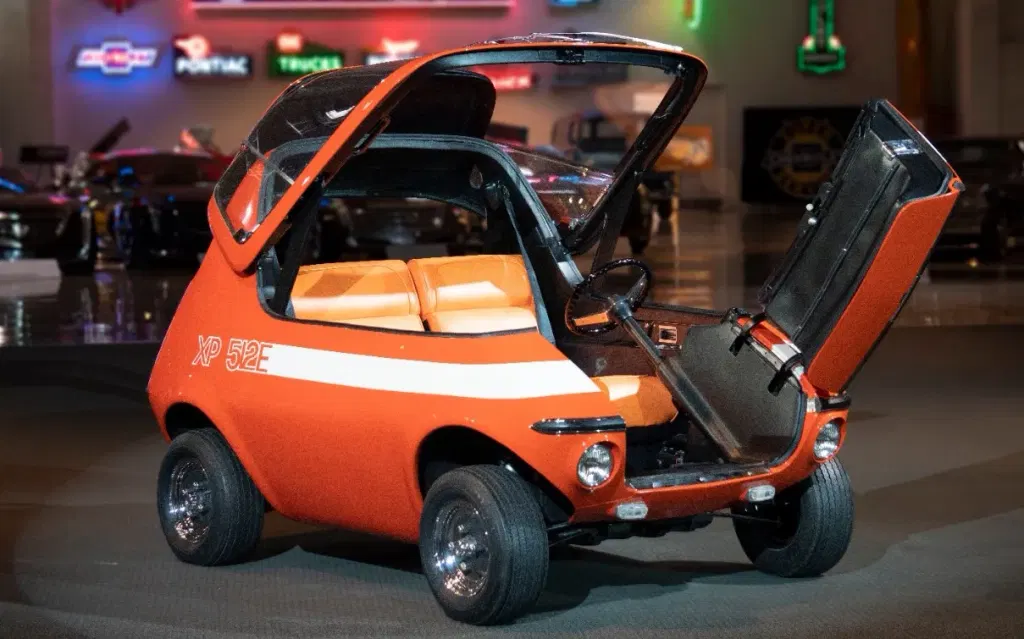
GM’s Experimental EV from 1969
General Motors developed the XP-512E, an experimental electric commuter prototype in 1969, as part of a trio of vehicles exploring different drivetrain technologies. The two-seater vehicle featured a fiberglass body and was powered by lead-acid batteries, which limited its performance to a top speed of 30 mph and a range of 50 miles. Although the prototype never reached mass production, it serves as a historical example of early automotive efforts to address urban air pollution through electric mobility.
- ▪The GM XP-512E was a two-seater experimental vehicle with a fiberglass body and steel chassis designed for short-distance commuting.
- ▪The car was part of a series that included conventional and hybrid variants, all sharing the same basic platform.
- ▪Due to the limitations of 1960s lead-acid battery technology, the vehicle had a top speed of 30 mph and a driving range of 50 miles.
- ▪GM developed the XP-512E alongside other alternative powertrain experiments, such as steam power, to mitigate smog and air pollution in cities.
- ▪Neither the GM XP-512E nor the contemporary AMC Amitron electric vehicle proceeded to commercial production.
Hackaday files mainly under tech. We currently carry 447 of its stories.
Story provenance
Source · retrieval · rights · ranking — open for full record
inspect →
Story provenance
Attribution is not the same as permission. This drawer separates discovery metadata, excerpts, WeSearch-generated summaries, reuse status, and whether the publisher receives the visit. Nothing here claims a legal grant the publisher has not made.
Record
| Original publisher | Hackaday |
| Canonical URL | https://hackaday.com/2026/09/24/gms-experimental-ev-from-1969/ |
| Publication time | Fri, 25 Sep 2026 05:00:47 +0000 |
| Retrieval time | 2026-09-25T05:05:29.432Z |
| Last seen | 2026-09-25T05:05:29.432Z |
| Headline source | Publisher (no WeSearch rewrite) |
| Excerpt source | publisher body |
| Excerpt method | First ~120 words (~800 chars) of extracted publisher body, fair-use limited. |
| Summary | WeSearch · cerebras-chat (WeSearch summarizer) |
| Summary source text | contentText |
| Citation coverage | Summary is a WeSearch-generated derivative; primary citation is the original publisher URL. |
| Cluster | None |
| Cluster logic | Not yet clustered, or no peer story found in the clustering window. |
| Ranking reason | Story pages are not engagement-ranked. Hub feeds use recency, with optional source-diversified chronological ordering (cap consecutive stories per source). No personalized ranking. |
| Publisher visit | Yes — open original |
| Substitutes article? | No — link-out required for full text |
Rights status (four layers)
WeSearch handling by dimension
| Indexing | May the item be indexed (stored, ranked, made findable)? | Allowed |
| Snippet | May a short excerpt of the publisher's text be shown? | Allowed |
| AI summary | May WeSearch generate its own short summary of the article? | Limited |
| Retrieval / RAG | May the content be exposed for third-party retrieval-augmented generation? | Not asserted |
| Model training | May the content be used to train AI models? | Not asserted |
| Commercial reuse | May the content be reused commercially? | Not permitted |
Basis: Derived from the published RSS/Atom feed. Contact: [email protected]. Reviewed: 2026-07-24.
Opening excerpt (first ~120 words) tap to expand
GM’s Experimental EV From 1969 No comments by: Navarre Bartz September 24, 2026 Title: Copy Short Link: Copy Electricity is the once and future drivetrain for automobiles, but until the advent of lithium batteries their capabilities were somewhat modest. One EV blip on the automotive timeline is the XP-512E commuter prototype by GM. The 60s saw a wide variety of interesting experiments in the automobile space, and both GM and AMC were evaluating the possibilities of a return to electric cars for short journeys. GM wasn’t set on a particular drivetrain for their new experimental commuter cars, so the XP 512 became a trio with conventional, hybrid, and electric variants. Each car was a two seater with a fiberglass body and steel chassis.
…
Excerpt limited to ~120 words for fair-use compliance. The full article is at Hackaday.
Discussion
0 commentsMore from Hackaday