Grading Tomatoes with an ESP32 and ML
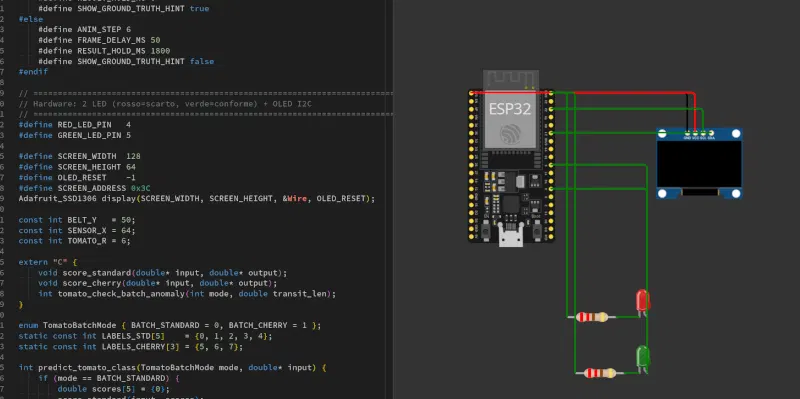
A system using an ESP32 and machine learning has been developed to grade tomatoes based on their color and size. The system can differentiate between standard tomatoes and cherry tomatoes, using separate sets of learned data for each. This technology has the potential to improve efficiency and accuracy in produce sorting and grading.
- ▪The system uses an optical sensor to collect raw data, which is then processed to remove empty belt images and compute statistical information.
- ▪The program includes heuristic checking to validate the size of the tomatoes, reducing miscategorizations.
- ▪A simulator is available online, allowing users to test the system without needing any hardware or tomatoes.
Hackaday files mainly under tech. We currently carry 298 of its stories.
Story provenance
Source · retrieval · rights · ranking — open for full record
inspect →
Story provenance
Attribution is not the same as permission. This drawer separates discovery metadata, excerpts, WeSearch-generated summaries, reuse status, and whether the publisher receives the visit. Nothing here claims a legal grant the publisher has not made.
Record
| Original publisher | Hackaday |
| Canonical URL | https://hackaday.com/2026/08/08/grading-tomatoes-with-an-esp32-and-ml/ |
| Publication time | Sat, 08 Aug 2026 20:00:23 +0000 |
| Retrieval time | 2026-08-08T20:00:42.854Z |
| Last seen | 2026-08-08T20:00:42.854Z |
| Headline source | Publisher (no WeSearch rewrite) |
| Excerpt source | publisher body |
| Excerpt method | First ~120 words (~800 chars) of extracted publisher body, fair-use limited. |
| Summary | WeSearch · cerebras-chat (WeSearch summarizer) |
| Summary source text | contentText |
| Citation coverage | Summary is a WeSearch-generated derivative; primary citation is the original publisher URL. |
| Cluster | QUD6QXV6cPA5 · 1 stories |
| Cluster logic | Grouped by semantic title/content similarity across sources within a rolling window. Same-publisher template collisions are excluded from coverage comparison. |
| Ranking reason | Story pages are not engagement-ranked. Hub feeds use recency, with optional source-diversified chronological ordering (cap consecutive stories per source). No personalized ranking. |
| Publisher visit | Yes — open original |
| Substitutes article? | No — link-out required for full text |
Rights status (four layers)
WeSearch handling by dimension
| Indexing | May the item be indexed (stored, ranked, made findable)? | Allowed |
| Snippet | May a short excerpt of the publisher's text be shown? | Allowed |
| AI summary | May WeSearch generate its own short summary of the article? | Limited |
| Retrieval / RAG | May the content be exposed for third-party retrieval-augmented generation? | Not asserted |
| Model training | May the content be used to train AI models? | Not asserted |
| Commercial reuse | May the content be reused commercially? | Not permitted |
Basis: Derived from the published RSS/Atom feed. Contact: [email protected]. Reviewed: 2026-07-24.
Opening excerpt (first ~120 words) tap to expand
Grading Tomatoes With An ESP32 And ML No comments by: Al Williams August 8, 2026 Title: Copy Short Link: Copy If you’ve ever worked with produce, you might know about grading. In addition to deciding if, say, a strawberry is good or not, they also have to sort them by color. Turns out, you don’t care if one package of berries is a bit redder than another, but you do care if one package has too much color variation. [Pmalfa31] applied an ESP32 and machine learning to grading tomatoes. The system knows in advance if you are processing standard tomatoes or cherry tomatoes and uses two different sets of learned data depending on which you select.
…
Excerpt limited to ~120 words for fair-use compliance. The full article is at Hackaday.
Discussion
0 commentsMore from Hackaday