Graph World Models for Verified and Efficient Long-Horizon LLM Task Planning
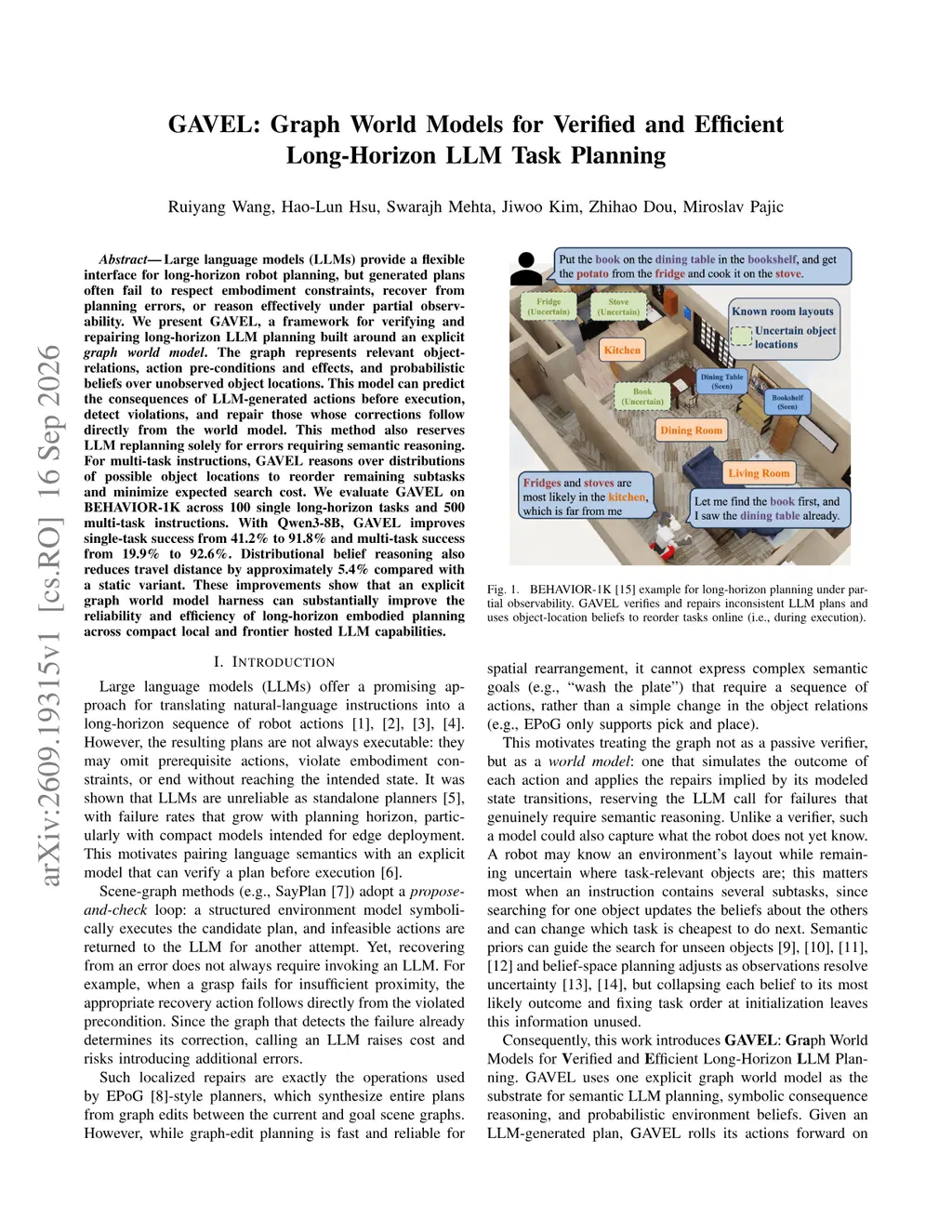
With Qwen3-8B on BEHAVIOR-1K across 100 long-horizon tasks; multi-task success rises from 19.9 to 92.6 percent across 500 multi-task instructions.02The graph predicts consequences before execution. Violations are detected and repaired directly when the correction follows from the world model, and LLM replanning is reserved for errors that need semantic reasoning.03Belief reasoning reorders subtasks. Reasoning over distributions of possible object locations reduces expected search cost and cuts travel distance about 5.4 percent against a static variant.04The gain holds for a compact model.
- ▪With Qwen3-8B on BEHAVIOR-1K across 100 long-horizon tasks; multi-task success rises from 19.9 to 92.6 percent across 500 multi-task instructions.02The graph predicts consequences before execution.
- ▪Violations are detected and repaired directly when the correction follows from the world model, and LLM replanning is reserved for errors that need semantic reasoning.03Belief reasoning reorders subtasks.
- ▪Reasoning over distributions of possible object locations reduces expected search cost and cuts travel distance about 5.4 percent against a static variant.04The gain holds for a compact model.
Hacker News (AI / LLM) files mainly under ai. We currently carry 5,748 of its stories.
Story provenance
Source · retrieval · rights · ranking — open for full record
inspect →
Story provenance
Attribution is not the same as permission. This drawer separates discovery metadata, excerpts, WeSearch-generated summaries, reuse status, and whether the publisher receives the visit. Nothing here claims a legal grant the publisher has not made.
Record
| Original publisher | Dair |
| Canonical URL | https://academy.dair.ai/papers/gavel-graph-world-models-for-verified-and-efficient-long-horizon-llm-task-planni-2609.19315 |
| Publication time | Sun, 20 Sep 2026 18:04:13 +0000 |
| Retrieval time | 2026-09-20T18:13:46.875Z |
| Last seen | 2026-09-20T18:13:46.875Z |
| Headline source | Publisher (no WeSearch rewrite) |
| Excerpt source | publisher body |
| Excerpt method | First ~120 words (~800 chars) of extracted publisher body, fair-use limited. |
| Summary | WeSearch · cerebras-chat (WeSearch summarizer) |
| Summary source text | contentText |
| Citation coverage | Summary is a WeSearch-generated derivative; primary citation is the original publisher URL. |
| Cluster | MlFDdhsYcvUs · 1 stories |
| Cluster logic | Grouped by semantic title/content similarity across sources within a rolling window. Same-publisher template collisions are excluded from coverage comparison. |
| Ranking reason | Story pages are not engagement-ranked. Hub feeds use recency, with optional source-diversified chronological ordering (cap consecutive stories per source). No personalized ranking. |
| Publisher visit | Yes — open original |
| Substitutes article? | No — link-out required for full text |
Rights status (four layers)
WeSearch handling by dimension
| Indexing | May the item be indexed (stored, ranked, made findable)? | Allowed |
| Snippet | May a short excerpt of the publisher's text be shown? | Allowed |
| AI summary | May WeSearch generate its own short summary of the article? | Limited |
| Retrieval / RAG | May the content be exposed for third-party retrieval-augmented generation? | Not asserted |
| Model training | May the content be used to train AI models? | Not asserted |
| Commercial reuse | May the content be reused commercially? | Not permitted |
Basis: Derived from the published RSS/Atom feed. Contact: [email protected]. Reviewed: 2026-07-24.
Opening excerpt (first ~120 words) tap to expand
Agents · RoboticsGAVEL: Graph World Models for Verified and Efficient Long-Horizon LLM Task PlanningRuiyang Wang, Hao-Lun Hsu, Swarajh Mehta, Jiwoo Kim, Zhihao Dou, Miroslav PajicChat with PaperFirst pageThe curator’s takeRuiyang Wang and colleagues present GAVEL, which verifies and repairs long-horizon LLM robot plans against an explicit graph world model holding object relations, action preconditions and effects, and probabilistic beliefs over unobserved locations.Ask this paperQuestion about this paperAsk in Paper ChatKey points01Single-task success goes from 41.2 to 91.8 percent. With Qwen3-8B on BEHAVIOR-1K across 100 long-horizon tasks; multi-task success rises from 19.9 to 92.6 percent across 500 multi-task instructions.02The graph predicts consequences before execution.
…
Excerpt limited to ~120 words for fair-use compliance. The full article is at Dair.
Discussion
0 commentsMore from Dair