
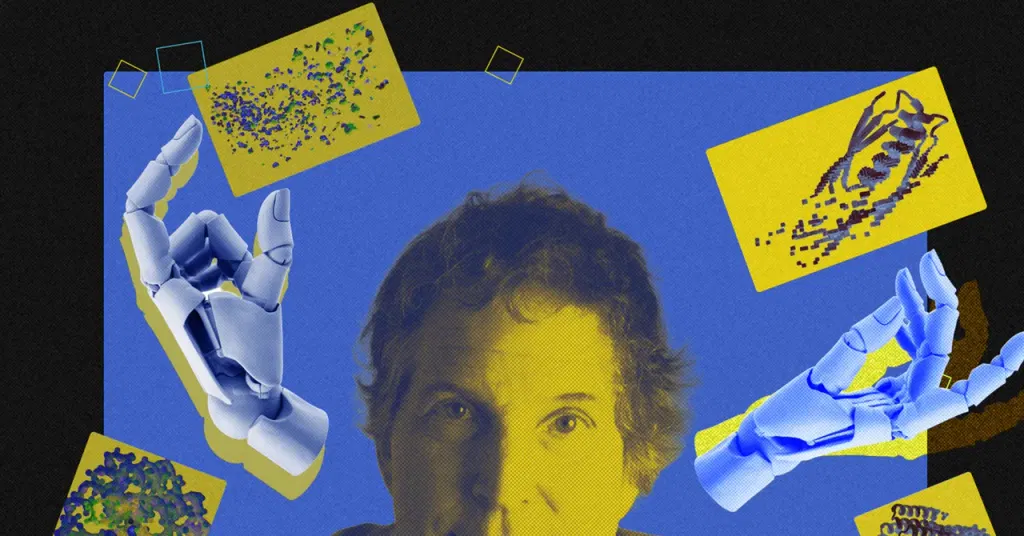
He Won the Nobel Prize for Protein Design. Now He Uses AI to Create Molecules Not Found in Nature
Jorge GarayScienceSep 18, 2026 6:30 AMHe Won the Nobel Prize for Protein Design. Materials courtesy of the Allen InstituteCommentLoaderSave StorySave this storyCommentLoaderSave StorySave this storyThe natural world as we know it represents only a fraction of what might exist. The authors envision, for example, new drugs to treat cancer and neurodegenerative diseases or enzymes capable of breaking down plastics in the ocean.Proteins that do not exist in nature but are technically possible can be designed and constructed using AI.
- ▪Jorge GarayScienceSep 18, 2026 6:30 AMHe Won the Nobel Prize for Protein Design.
- ▪Materials courtesy of the Allen InstituteCommentLoaderSave StorySave this storyCommentLoaderSave StorySave this storyThe natural world as we know it represents only a fraction of what might exist.
- ▪The authors envision, for example, new drugs to treat cancer and neurodegenerative diseases or enzymes capable of breaking down plastics in the ocean.Proteins that do not exist in nature but are technically possible can be designed and cons
WIRED files mainly under tech. We currently carry 836 of its stories.
Story provenance
Source · retrieval · rights · ranking — open for full record
inspect →
Story provenance
Attribution is not the same as permission. This drawer separates discovery metadata, excerpts, WeSearch-generated summaries, reuse status, and whether the publisher receives the visit. Nothing here claims a legal grant the publisher has not made.
Record
| Original publisher | WIRED |
| Canonical URL | https://www.wired.com/story/nobel-prize-protein-design-now-using-ai-to-create-molecules-beyond-nature/ |
| Publication time | Fri, 18 Sep 2026 10:30:00 +0000 |
| Retrieval time | 2026-09-18T10:38:45.845Z |
| Last seen | 2026-09-18T10:38:45.845Z |
| Headline source | Publisher (no WeSearch rewrite) |
| Excerpt source | publisher body |
| Excerpt method | First ~120 words (~800 chars) of extracted publisher body, fair-use limited. |
| Summary | WeSearch · cerebras-chat (WeSearch summarizer) |
| Summary source text | contentText |
| Citation coverage | Summary is a WeSearch-generated derivative; primary citation is the original publisher URL. |
| Cluster | nRvMwxutxrLB · 1 stories |
| Cluster logic | Grouped by semantic title/content similarity across sources within a rolling window. Same-publisher template collisions are excluded from coverage comparison. |
| Ranking reason | Story pages are not engagement-ranked. Hub feeds use recency, with optional source-diversified chronological ordering (cap consecutive stories per source). No personalized ranking. |
| Publisher visit | Yes — open original |
| Substitutes article? | No — link-out required for full text |
Rights status (four layers)
WeSearch handling by dimension
| Indexing | May the item be indexed (stored, ranked, made findable)? | Allowed |
| Snippet | May a short excerpt of the publisher's text be shown? | Allowed |
| AI summary | May WeSearch generate its own short summary of the article? | Limited |
| Retrieval / RAG | May the content be exposed for third-party retrieval-augmented generation? | Not asserted |
| Model training | May the content be used to train AI models? | Not asserted |
| Commercial reuse | May the content be reused commercially? | Not permitted |
Basis: Derived from the published RSS/Atom feed. Contact: [email protected]. Reviewed: 2026-07-24.
Opening excerpt (first ~120 words) tap to expand
Jorge GarayScienceSep 18, 2026 6:30 AMHe Won the Nobel Prize for Protein Design. Now He Uses AI to Create Molecules Not Found in NatureDavid Baker spoke with WIRED en Español about where biological design is headed next and the great potential and risks of taking biology outside the bounds of the natural world.David Baker, a pioneer of protein design, is using AI to go where nature hasn’t.PHOTOILLUSTRATION: Rodrigo Meade/WIRED en Español. Materials courtesy of the Allen InstituteCommentLoaderSave StorySave this storyCommentLoaderSave StorySave this storyThe natural world as we know it represents only a fraction of what might exist.
…
Excerpt limited to ~120 words for fair-use compliance. The full article is at WIRED.
Discussion
0 commentsMore from WIRED


.jpg&w=320)


