
How AI is creating a UK super-museum and revealing our planet's history
The resource is called the Distributed System of Scientific Collections, external (DiSSCo UK). Its body is dark brown to black, long and slightly flattened, with several irregular cream-coloured markings along its wing cases. Fine antennae project from its head, while six slender legs curl beneath its body.
- ▪The resource is called the Distributed System of Scientific Collections, external (DiSSCo UK).
- ▪Its body is dark brown to black, long and slightly flattened, with several irregular cream-coloured markings along its wing cases.
- ▪Fine antennae project from its head, while six slender legs curl beneath its body.
BBC News — Science publishes from United Kingdom and files mainly under science. We currently carry 284 of its stories.
Story provenance
Source · retrieval · rights · ranking — open for full record
inspect →
Story provenance
Attribution is not the same as permission. This drawer separates discovery metadata, excerpts, WeSearch-generated summaries, reuse status, and whether the publisher receives the visit. Nothing here claims a legal grant the publisher has not made.
Record
| Original publisher | BBC News — Science |
| Canonical URL | https://www.bbc.co.uk/news/articles/cv5yjgrj4ello?at_medium=RSS&at_campaign=rss |
| Publication time | Wed, 30 Sep 2026 00:46:29 GMT |
| Retrieval time | 2026-09-30T00:47:34.124Z |
| Last seen | 2026-09-30T00:47:34.124Z |
| Headline source | Publisher (no WeSearch rewrite) |
| Excerpt source | publisher body |
| Excerpt method | First ~120 words (~800 chars) of extracted publisher body, fair-use limited. |
| Summary | WeSearch · cerebras-chat (WeSearch summarizer) |
| Summary source text | contentText |
| Citation coverage | Summary is a WeSearch-generated derivative; primary citation is the original publisher URL. |
| Cluster | Tw2pRTy6VSyJ · 1 stories |
| Cluster logic | Grouped by semantic title/content similarity across sources within a rolling window. Same-publisher template collisions are excluded from coverage comparison. |
| Ranking reason | Story pages are not engagement-ranked. Hub feeds use recency, with optional source-diversified chronological ordering (cap consecutive stories per source). No personalized ranking. |
| Publisher visit | Yes — open original |
| Substitutes article? | No — link-out required for full text |
Rights status (four layers)
WeSearch handling by dimension
| Indexing | May the item be indexed (stored, ranked, made findable)? | Allowed |
| Snippet | May a short excerpt of the publisher's text be shown? | Allowed |
| AI summary | May WeSearch generate its own short summary of the article? | Limited |
| Retrieval / RAG | May the content be exposed for third-party retrieval-augmented generation? | Not asserted |
| Model training | May the content be used to train AI models? | Not asserted |
| Commercial reuse | May the content be reused commercially? | Not permitted |
Basis: Derived from the published RSS/Atom feed. Contact: [email protected]. Reviewed: 2026-07-24.
Opening excerpt (first ~120 words) tap to expand
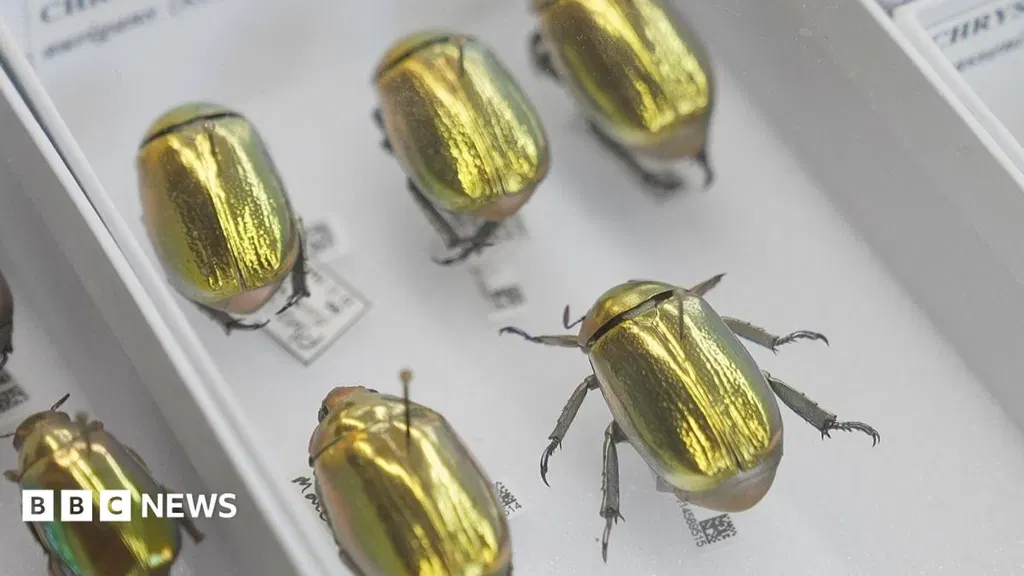
How AI is creating a UK super-museum and revealing our planet's historyImage source, Kevin Church/BBCImage caption, Beetles that look as if they are gold plated are among the millions of specimens that will be available to view onlineByPallab Ghosh, Science Correspondent, Kevin Church and Maddie MolloyPublishedJust nowResearchers are using AI to create a vast digital museum of millions of specimens from collections across the UK that they say could "supercharge" our understanding of the natural world.People will eventually be able to see around 70 million animals, plants, fossils and rocks from their phones and computers.Robots and AI are being used to scan and analyse the specimens - some collected centuries ago - speeding up the digitisation process from hundreds of years to a decade.
…
Excerpt limited to ~120 words for fair-use compliance. The full article is at BBC News — Science.
Discussion
0 commentsMore from BBC News — Science


