
How honeybees really crown their queens
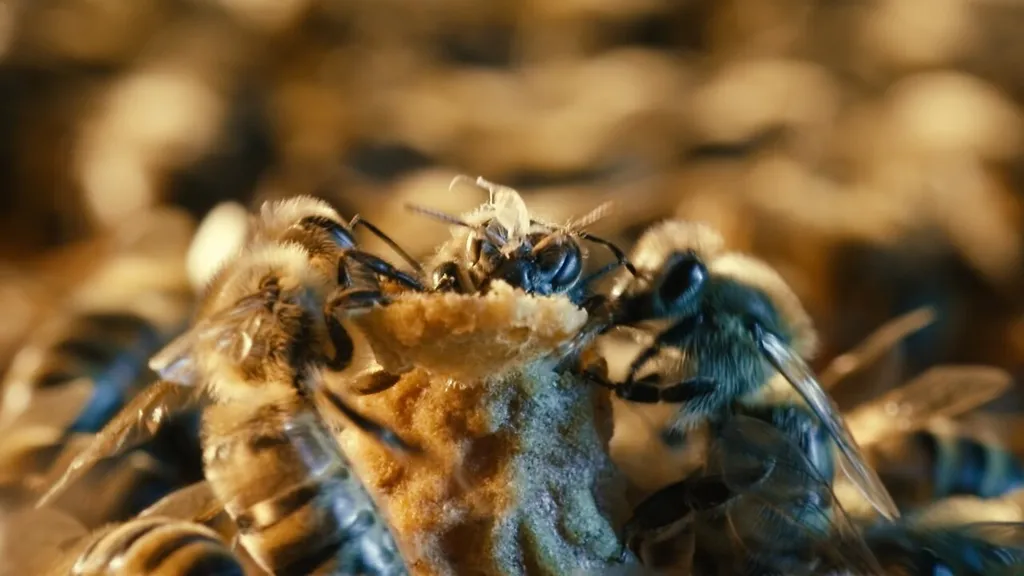
For generations, scientists believed a queen honeybee was made almost entirely by diet, but new research suggests queens are created through a more elaborate process. Young worker bees construct specialized nursery chambers complete with custom wax, warmer temperatures, and devoted attendants that help determine whether a larva becomes royalty. The study found that wax chambers where future queens develop are not simply protective shelters, but carefully engineered environments essential to producing healthy queens.
- ▪Researchers identified a previously unrecognized class of young worker bees dubbed 'queen cell builders' that appear uniquely adapted for the task.
- ▪The wax chambers where future queens develop, called queen cells or 'royal cribs,' are carefully engineered environments essential to producing healthy queens.
- ▪The study found that queen cells differ sharply from the familiar hexagonal chambers used to rear worker bees, with distinct physical and chemical properties.
Phys.org files mainly under science. We currently carry 1,260 of its stories.
Story provenance
Source · retrieval · rights · ranking — open for full record
inspect →
Attribution is not the same as permission. This drawer separates discovery metadata, excerpts, WeSearch-generated summaries, reuse status, and whether the publisher receives the visit. Nothing here claims a legal grant the publisher has not made.
Record
| Original publisher | Phys.org |
| Canonical URL | https://phys.org/news/2026-06-honeybees-crown-queens.html |
| Publication time | Wed, 03 Jun 2026 11:00:05 EDT |
| Retrieval time | 2026-06-03T15:02:09.825Z |
| Last seen | 2026-06-03T15:02:11.838Z |
| Headline source | Publisher (no WeSearch rewrite) |
| Excerpt source | publisher body |
| Excerpt method | First ~120 words (~800 chars) of extracted publisher body, fair-use limited. |
| Summary | WeSearch · cerebras-chat (WeSearch summarizer) |
| Summary source text | contentText |
| Citation coverage | Summary is a WeSearch-generated derivative; primary citation is the original publisher URL. |
| Cluster | Fak3yydu1Cg5 |
| Cluster logic | Grouped by semantic title/content similarity across sources within a rolling window. Same-publisher template collisions are excluded from coverage comparison. |
| Ranking reason | Story pages are not engagement-ranked. Hub feeds use recency, with optional source-diversified chronological ordering (cap consecutive stories per source). No personalized ranking. |
| Publisher visit | Yes — open original |
| Substitutes article? | No — link-out required for full text |
Rights status (four layers)
WeSearch handling by dimension
| Indexing | May the item be indexed (stored, ranked, made findable)? | Allowed |
| Snippet | May a short excerpt of the publisher's text be shown? | Allowed |
| AI summary | May WeSearch generate its own short summary of the article? | Limited |
| Retrieval / RAG | May the content be exposed for third-party retrieval-augmented generation? | Not asserted |
| Model training | May the content be used to train AI models? | Not asserted |
| Commercial reuse | May the content be reused commercially? | Not permitted |
Basis: Derived from the published RSS/Atom feed. Contact: [email protected]. Reviewed: 2026-07-24.
Opening excerpt (first ~120 words) tap to expand
June 3, 2026 How honeybees really crown their queens by University of California - Riverside edited by Sadie Harley, reviewed by Robert Egan Sadie Harley Scientific Editor Meet our editorial team Behind our editorial process Robert Egan Associate Editor Meet our editorial team Behind our editorial process Editors' notes This article has been reviewed according to Science X's editorial process and policies. Editors have highlighted the following attributes while ensuring the content's credibility: fact-checked peer-reviewed publication trusted source proofread The GIST Add as preferred source Hatching queen surrounded by royal guards.
…
Excerpt limited to ~120 words for fair-use compliance. The full article is at Phys.org.