
How Remote Work Has Grown – and Shrunk – Since Covid
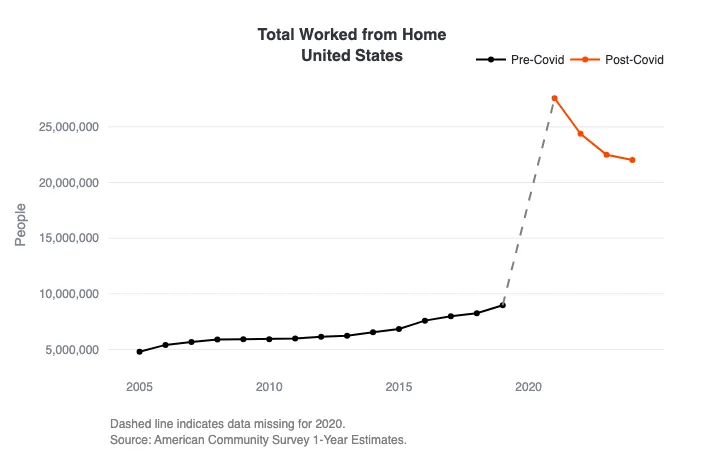
Remote work has significantly increased since the onset of Covid, peaking at nearly 28 million workers during the pandemic. Although the number has declined to about 22 million, it remains substantially higher than pre-pandemic levels. The trends in remote work have varied greatly across different regions, with some areas experiencing significant increases while others saw declines.
- ▪Remote work more than tripled from 2019 to 2021, reaching nearly 28 million people.
- ▪Sunnyvale, California, saw the largest increase in remote workers during the pandemic, with an 11-fold rise.
- ▪From 2021 to 2024, Sunnyvale experienced the largest decline in remote work, dropping by 67.2%.
- ▪Most locations in the U.S. have seen a decline in remote work between 10% and 30% since 2021.
- ▪Some warm-weather areas, like Marion County, Florida, have seen increases in remote work as people relocate for quality of life.
Hacker News (Newest) files mainly under programming. We currently carry 5,306 of its stories.
Story provenance
Source · retrieval · rights · ranking — open for full record
inspect →
Attribution is not the same as permission. This drawer separates discovery metadata, excerpts, WeSearch-generated summaries, reuse status, and whether the publisher receives the visit. Nothing here claims a legal grant the publisher has not made.
Record
| Original publisher | Ari Lamstein |
| Canonical URL | https://arilamstein.com/blog/2026/05/18/how-remote-work-has-grown-and-shrunk-since-covid/ |
| Publication time | Tue, 19 May 2026 08:54:25 +0000 |
| Retrieval time | 2026-05-19T09:04:57.469Z |
| Last seen | 2026-05-19T09:04:57.469Z |
| Headline source | Publisher (no WeSearch rewrite) |
| Excerpt source | publisher body |
| Excerpt method | First ~120 words (~800 chars) of extracted publisher body, fair-use limited. |
| Summary | WeSearch · cerebras-chat (WeSearch summarizer) |
| Summary source text | contentText |
| Citation coverage | Summary is a WeSearch-generated derivative; primary citation is the original publisher URL. |
| Cluster | UICSGzCy1-Gy |
| Cluster logic | Grouped by semantic title/content similarity across sources within a rolling window. Same-publisher template collisions are excluded from coverage comparison. |
| Ranking reason | Story pages are not engagement-ranked. Hub feeds use recency, with optional source-diversified chronological ordering (cap consecutive stories per source). No personalized ranking. |
| Publisher visit | Yes — open original |
| Substitutes article? | No — link-out required for full text |
Rights status (four layers)
WeSearch handling by dimension
| Indexing | May the item be indexed (stored, ranked, made findable)? | Allowed |
| Snippet | May a short excerpt of the publisher's text be shown? | Allowed |
| AI summary | May WeSearch generate its own short summary of the article? | Limited |
| Retrieval / RAG | May the content be exposed for third-party retrieval-augmented generation? | Not asserted |
| Model training | May the content be used to train AI models? | Not asserted |
| Commercial reuse | May the content be reused commercially? | Not permitted |
Basis: Derived from the published RSS/Atom feed. Contact: [email protected]. Reviewed: 2026-07-24.
Opening excerpt (first ~120 words) tap to expand
Remote work surged during Covid — and while it has declined since, it’s still far above pre‑pandemic levels. I just updated my Covid Demographics Explorer with the latest ACS data, and the national trend is striking: Remote work more than tripled between 2019 and 2021, rising to nearly 28 million people at the height of the pandemic. Since then it has edged down each year, but only modestly. Even today, at about 22 million, it remains roughly 2.5 times the pre‑Covid level. The app now lets you generate this same graph for every state, as well as for counties and cities with populations of at least 65,000. See how the trend looks where you live.
…
Excerpt limited to ~120 words for fair-use compliance. The full article is at Ari Lamstein.
Discussion
0 commentsMore from Ari Lamstein

![Why open AI models have become a matter of American national security [Italian]](/img-proxy?url=https%3A%2F%2Fcdn.dday.it%2Fsystem%2Fuploads%2Fnews%2Fmain_image%2F58170%2Fsocial_67e4e7_ChatGPT_Image_26_lug_2026__19_15_44.png&w=320)


