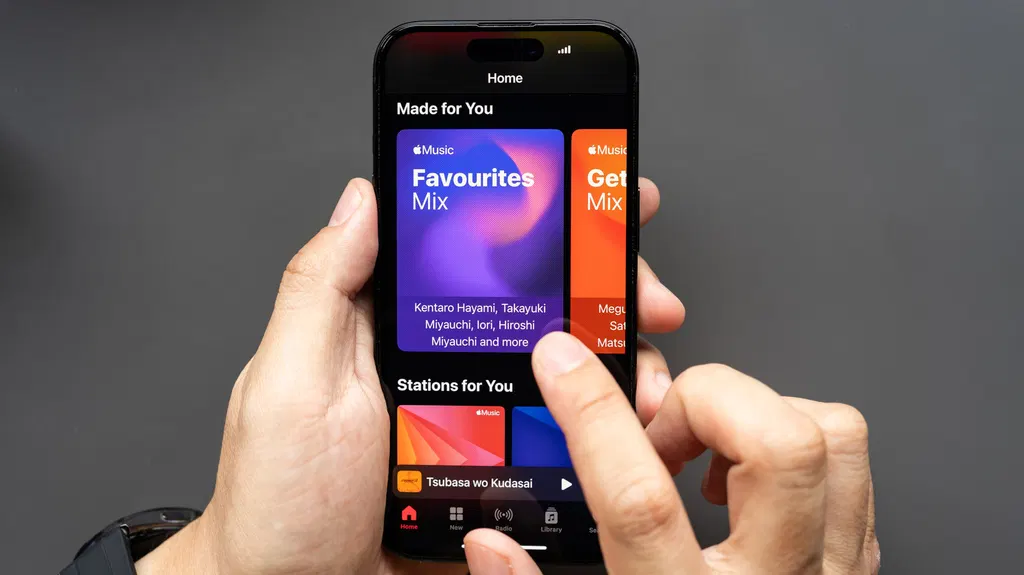
How to adjust the audio quality in Apple Music
Apple Music provides robust cross-platform support with advanced audio features, including two tiers of lossless streaming and an equalizer. Users must manually enable lossless playback in their device settings to access these high-quality audio options, as they are not active by default. The article outlines specific steps for adjusting these settings on iOS, Android, macOS, and Windows, while noting hardware limitations for Bluetooth users.
- ▪Apple Music offers two lossless audio tiers: standard lossless at 24-bit/48kHz and Hi-Res Lossless at 24-bit/192kHz.
- ▪Lossless audio is not enabled by default and must be manually activated in the settings of each individual device.
- ▪iOS devices do not support high-resolution Bluetooth codecs, meaning iPhone users require wired connections to hear true lossless quality.
- ▪Android users can access lossless audio via certain wireless headphones, but the app lacks an in-app equalizer, redirecting users to system settings instead.
Engadget files mainly under tech. We currently carry 1,128 of its stories.
Story provenance
Source · retrieval · rights · ranking — open for full record
inspect →
Story provenance
Attribution is not the same as permission. This drawer separates discovery metadata, excerpts, WeSearch-generated summaries, reuse status, and whether the publisher receives the visit. Nothing here claims a legal grant the publisher has not made.
Record
| Original publisher | Engadget |
| Canonical URL | https://www.engadget.com/2273330/how-to-adjust-audio-quality-apple-music/ |
| Publication time | Sat, 03 Oct 2026 12:30:00 +0000 |
| Retrieval time | 2026-10-03T12:33:12.663Z |
| Last seen | 2026-10-03T12:33:12.663Z |
| Headline source | Publisher (no WeSearch rewrite) |
| Excerpt source | publisher body |
| Excerpt method | First ~120 words (~800 chars) of extracted publisher body, fair-use limited. |
| Summary | WeSearch · cerebras-chat (WeSearch summarizer) |
| Summary source text | contentText |
| Citation coverage | Summary is a WeSearch-generated derivative; primary citation is the original publisher URL. |
| Cluster | L3wrDRF4IrdE · 1 stories |
| Cluster logic | Grouped by semantic title/content similarity across sources within a rolling window. Same-publisher template collisions are excluded from coverage comparison. |
| Ranking reason | Story pages are not engagement-ranked. Hub feeds use recency, with optional source-diversified chronological ordering (cap consecutive stories per source). No personalized ranking. |
| Publisher visit | Yes — open original |
| Substitutes article? | No — link-out required for full text |
Rights status (four layers)
WeSearch handling by dimension
| Indexing | May the item be indexed (stored, ranked, made findable)? | Allowed |
| Snippet | May a short excerpt of the publisher's text be shown? | Allowed |
| AI summary | May WeSearch generate its own short summary of the article? | Limited |
| Retrieval / RAG | May the content be exposed for third-party retrieval-augmented generation? | Not asserted |
| Model training | May the content be used to train AI models? | Not asserted |
| Commercial reuse | May the content be reused commercially? | Not permitted |
Basis: Derived from the published RSS/Atom feed. Contact: [email protected]. Reviewed: 2026-07-24.
Opening excerpt (first ~120 words) tap to expand
Entertainment Streaming How to adjust the audio quality in Apple Music The service offers both lossless streaming and EQ features, if you know where to look. By Max Miller Oct. 3, 2026 8:30 am EST Wongsakorn 2468/Shutterstock Add Engadget on Google: Preferred Source Google Discover We may receive a commission on purchases made from links. Apple Music has shockingly robust cross-platform support for an Apple service. Native apps are available for iOS and macOS, of course, but there are also very well-designed version for Android, Windows and other devices — including smart TVs and game consoles. Thankfully, there's very little feature discrepancy between the Apple and non-Apple versions.
…
Excerpt limited to ~120 words for fair-use compliance. The full article is at Engadget.
Discussion
0 commentsMore from Engadget