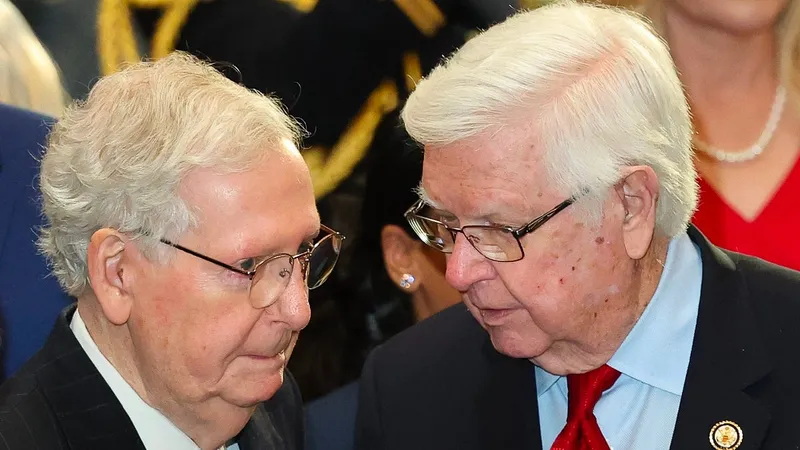
How to Fix America’s Geriatric Politician Problem
The article discusses the challenges posed by aging politicians in the U.S. government. It highlights the potential disruptions caused by their declining capacities and the need for age limits on candidates. The piece also notes the generational divide in politics and the impact on younger citizens seeking opportunities.
- ▪Nearly 20 percent of baby boomers refuse to step aside from public office.
- ▪The aging of politicians can create havoc and uncertainty in government.
- ▪Several prominent politicians from the Silent Generation are retiring, but many others wish to remain in office.
2 outlets in our directory ran this story, first to last over 27 hours. All of the coverage we found sits in one bucket: centre. That one-sidedness is itself worth noticing.
- ▪ Your Tech Stack Has an AI Problem: How to Audit and Fix It in 2026 — DEV.to (Top)
The Bulwark files mainly under politics. We currently carry 328 of its stories.
Story provenance
Source · retrieval · rights · ranking — open for full record
inspect →
Story provenance
Attribution is not the same as permission. This drawer separates discovery metadata, excerpts, WeSearch-generated summaries, reuse status, and whether the publisher receives the visit. Nothing here claims a legal grant the publisher has not made.
Record
| Original publisher | The Bulwark |
| Canonical URL | https://www.thebulwark.com/p/how-to-fix-americas-geriatric-politician-problem-age-limits-constitution |
| Publication time | Wed, 20 May 2026 06:37:11 GMT |
| Retrieval time | 2026-05-20T06:40:00.396Z |
| Last seen | 2026-05-20T07:43:23.231Z |
| Headline source | Publisher (no WeSearch rewrite) |
| Excerpt source | publisher body |
| Excerpt method | First ~120 words (~800 chars) of extracted publisher body, fair-use limited. |
| Summary | WeSearch · cerebras-chat (WeSearch summarizer) |
| Summary source text | contentText |
| Citation coverage | Summary is a WeSearch-generated derivative; primary citation is the original publisher URL. |
| Cluster | 96TqRVzuvHdn · 2 stories |
| Cluster logic | Grouped by semantic title/content similarity across sources within a rolling window. Same-publisher template collisions are excluded from coverage comparison. |
| Ranking reason | Story pages are not engagement-ranked. Hub feeds use recency, with optional source-diversified chronological ordering (cap consecutive stories per source). No personalized ranking. |
| Publisher visit | Yes — open original |
| Substitutes article? | No — link-out required for full text |
Rights status (four layers)
WeSearch handling by dimension
| Indexing | May the item be indexed (stored, ranked, made findable)? | Allowed |
| Snippet | May a short excerpt of the publisher's text be shown? | Allowed |
| AI summary | May WeSearch generate its own short summary of the article? | Limited |
| Retrieval / RAG | May the content be exposed for third-party retrieval-augmented generation? | Not asserted |
| Model training | May the content be used to train AI models? | Not asserted |
| Commercial reuse | May the content be reused commercially? | Not permitted |
Basis: Derived from the published RSS/Atom feed. Contact: [email protected]. Reviewed: 2026-07-24.
Opening excerpt (first ~120 words) tap to expand
How to Fix America’s Geriatric Politician ProblemSure, some people can work well into old age. But we still need age limits on candidates for office.Jill LawrenceMay 20, 2026ShareHal Rogers (right)—now 88, the oldest member of the House of Representatives, who last night won his primary to run again in this fall’s election—with fellow Kentuckian Mitch McConnell, now 84, the third-oldest member of the Senate, who is retiring rather than running for re-election this year. (Photo by Kevin Dietsch/Getty Images)MY HUSBAND AND I are baby boomers, and we know how lucky we are. We know it from the house we bought in 1984 that has appreciated to nearly ten times the purchase price. From the steady jobs we had for decades in a field—“traditional” journalism—that’s hit hard times.
…
Excerpt limited to ~120 words for fair-use compliance. The full article is at The Bulwark.
Discussion
0 commentsMore from The Bulwark