
How to Optimize Vector Search When RAM Gets Too Expensive: On-Disk vs. In-Memory ANN Indexes
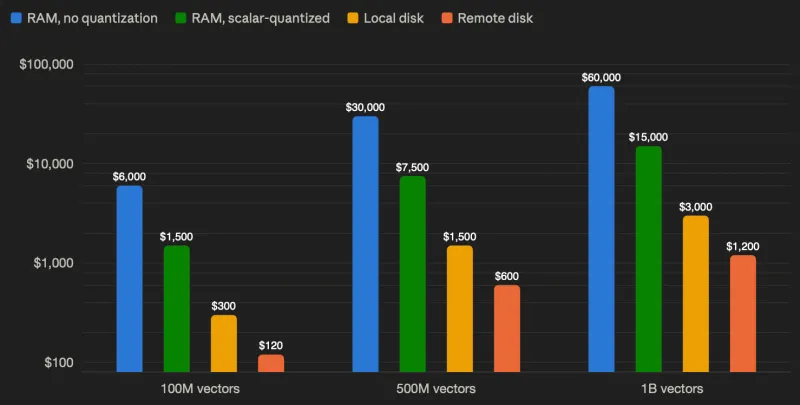
Machine Learning How to Optimize Vector Search When RAM Gets Too Expensive: On-Disk vs. With the rise of agentic systems, companies are trying to provide as much context to the agents as possible, which requires vector db indexes to grow from an initial million or dozens of millions scale to the hundreds of millions or even billions. At this scale, storing indexes and associated data in RAM will cost thousands of dollars per month, and HNSW can become a scalability bottleneck.
- ▪Machine Learning How to Optimize Vector Search When RAM Gets Too Expensive: On-Disk vs.
- ▪With the rise of agentic systems, companies are trying to provide as much context to the agents as possible, which requires vector db indexes to grow from an initial million or dozens of millions scale to the hundreds of millions or even bi
- ▪At this scale, storing indexes and associated data in RAM will cost thousands of dollars per month, and HNSW can become a scalability bottleneck.
Towards Data Science files mainly under ai. We currently carry 269 of its stories.
Story provenance
Source · retrieval · rights · ranking — open for full record
inspect →
Story provenance
Attribution is not the same as permission. This drawer separates discovery metadata, excerpts, WeSearch-generated summaries, reuse status, and whether the publisher receives the visit. Nothing here claims a legal grant the publisher has not made.
Record
| Original publisher | Towards Data Science |
| Canonical URL | https://towardsdatascience.com/optimizing-vector-search-on-disk-vs-in-memory-ann-indexes-when-ram-gets-too-expensive/ |
| Publication time | Sat, 25 Jul 2026 15:00:00 +0000 |
| Retrieval time | 2026-07-25T15:07:16.559Z |
| Last seen | 2026-07-25T15:07:16.559Z |
| Headline source | Publisher (no WeSearch rewrite) |
| Excerpt source | publisher body |
| Excerpt method | First ~120 words (~800 chars) of extracted publisher body, fair-use limited. |
| Summary | WeSearch · cerebras-chat (WeSearch summarizer) |
| Summary source text | contentText |
| Citation coverage | Summary is a WeSearch-generated derivative; primary citation is the original publisher URL. |
| Cluster | Msmq-dPV4V-7 |
| Cluster logic | Grouped by semantic title/content similarity across sources within a rolling window. Same-publisher template collisions are excluded from coverage comparison. |
| Ranking reason | Story pages are not engagement-ranked. Hub feeds use recency, with optional source-diversified chronological ordering (cap consecutive stories per source). No personalized ranking. |
| Publisher visit | Yes — open original |
| Substitutes article? | No — link-out required for full text |
Rights status (four layers)
WeSearch handling by dimension
| Indexing | May the item be indexed (stored, ranked, made findable)? | Allowed |
| Snippet | May a short excerpt of the publisher's text be shown? | Allowed |
| AI summary | May WeSearch generate its own short summary of the article? | Limited |
| Retrieval / RAG | May the content be exposed for third-party retrieval-augmented generation? | Not asserted |
| Model training | May the content be used to train AI models? | Not asserted |
| Commercial reuse | May the content be reused commercially? | Not permitted |
Basis: Derived from the published RSS/Atom feed. Contact: [email protected]. Reviewed: 2026-07-24.
Opening excerpt (first ~120 words) tap to expand
Machine Learning How to Optimize Vector Search When RAM Gets Too Expensive: On-Disk vs. In-Memory ANN Indexes Architecting cost-effective infrastructure by navigating the latency and storage trade-offs of HNSW, SPANN, and DiskANN Oleg Tereshin Jul 25, 2026 11 min read Share Over the last few years, vector search has become a critical piece of AI infrastructure, powering use cases from RAG and semantic search to agentic memory and context layers. With the rise of agentic systems, companies are trying to provide as much context to the agents as possible, which requires vector db indexes to grow from an initial million or dozens of millions scale to the hundreds of millions or even billions.
…
Excerpt limited to ~120 words for fair-use compliance. The full article is at Towards Data Science.