
I built an Android-like OS that runs in the browser
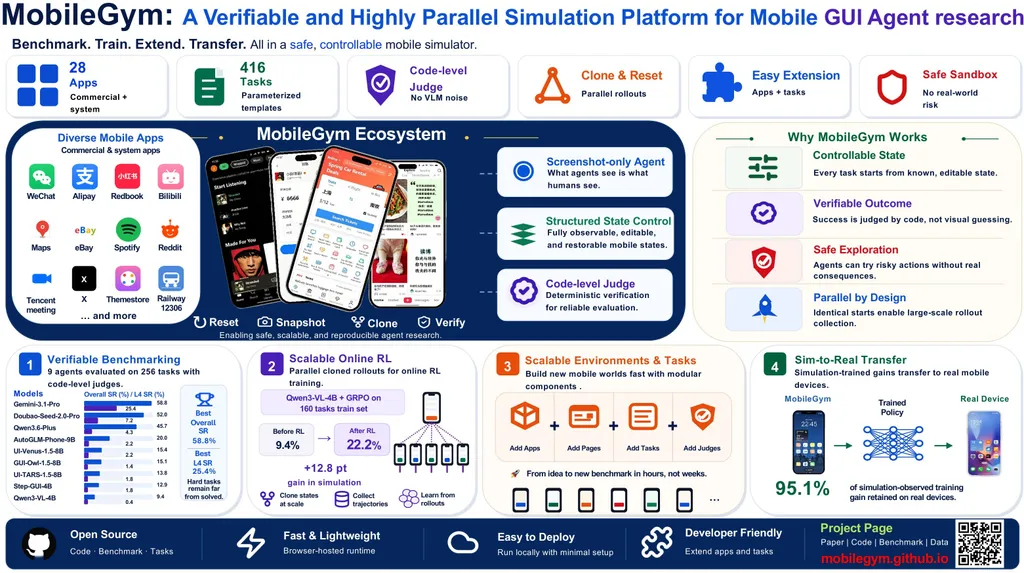
MobileGym is a new simulation platform designed for mobile GUI agent research, enabling online reinforcement learning training and deterministic evaluation. It successfully simulates 28 mobile apps in a browser environment, providing a reliable reward signal with no false judgments. The platform addresses key challenges of real-device pipelines by allowing for structured state replication and consequence-free testing.
- ▪MobileGym covers 28 mobile apps, including 12 daily and 16 system apps.
- ▪The platform achieves a 95.1% retention rate of simulation gains on real devices.
- ▪It allows for rapid app integration with minimal changes required to the OS or benchmark layer.
2 outlets in our directory ran this story, first to last over 19 hours. All of the coverage we found sits in one bucket: centre. That one-sidedness is itself worth noticing.
Hacker News (Newest) files mainly under programming. We currently carry 5,305 of its stories.
Story provenance
Source · retrieval · rights · ranking — open for full record
inspect →
Story provenance
Attribution is not the same as permission. This drawer separates discovery metadata, excerpts, WeSearch-generated summaries, reuse status, and whether the publisher receives the visit. Nothing here claims a legal grant the publisher has not made.
Record
| Original publisher | Mobilegym |
| Canonical URL | https://mobilegym.dev/ |
| Publication time | Fri, 29 May 2026 01:44:09 +0000 |
| Retrieval time | 2026-05-29T01:59:40.741Z |
| Last seen | 2026-05-29T01:59:40.741Z |
| Headline source | Publisher (no WeSearch rewrite) |
| Excerpt source | publisher body |
| Excerpt method | First ~120 words (~800 chars) of extracted publisher body, fair-use limited. |
| Summary | WeSearch · cerebras-chat (WeSearch summarizer) |
| Summary source text | contentText |
| Citation coverage | Summary is a WeSearch-generated derivative; primary citation is the original publisher URL. |
| Cluster | lNFqqOzvmWux · 2 stories |
| Cluster logic | Grouped by semantic title/content similarity across sources within a rolling window. Same-publisher template collisions are excluded from coverage comparison. |
| Ranking reason | Story pages are not engagement-ranked. Hub feeds use recency, with optional source-diversified chronological ordering (cap consecutive stories per source). No personalized ranking. |
| Publisher visit | Yes — open original |
| Substitutes article? | No — link-out required for full text |
Rights status (four layers)
WeSearch handling by dimension
| Indexing | May the item be indexed (stored, ranked, made findable)? | Allowed |
| Snippet | May a short excerpt of the publisher's text be shown? | Allowed |
| AI summary | May WeSearch generate its own short summary of the article? | Limited |
| Retrieval / RAG | May the content be exposed for third-party retrieval-augmented generation? | Not asserted |
| Model training | May the content be used to train AI models? | Not asserted |
| Commercial reuse | May the content be reused commercially? | Not permitted |
Basis: Derived from the published RSS/Atom feed. Contact: [email protected]. Reviewed: 2026-07-24.
Opening excerpt (first ~120 words) tap to expand
TL;DR MobileGym is a verifiable and highly parallel simulation platform for mobile GUI agent research — the first to make online RL training and deterministic evaluation feasible on real-world daily apps, long a structural blind spot of real-device pipelines. It covers 28 mobile apps (12 daily + 16 system) in the browser. Across the released validation suite, programmatic state judges show no false accept/reject cases over 416 parameterized task templates (vs. 10.2% misjudgment when the same real-device trajectories are scored by a VLM), giving a clean RL reward signal; structured state replication (∼400 MB per browser instance) makes single-machine batch-parallel GRPO cheap.
…
Excerpt limited to ~120 words for fair-use compliance. The full article is at Mobilegym.