I Built My First ETL Pipeline as a Complete Beginner. Here’s How.
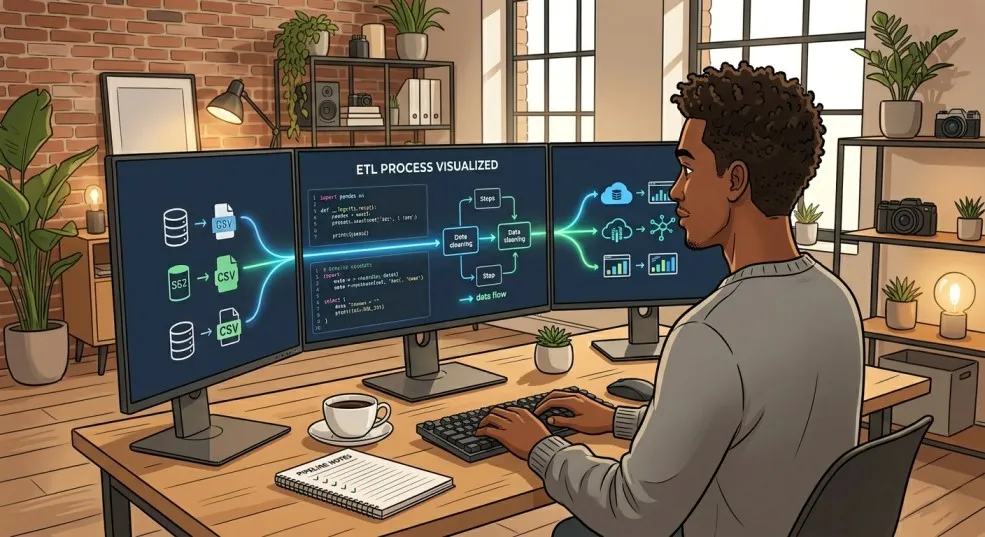
The article details a beginner's experience building their first ETL pipeline using the GitHub API. It outlines the steps of Extract, Transform, Load, and emphasizes the importance of hands-on learning. The author shares their journey, including challenges faced and the satisfaction of creating a functional project.
- ▪The author transitioned from a data analyst to a data engineer over a 12-month roadmap.
- ▪They built an ETL pipeline from scratch using Python and the GitHub API to extract data.
- ▪The process involved extracting data, cleaning it, and saving it as a CSV file.
Towards Data Science files mainly under ai. We currently carry 83 of its stories.
Story provenance
Source · retrieval · rights · ranking — open for full record
inspect →
Attribution is not the same as permission. This drawer separates discovery metadata, excerpts, WeSearch-generated summaries, reuse status, and whether the publisher receives the visit. Nothing here claims a legal grant the publisher has not made.
Record
| Original publisher | Towards Data Science |
| Canonical URL | https://towardsdatascience.com/i-built-my-first-etl-pipeline-as-a-complete-beginner-heres-exactly-how/ |
| Publication time | Mon, 25 May 2026 17:37:48 +0000 |
| Retrieval time | 2026-05-25T17:42:39.407Z |
| Last seen | 2026-05-25T17:42:39.407Z |
| Headline source | Publisher (no WeSearch rewrite) |
| Excerpt source | publisher body |
| Excerpt method | First ~120 words (~800 chars) of extracted publisher body, fair-use limited. |
| Summary | WeSearch · cerebras-chat (WeSearch summarizer) |
| Summary source text | contentText |
| Citation coverage | Summary is a WeSearch-generated derivative; primary citation is the original publisher URL. |
| Cluster | aUlD8OZfl6Ep |
| Cluster logic | Grouped by semantic title/content similarity across sources within a rolling window. Same-publisher template collisions are excluded from coverage comparison. |
| Ranking reason | Story pages are not engagement-ranked. Hub feeds use recency, with optional source-diversified chronological ordering (cap consecutive stories per source). No personalized ranking. |
| Publisher visit | Yes — open original |
| Substitutes article? | No — link-out required for full text |
Rights status (four layers)
WeSearch handling by dimension
| Indexing | May the item be indexed (stored, ranked, made findable)? | Allowed |
| Snippet | May a short excerpt of the publisher's text be shown? | Allowed |
| AI summary | May WeSearch generate its own short summary of the article? | Limited |
| Retrieval / RAG | May the content be exposed for third-party retrieval-augmented generation? | Not asserted |
| Model training | May the content be used to train AI models? | Not asserted |
| Commercial reuse | May the content be reused commercially? | Not permitted |
Basis: Derived from the published RSS/Atom feed. Contact: [email protected]. Reviewed: 2026-07-24.
Opening excerpt (first ~120 words) tap to expand
Data Engineering I Built My First ETL Pipeline as a Complete Beginner. Here’s How. A beginner's honest walkthrough of Extract, Transform, Load using the GitHub API Ibrahim Salami May 25, 2026 7 min read Share Generated with Gemini This is part two of my data engineering journey series. In part one, I shared my 12-month roadmap for transitioning from data analyst to data engineer. This is where the actual building begins.When I published my first article documenting my data engineering journey, something unexpected happened. People resonated with it. I had strangers reaching out saying they were excited to follow along. That felt good. But it also came with pressure. Suddenly this wasn’t just a personal goal I could quietly abandon if things got hard. People were watching.
…
Excerpt limited to ~120 words for fair-use compliance. The full article is at Towards Data Science.
Discussion
0 commentsMore from Towards Data Science