
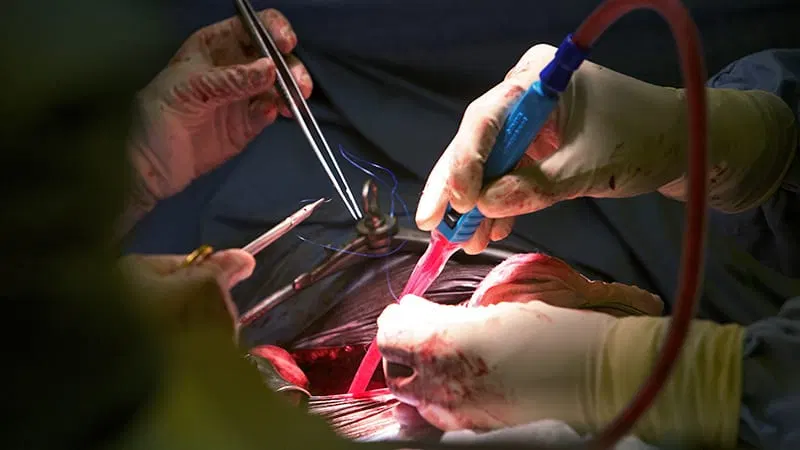
Indigenous-Led Study Targets Transplant Inequities
The Canadian Institutes of Health Research is funding an Indigenous-led study to address inequities in organ donation and transplantation. The project aims to identify gaps in data and access to treatment for Indigenous communities in Canada. Researchers emphasize the need for culturally safer care and improved preventive measures to enhance health outcomes.
- ▪The study is receiving CAD $1.7 million to improve equity in organ donation and transplantation among Indigenous peoples.
- ▪High rates of kidney disease in First Nations populations are linked to historical and ongoing inequities.
- ▪Geographical barriers and socioeconomic challenges hinder access to necessary medical care for Indigenous patients.
Medscape files mainly under health. We currently carry 231 of its stories.
Story provenance
Source · retrieval · rights · ranking — open for full record
inspect →
Story provenance
Attribution is not the same as permission. This drawer separates discovery metadata, excerpts, WeSearch-generated summaries, reuse status, and whether the publisher receives the visit. Nothing here claims a legal grant the publisher has not made.
Record
| Original publisher | Medscape |
| Canonical URL | https://www.medscape.com/viewarticle/indigenous-led-study-targets-transplant-inequities-2026a1000hgi?src=rss |
| Publication time | Wed, 27 May 2026 07:57:41 EDT |
| Retrieval time | 2026-05-27T12:07:59.258Z |
| Last seen | 2026-05-27T12:07:59.258Z |
| Headline source | Publisher (no WeSearch rewrite) |
| Excerpt source | publisher body |
| Excerpt method | First ~120 words (~800 chars) of extracted publisher body, fair-use limited. |
| Summary | WeSearch · cerebras-chat (WeSearch summarizer) |
| Summary source text | contentText |
| Citation coverage | Summary is a WeSearch-generated derivative; primary citation is the original publisher URL. |
| Cluster | _QTlFRWqMJ9m |
| Cluster logic | Grouped by semantic title/content similarity across sources within a rolling window. Same-publisher template collisions are excluded from coverage comparison. |
| Ranking reason | Story pages are not engagement-ranked. Hub feeds use recency, with optional source-diversified chronological ordering (cap consecutive stories per source). No personalized ranking. |
| Publisher visit | Yes — open original |
| Substitutes article? | No — link-out required for full text |
Rights status (four layers)
WeSearch handling by dimension
| Indexing | May the item be indexed (stored, ranked, made findable)? | Allowed |
| Snippet | May a short excerpt of the publisher's text be shown? | Allowed |
| AI summary | May WeSearch generate its own short summary of the article? | Limited |
| Retrieval / RAG | May the content be exposed for third-party retrieval-augmented generation? | Not asserted |
| Model training | May the content be used to train AI models? | Not asserted |
| Commercial reuse | May the content be reused commercially? | Not permitted |
Basis: Derived from the published RSS/Atom feed. Contact: [email protected]. Reviewed: 2026-07-24.
Opening excerpt (first ~120 words) tap to expand
The Canadian Institutes of Health Research is providing CAD $1.7 million to support Indigenous-led research aimed at improving equity in organ donation and transplantation.The project will examine gaps in data, access to treatment, and health outcomes among Indigenous communities in British Columbia, Alberta, and Saskatchewan. One goal is to develop a database that captures the lived experiences of Indigenous peoples with organ donation and transplantation.“We know that 50% of the people in Saskatchewan waiting for a kidney transplant are status First Nations. That doesn’t even include nonstatus First Nations or Métis people.
…
Excerpt limited to ~120 words for fair-use compliance. The full article is at Medscape.
Discussion
0 commentsMore from Medscape


